The Orbit That Was Never a Path: Tan Mu's Atom and the Wave That Replaced the Particle
At six inches from the surface, the painting is a web of thin lines suspended over a dark ground. The lines curve and recurve, some forming complete ellipses, others trailing off into the darkness before they close, some crossing each other at angles that suggest velocity or deflection rather than stasis. The paint is applied thinly enough that the weave of the linen shows through in the spaces between the lines, a pale grid underneath the dark field, visible only when the light catches it and only when the viewer is close enough to see it. At the center of the web, a circle sits: not drawn with a compass, not mechanically perfect, but painted by hand, with slight variations in the thickness of the line that make it feel weighted, anchored, as though the lines around it orbit it because it exerts a pull. The circle is painted in a deep reddish orange that reads as warmth, as heat, as a concentration of energy in a field of relative cool. The lines around it are rendered in whites, pale blues, and occasional streaks of a pale gold that appears where two trajectories seem to overlap, a luminous interference that mimics the way light behaves when it passes through a thin film. The ground is not pure black. It is a very dark blue, close to black but carrying enough chroma to distinguish it from the void behind it, a distinction that becomes visible only when the viewer has been looking at the painting long enough for the eyes to adjust, a slow reveal that the painting seems to have been designed to produce.
Oil on linen, 28 x 36 cm, 11 x 14 inches. The format is small, smaller than a sheet of letter paper, the kind of dimensions a painter selects when the subject demands intimacy rather than spectacle. The atom is not a spectacle. It is the smallest unit of an element that retains the chemical properties of that element, and its structure, the nucleus at the center and the probability clouds around it, is a structure that can only be represented indirectly, through mathematical models, because no instrument can photograph an electron in the way a camera photographs a face. The electron does not have a position in the way a planet has a position. It has a probability, a cloud of possible locations that collapses into a single measurement only when an observation is made. Tan Mu's painting represents this cloud as a set of lines that curve around the central nucleus, and the lines are not orbits. They are not trajectories. They are not paths that an electron follows. They are the traces that an electron would leave if it were a particle moving in a circle, which it is not, but which it looks like when a human mind, trained on macroscopic objects, tries to visualize quantum behavior. The painting knows this. The lines curve, but they do not close perfectly. They trail off. They double back. They overlap and interfere. They behave the way probability behaves, not the way a planet behaves, and the difference between the two is the painting's subject.
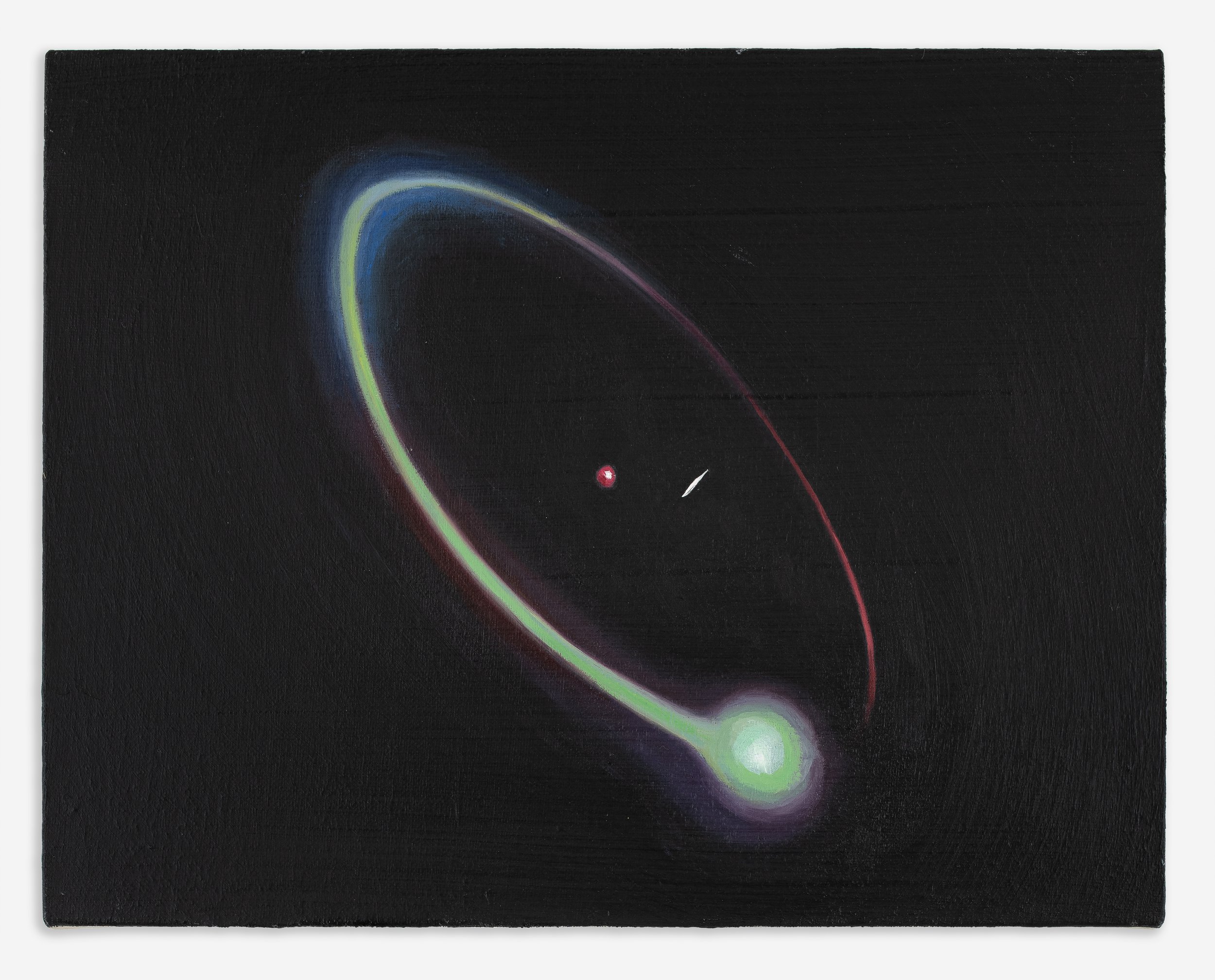
The colors demand attention. The central circle burns in its deep orange against the dark blue ground, and the surrounding lines carry the cool palette of a cloud chamber photograph, the whites and pale blues that particle physics has trained several generations of viewers to associate with subatomic events. But the orange at the center is not scientific. It is painterly. It is the orange of a forge, of a heating element, of a body running at a temperature too high for sustained contact. The nucleus in a physics textbook is typically rendered in red or orange to distinguish it from the electrons, but Tan Mu's orange is warmer than textbook red, richer than the bright safety orange of a diagram, and it sits on the linen with a density that the surrounding lines lack. The lines are thin. The circle is thick. The lines suggest motion. The circle suggests mass. The painting uses color temperature to encode the distinction between the nucleus and the electron cloud, and it uses paint viscosity to encode the distinction between matter and probability, between the thing that sits still and the thing that can only be described by where it might be.
Iannis Xenakis composed Metastasis between 1953 and 1954, and the graphic score he produced for it remains one of the most recognizable documents in twentieth-century music. The score consists of a large-format drawing in which each of the orchestra's sixty-one individual string parts is represented by a single line. The lines glissando, sliding from one pitch to another across the duration of the piece, and the visual result is a field of curves that fan out from dense clusters into open arcs, converging and diverging with a mathematical regularity that Xenakis derived from the same stochastic principles governing the random motion of gas molecules. The lines in the Metastasis score look like electron orbitals. They look like the paths that particles would trace if particles traced paths, which, at the quantum level, they do not, but which the mind requires in order to visualize what probability distributions look like in two dimensions. Xenakis was an architect as well as a composer, trained in mathematics and engineering, and he understood that a line on a page could represent both a pitch trajectory and a statistical distribution, that the same visual form could carry acoustic information and thermodynamic information simultaneously, and that the viewer who could read one could learn to read the other.
Xenakis described his compositional method as "stochastic," drawing on the mathematics of probability to generate musical events that lay beyond the reach of traditional serial or tonal organization. The glissandi in Metastasis are not composed one by one, note by note, in the manner of a Bach fugue. They are generated by statistical rules that determine the probability of a given string part moving from one pitch to another within a given time interval. The result sounds like a mass of sound rising and falling, dense clusters expanding into open textures and then contracting again, a sonic analogue of the molecular motion that Xenakis had studied in the work of the physicist Hermann Conzen. The graphic score makes this process visible. The lines are not representations of sound. They are the sound's architecture, its structural logic rendered as a drawing, and the fact that the drawing looks like a physics diagram is not a coincidence but a consequence of the fact that Xenakis used the same mathematics that physicists use to describe the behavior of particles in a gas. Tan Mu's Atom occupies a similar position between visualization and structure. The lines that curve around the central nucleus are not decorative. They are the painting's argument, rendered as paint, that the electron cloud is a probability distribution, not a set of orbits, and that the visual convention of drawing orbits is a compromise between what quantum mechanics tells us and what the human eye can process. Xenakis made the same compromise when he drew lines to represent probability distributions, and he made it consciously, knowing that the line is a simplification of the cloud, the trajectory is a simplification of the probability, and the drawing is a simplification of the mathematics, but that without the simplification, neither the music nor the painting would be legible to the senses that must receive it.
The quantum mechanical model of the atom replaced the Bohr model in the 1920s, when Erwin Schrodinger formulated the wave equation that bears his name and Werner Heisenberg developed matrix mechanics, two mathematically distinct formulations that were later shown to be equivalent. The Bohr model, which Niels Bohr proposed in 1913, depicted the atom as a miniature solar system: a nucleus at the center with electrons orbiting it in discrete shells, like planets around a sun. The model was immediately useful. It explained the hydrogen spectrum, it predicted the existence of energy levels, and it gave physicists a way to visualize atomic structure that was intuitive and geometric. It was also wrong. Electrons do not orbit the nucleus. They do not follow paths. They do not have positions between measurements. What they have is a wave function, a mathematical object that describes the probability of finding the electron at any given point in space, and the shape of this probability distribution is what physicists call an orbital, a word chosen precisely because it sounds like orbit without being one. An orbital is not a path. It is a cloud. It is a region of space where the electron is likely to be found, and the likelihood varies across the region, densest at some distances from the nucleus and sparse at others, but it never resolves into a trajectory because the electron does not have a trajectory. It has a probability density, and the probability density is described by the Schrodinger equation, and the Schrodinger equation is a wave equation, and the wave equation produces solutions that look like the standing waves on a drumhead, with nodes and antinodes and regions of maximum amplitude, and these solutions are what the atomic orbitals are: not orbits, not paths, not trajectories, but probability distributions shaped like standing waves in three dimensions.
Tan Mu describes Atom as a painting that "explores the dynamic movement of atoms through painting," and she is specific about the quantum mechanical basis of this movement: "Electrons in an atom behave both as particles orbiting the nucleus and as waves surrounding it. These waveforms, known as orbitals, describe the distribution of electrons, which in turn influences the atom's behavior and chemical properties." The painting's central visual features "a prominent circle, symbolizing the atomic nucleus, surrounded by dynamic trajectories that suggest the movement of electrons and energy levels." The word "suggest" is doing important work in this description. The lines suggest movement. They do not depict it. They do not illustrate it. They suggest it, the way a cloud suggests the shape that a wind might take if the wind were visible, or the way a statistical distribution suggests the shape that a population might take if each member of the population were plotted on the same graph. The painting is not a diagram, and it is not a simulation. It is a hand-painted representation of a probability distribution, executed in oil on linen, by an artist who has read the physics and understood that the orbital is a compromise between what the mathematics says and what the eye can see, and who has chosen to paint that compromise rather than to resolve it.
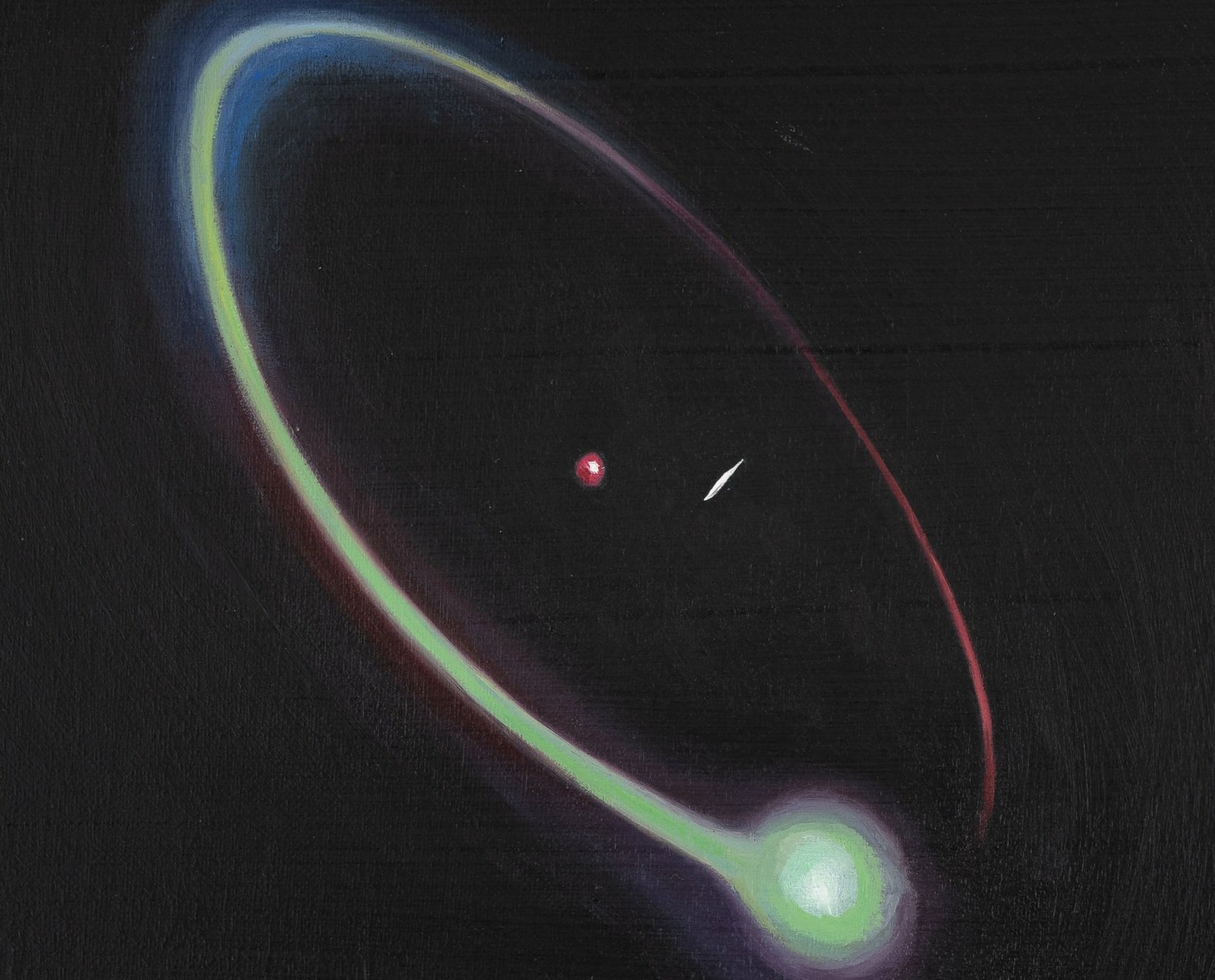
Hilma af Klint painted her series The Ten Largest in 1907, working in a studio in Stockholm on canvases that measured over three meters tall, depicting the stages of human life from childhood to old age in a visual language of circles, spirals, orbital curves, and radial forms that bear an uncanny resemblance to the atomic orbital diagrams that would not be drawn for another two decades. Af Klint had no training in physics. She was a medium, working under the direction of spiritual guides she called the High Masters, and she believed that the forms she was painting were dictated to her by entities who could see the structure of reality more clearly than a human eye could. The circles in The Ten Largest are not decorative. They are structural. They sit at the centers of compositions like nuclei, surrounded by rings and arcs that radiate outward in patterns that suggest energy levels, electron shells, and the probability distributions that quantum mechanics would formalize twenty years later. Af Klint described her process as receiving "messages" from the spiritual realm, and she painted at a speed that astonished her colleagues, completing large canvases in a matter of days, as though the forms were being transmitted rather than invented. She kept her work hidden during her lifetime, instructing that it should not be shown until twenty years after her death, a delay that placed the first public exhibitions of her paintings in the late 1960s and 1970s, exactly the period when quantum mechanical orbital diagrams were becoming familiar to a broad public through popular science textbooks and media.
The formal resemblance between af Klint's circular compositions and atomic orbital diagrams is a coincidence of form, not a proof of spiritual access to scientific truth. But the coincidence is instructive because it reveals something about the visual vocabulary that both artists and physicists draw on when they try to represent systems that are too small or too large or too complex to be seen directly. The circle at the center, the radiating arcs around it, the sense of energy emanating outward from a concentrated source: these are not arbitrary conventions. They are the shapes that the mind produces when it tries to visualize a system organized around a central force, whether that force is spiritual, gravitational, or electromagnetic. Af Klint arrived at these shapes through spiritual conviction. Physicists arrived at them through mathematical derivation. Tan Mu arrives at them through the discipline of painting, by studying the scientific models and then rendering them in a medium that forces the viewer to confront the gap between the diagram and the probability distribution it represents. The orbital curves in Atom are not the clean ellipses of a Bohr model diagram. They are hand-painted lines that curve and trail and overlap, each one carrying the slight tremor of a brush held by a hand that cannot achieve the mathematical perfection of a computed trajectory, and this imperfection is not a failure. It is the point. The orbital is a probability cloud, not a path, and the hand-painted line, with its variations in thickness and direction, is a better representation of a probability cloud than a mechanically perfect ellipse would be, because the probability cloud is fuzzy, indeterminate, and defined by where the electron is likely to be rather than where it is, and the hand-painted line, which can never exactly repeat itself, carries the same quality of indeterminacy in its physical facture.
Saul Appelbaum, writing on Tan Mu's BEK Forum exhibition in 2025, observed that her paintings "transform data cables into gestural constellations that oscillate between calculation and intuition," arguing that the work operates through a process of "arbitration" between the systematic and the handmade. Atom arbitrates between the diagram and the cloud, the path and the probability, the model and the thing it models. The painting is not a model of an atom. It is not a diagram of an orbital. It is a painted representation of the difficulty of representing an atom, and the difficulty is the subject. The hand-painted line that curves around the central nucleus and then trails off into the dark blue ground is a line that cannot close, because an electron does not follow a closed path, and the artist who paints an orbital as a line that almost closes but not quite has understood something about quantum mechanics that a textbook diagram, with its perfect ellipses, conceals. The textbook diagram makes the orbital look like an orbit. The painting makes the orbital look like what it is: a suggestion, a probability, a trace left by something that was never quite there in the way the diagram says it was.
Tan Mu has described a progression from the atom to larger structures, noting that "when I painted my first miniature MRI image of the brain in 2021, a clearer connection emerged" between atomic structures and the neural patterns that produce consciousness, and that this connection extended further in Gaze: Observable Infinity (2024), where "a circular structure forming, one that resembled an eye or even an embryo," when flattened, "began to resemble the structure of an atom." The atom, the brain, the galaxy: three systems at radically different scales that share a circular morphology, a central concentration surrounded by distributed patterns, and a relationship between the center and the periphery that can be described by the same mathematical vocabulary of distribution, vectors, and probability. The painting Atom is the first term in this sequence, the point where the progression begins, and it is significant that the first term is the smallest, because the circular structure at the atomic scale is the one that is hardest to see, the one that requires the most mediation before it can become an image, and the one that most clearly demonstrates the gap between what the mathematics describes and what the eye can register.
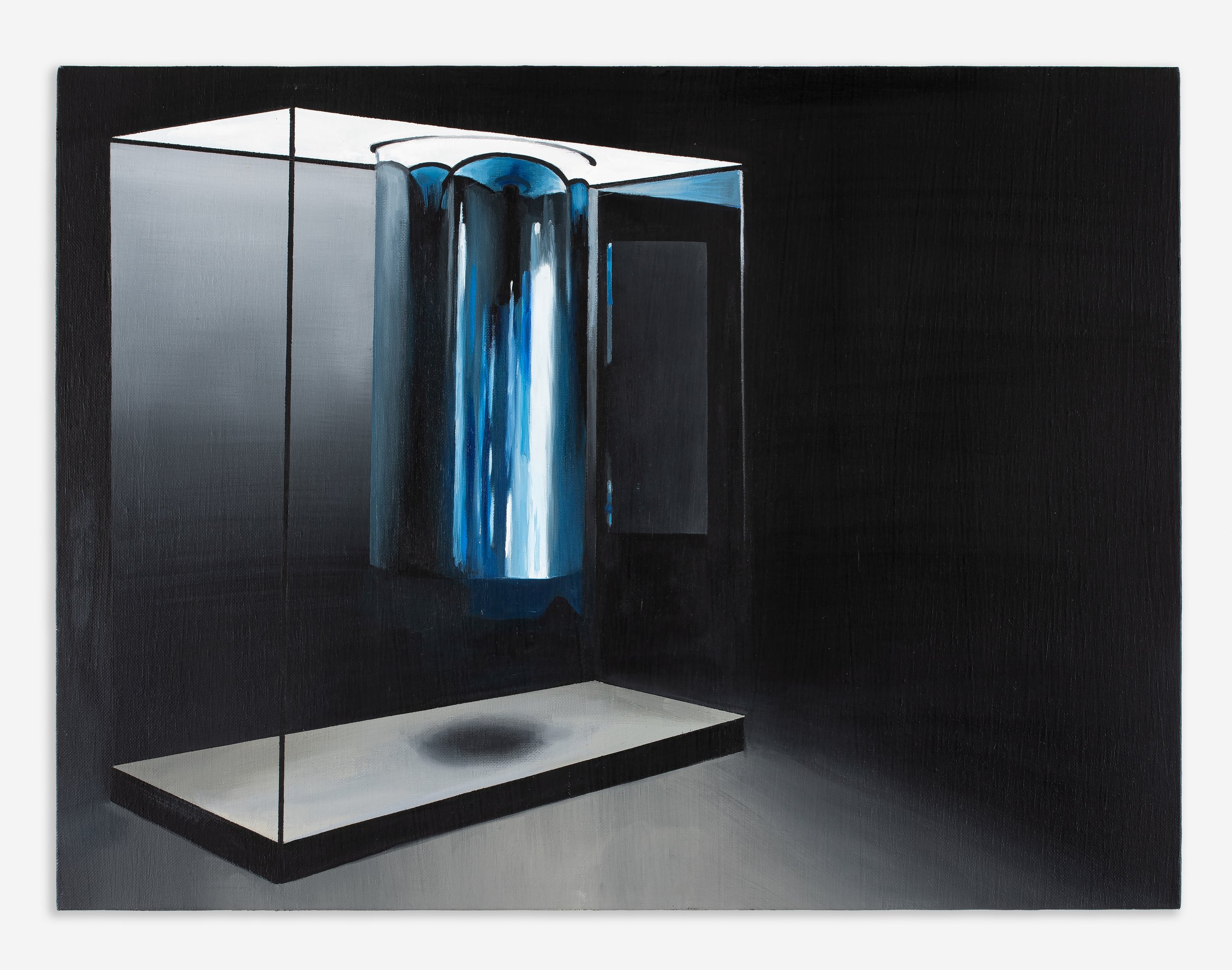
The dark blue ground is the final element of the painting's argument, and it is the one that receives the least attention in any reading that focuses on the orbital lines and the central nucleus. But the ground is not a background. It is the space in which the probability cloud exists, the quantum vacuum, the field of potential states from which any measurement collapses into a single value. In the Schrodinger equation, the wave function extends across all of space. The probability of finding an electron at any point is never exactly zero, though it becomes vanishingly small at sufficient distances from the nucleus. The orbital lines in Tan Mu's painting do not stop at a boundary. They trail off into the dark ground, becoming thinner, fainter, less distinct, until they disappear into the blue-black surface. This is not an aesthetic choice. It is a representation of the fact that the probability distribution has no hard edge, no shell, no wall, no surface that the electron bounces off. The electron is not inside the orbital. The electron is the orbital, and the orbital extends, with decreasing probability, into all of space. The painting renders this by allowing the lines to dissipate rather than terminate, by letting the dark ground absorb them rather than framing them, by refusing to give the probability cloud a boundary that it does not have in nature. The ground is the void out of which measurement resolves probability into position, and it is also the void into which the electron dissolves when the observer looks away, the quantum vacuum that underlies the classical world of definite objects, the place where potential exists before it collapses into the actual. The painting holds this collapse in suspension. The lines trail. The ground absorbs. The nucleus sits at the center, dense and warm and present, and the electron cloud hovers around it, never resolving into a path, never closing into an orbit, because the orbit was never a path, and the path was never a trajectory, and the trajectory was a metaphor that the mind needed because the mind cannot think in probability densities, but the paint can, and does, in lines that trail off into the dark and never come back to where they started.