The Machine That Learned to Look Ahead: Tan Mu's Checkmate and the Intelligence That Was Never Human
A machine does not experience doubt. It does not feel the weight of a clock, or hear the murmur of an audience holding its breath, or know what it means to have a reputation that can be lost. On May 11, 1997, in the sixth game of a match that had already become the most scrutinized chess contest in history, IBM's Deep Blue made a move that Garry Kasparov could not explain. The machine sacrificed a knight in a position where every grandmaster who later studied the game agreed the sacrifice was, by the standards of competitive play, a mistake. But Kasparov, who had never before faced an opponent that could evaluate two hundred million positions per second, could not determine whether the sacrifice was a blunder or a profundity. He spent the remainder of the game trying to read intention into a computation, searching for the strategy behind a move that had no strategy, only a search tree and a heuristic. The uncertainty broke him. He resigned a position that was, by most analyses, still playable. The machine did not know it had won. It had no concept of winning. It had a score function that returned a number, and the number was higher at the end of the game than at the beginning, and that was the entire content of its victory. Kasparov left the table knowing he had been defeated, and the machine sat in its casing, computing nothing, waiting for the next input, unaware that it had entered history.
Oil on linen, 91 x 76 cm, 36 x 30 inches. The canvas is vertical, portrait format, taller than it is wide, and the subject that fills it is a single tall form that stands against a red ground like a column or a totem or a figure standing in a doorway. The form is blue. It is not the blue of a summer sky or the blue of a twilight horizon. It is the blue of circuit boards and server racks and the cold glow of a cathode ray tube in a dark room, the blue that IBM chose for its corporate identity and that the Deep Blue project inherited when the machine was named after the color of its custom VLSI chips. Tan Mu has described this blue as grounded in the machine's "technological origin," and the description is exact. The blue is not symbolic. It is literal. The chips were blue. The casing was blue. The logo was blue. The machine was called Deep Blue because it was blue, and the painting is blue because the machine was blue, and the color carries the weight of that material fact into the viewer's eye, where it registers as both a color and a citation, a hue that cannot be separated from the hardware it references.
The form itself is rectangular and tall, with a slight taper toward the top that gives it the silhouette of a tower or a monolith. Its surface is not smooth. It carries a pattern of small, luminous yellow marks that Tan Mu describes as "computational nodes or internal logic units," and that she connects to "eyes or neurons, implying awareness without humanity." The marks are distributed across the blue body in a configuration that suggests the arrangement of chips on a circuit board, clusters of processing units mounted on a substrate, each one a point where calculation happens, where a number passes through a gate and emerges on the other side as a different number. The yellow is warm against the blue, the way a pilot light is warm against the casing of a furnace, and it flickers visually in a manner that suggests activity, computation, the movement of electrical signals through silicon, even though nothing in the painting actually moves. The marks are still. They are painted marks, oil pigment on linen, and they do not glow in the way LEDs glow. But Tan Mu has rendered them with a luminosity that reads as light rather than pigment, a yellow that appears to emit rather than reflect, and the effect produces a visual tension that mirrors the conceptual tension the painting addresses: the machine that appears to think, the computation that appears to be intelligence, the nodes that appear to be eyes.
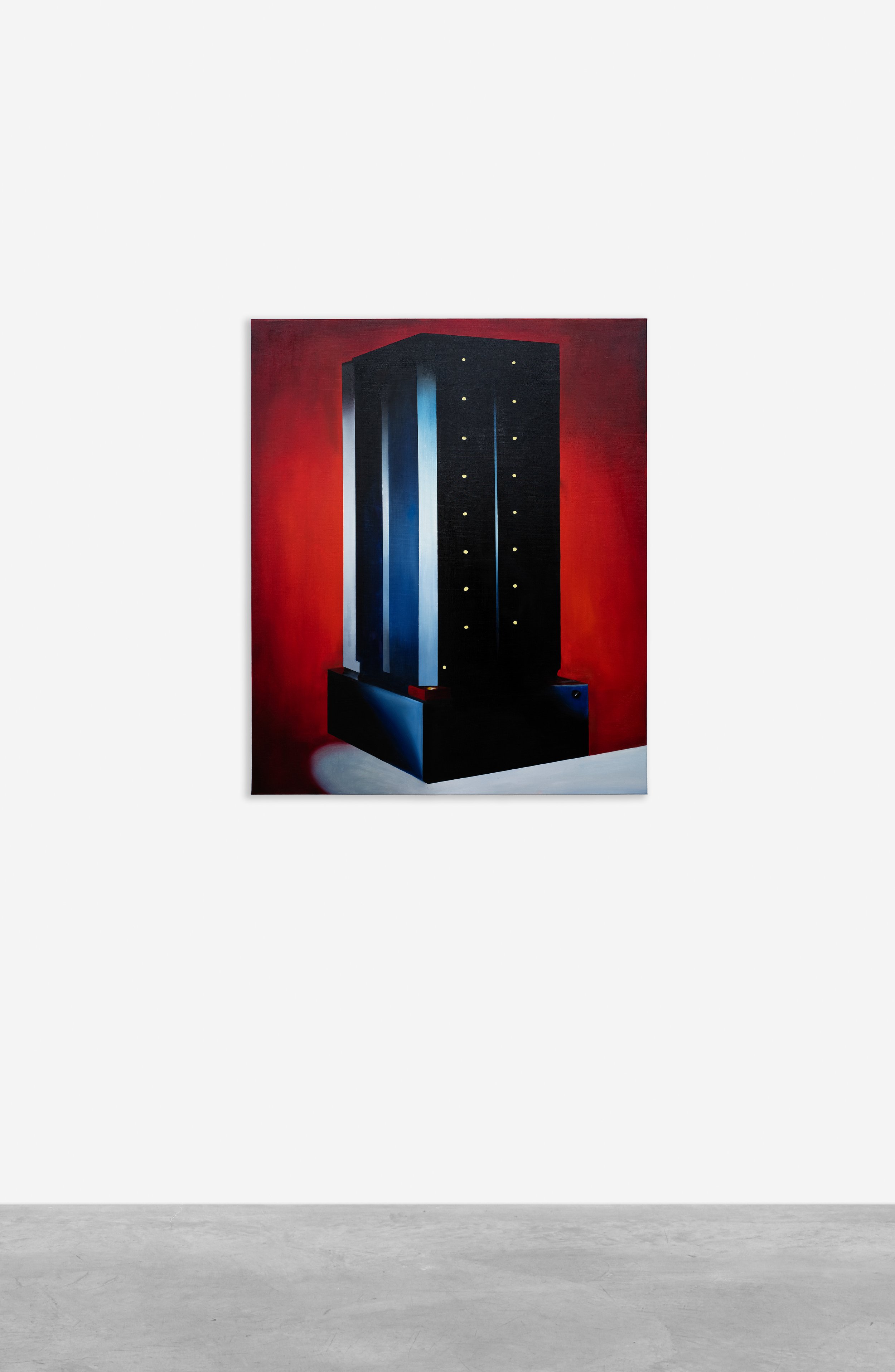
The red ground is the third term in the painting's color system, and it is the term that does the most psychological work. Tan Mu describes the red as intensifying "the psychological tension of the scene" and echoing "the emotional pressure of the match itself and the broader confrontation between human intellect and machine computation." The red is not the red of a chessboard square. It is not the red of a warning light or a stop sign. It is the red of pressure, of heat, of the blood that rises to the face when a person is under stress, and it fills the space around the blue form with an intensity that makes the blue feel colder by contrast, more alien, more mechanical, more removed from the warm animal world that the red represents. The painting does not depict the chessboard. It does not depict Kasparov. It does not depict the room at the Equitable Center in Manhattan where the match took place. It isolates the machine, as Tan Mu has said she intended: "Rather than depicting a chessboard or a human opponent, I chose to isolate the machine, allowing it to stand as an emblem of a new kind of intelligence entering human history." The isolation is the painting's argument. The machine stands alone. The human is absent. The red ground is the space where the human should be, the arena of emotion and pressure and biological urgency that the machine enters without sharing, and the fact that this space is empty, that the viewer looks at the machine and sees only the machine, is the painting's way of saying that the confrontation has already happened and the machine is what remains.
Marcel Duchamp painted The King and Queen Surrounded by Swift Nudes in 1912, during the brief period when chess was still a subject in his art rather than a replacement for it. The painting, now in the Philadelphia Museum of Art, presents the chess pieces as abstract forms, a king and queen rendered as geometric shapes that suggest mechanical components, surrounded by swirling lines that represent the nudes in motion, their bodies dissolved into trajectories and arcs that cross the chessboard at velocities no human body could achieve. The painting is a visualization of a chess game as a system of forces, where the pieces are not objects on a board but vectors in a field, and the nudes are not people but the lines of force that the pieces generate when they move. Duchamp was already thinking about chess as a system of abstract relationships, a structure that could be represented visually without representing the physical objects that instantiate it, and this way of thinking would eventually lead him to abandon painting entirely and devote himself to competitive chess, a decision he announced by declaring that chess was better than art because it was purer, more abstract, and free from the contamination of the art market and the art audience.
In 1968, at a festival in Toronto, Duchamp played a game of chess against the composer John Cage. The board was wired with sensors, and each move controlled a different element of a sound and light installation: moving a knight triggered a different electronic tone than moving a bishop, and each position on the board activated a different combination of visual projections. The game, documented in a photograph that shows Duchamp and Cage sitting across from each other in a darkened room lit by the projections their moves have generated, is one of the most famous images of the twentieth-century avant-garde, and it is famous because it makes visible the same relationship that Tan Mu's Checkmate makes visible: the relationship between the game, the system, and the representation. Duchamp and Cage played chess, and their moves produced sounds and images, and the sounds and images were the game made visible in another medium, the way the computation inside Deep Blue was a chess game made visible in another medium, and the way Tan Mu's painting is a historical event made visible in another medium. Duchamp understood that a chess game is not the pieces on the board. It is the system of rules and relationships that the pieces instantiate, and this system can be translated into other systems, other media, other forms, without losing its identity. His 1968 match with Cage proved this by translating the chess game into a musical performance. Deep Blue proved it by translating the chess game into a computation. Tan Mu proves it by translating the computation into a painting, and the painting, standing in the place where the machine stood, makes the argument that the translation is the event, that what matters about Deep Blue's victory is not the machine or the match but the threshold it represents, the moment when a system of rules and relationships that had always been instantiated by human minds was instantiated by a machine, and the machine won.
The Deep Blue project began in 1985, when a graduate student named Feng-hsiung Hsu at Carnegie Mellon University started building a chess-playing machine called ChipTest. Hsu and his teammates, including Murray Campbell and Thomas Anantharaman, joined IBM in 1989 and began developing the specialized hardware that would become Deep Blue. The machine used a combination of custom VLSI chips for move generation and position evaluation, and a general-purpose IBM RS/6000 workstation for high-level search and strategic planning. The alpha-beta search algorithm at the core of Deep Blue's software allowed it to prune the game tree, eliminating branches that could not lead to better outcomes and focusing its computational resources on the lines of play that mattered. By the 1997 match, Deep Blue could evaluate two hundred million positions per second, a number that Kasparov, who could evaluate perhaps two or three positions per second, found incomprehensible. The speed was not intelligence in the way that Kasparov understood intelligence. It was brute force applied to a problem that had previously been solved by intuition, pattern recognition, and the accumulated knowledge of a lifetime spent studying the game. But the result was the same: the machine made better moves than the human, and the human lost.
Tan Mu describes the event as "not simply a technological milestone" but "a shift in how we understand intelligence itself," and she connects it to the present moment of large language models and artificial general intelligence research with a precision that distinguishes her account from the usual tech-industry triumphalism. She notes that "recent studies suggest that large language models exhibit structural similarities to human cognitive systems, forming complex point cloud patterns that resemble atoms, neural networks, and even cosmic structures," and that this parallel "suggests that intelligence, whether biological or artificial, may follow shared organizational principles across different scales." This is not a claim that machines are conscious. It is a claim that the structures through which intelligence manifests, whether in a brain or in a neural network, may share deep formal properties, and that the moment when a machine first defeated a human at chess is the first moment when this shared structure became visible, not as a theory but as a fact, as something that happened in a room in Manhattan and was broadcast on television and reported in every newspaper in the world.
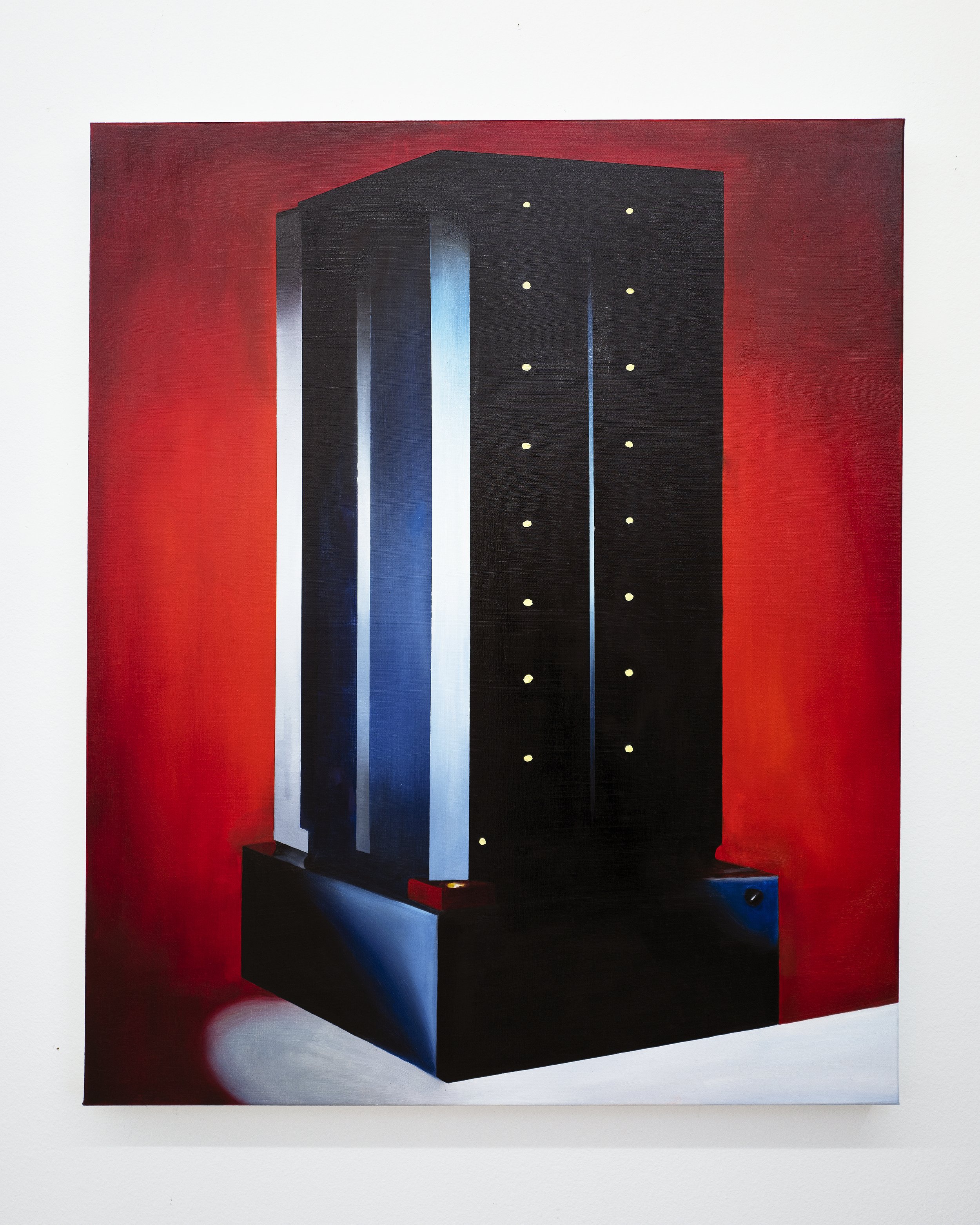
Nam June Paik built his Bakelite Robot between 1974 and 1978, assembling it from vintage Bakelite radio cabinets, vintage television monitors, and a system of electronic circuits that allowed the sculpture to respond to sound and movement in its environment. The robot stood upright, humanoid in proportion, its radio-cabinet body stacked vertically like a column of obsolete appliances, its screens flickering with video feedback loops that Paik manipulated in real time. The Bakelite Robot was not an attempt to build an intelligent machine. It was an attempt to build a machine that looked like a person, and to let the look carry the irony, the affection, and the anxiety that the idea of machine intelligence provoked in the 1970s. Paik, who had been making video art since the early 1960s and who coined the term "electronic superhighway" in 1974, understood that the relationship between humans and machines was not a competition but a conversation, and his robot sculptures were interlocutors, not opponents. They stood in the gallery and broadcast their video loops, and the viewers stood in front of them and watched, and the act of watching was the content, the way the act of playing is the content of a chess game.
Paik's Good Morning, Mr. Orwell (1984), a live satellite broadcast that connected artists and performers across three continents, made a more explicit argument about the relationship between technology and creativity. The broadcast was staged as a response to George Orwell's novel 1984, and specifically to the novel's vision of television as a tool of surveillance and control. Paik assembled a cast of more than thirty artists, including John Cage, Charlotte Moorman, Merce Cunningham, and Joseph Beuys, and transmitted their performances live to an audience of over twenty-five million viewers in the United States, Europe, and Asia. The broadcast was chaotic, technically flawed, and intermittently brilliant, and it made the case that broadcast technology could be used for connection rather than control, that the same satellite links that carried military communications could carry Merce Cunningham's choreography, and that the machine was not the enemy of art but its medium. Paik's position was the opposite of the position that Checkmate represents. Paik believed that the machine and the human could collaborate. Deep Blue proved that the machine could defeat the human. Tan Mu's painting does not take a side in this argument. It stands in the position of the viewer who watches the machine stand on the red ground, cold and luminous and alone, and recognizes that the machine does not care whether it collaborates or competes, that it has no position on the question of whether art or chess or intelligence is a human province, and that this indifference is the most alien thing about it, the thing that the red ground and the yellow nodes and the blue body are all trying to make visible.
Nick Koenigsknecht, writing on Tan Mu's practice in the BEK Forum catalog, observed that her technology paintings function as "self-portraits of the systems that made us," and that the cables, circuits, and machines she depicts are "not subjects but protagonists" in narratives that belong to the viewer as much as to the artist. Checkmate extends this reading. Deep Blue is not a portrait of a machine. It is a portrait of the threshold that the machine crossed, and the threshold is not a property of the machine. It is a property of the culture that witnessed the crossing. The machine that evaluated two hundred million positions per second did not know it had entered history. The history entered it. The red ground, the warm arena of biological urgency that surrounds the blue column, is the culture that the machine entered, and the yellow nodes on the blue surface are the points where the culture registered the entry, the places where the machine's computation became legible as intelligence, or at least as something that looked enough like intelligence to make a world champion resign a game he had not yet lost.
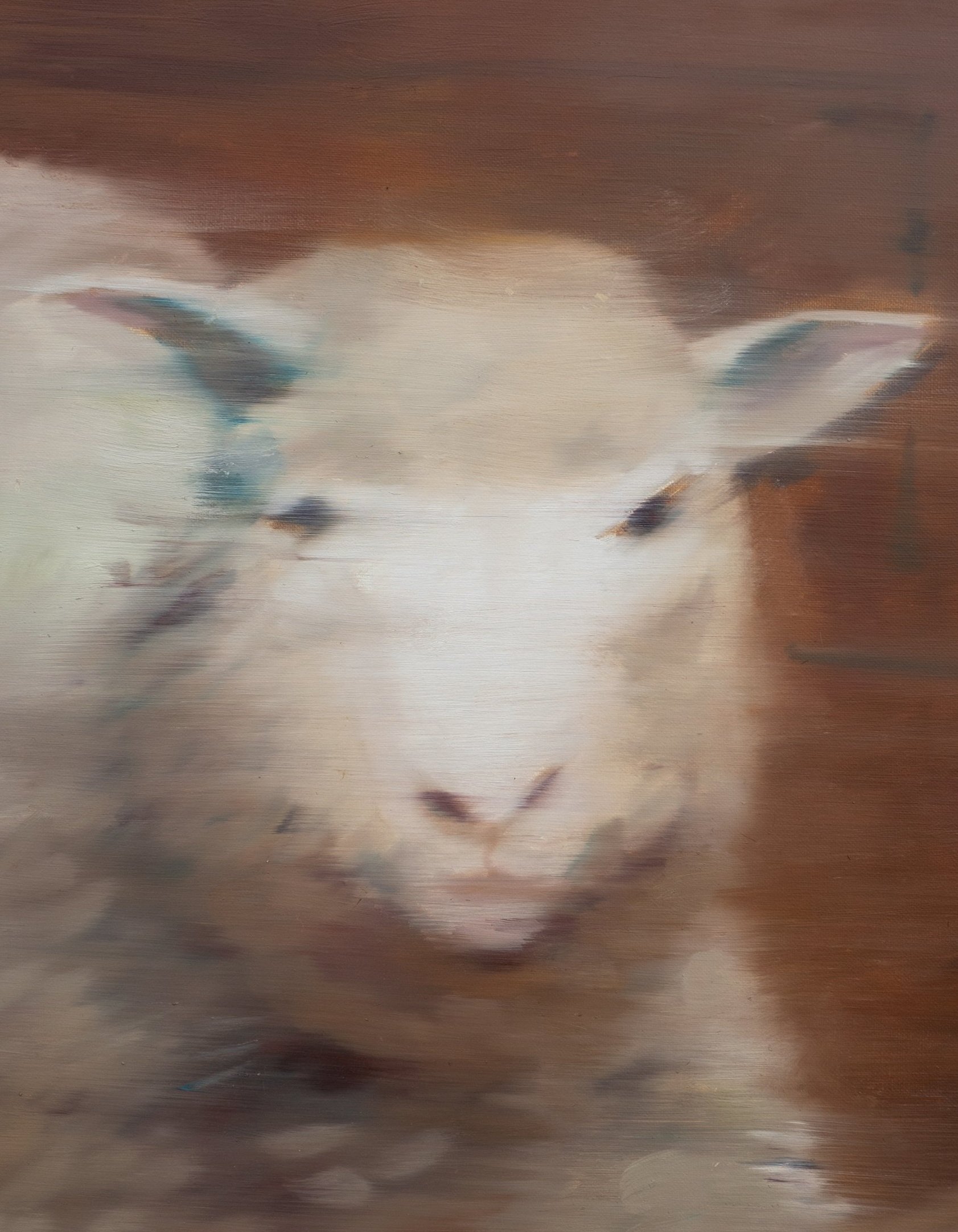
Tan Mu has described Checkmate as "a time capsule, allowing future viewers to look back at how we once understood intelligence, competition, and the role of machines in shaping human destiny." The time capsule metaphor is apt because it captures the double temporality of the painting: it records a moment in 1997 and it anticipates a moment in the future when the recording will be read differently. When Kasparov resigned the sixth game, the event was understood as a defeat for human intelligence and a victory for machine computation. Twenty-nine years later, the same event reads as the first chapter in a story whose ending is still unknown, and the machine that seemed so alien in 1997 now seems primitive compared to the language models and neural networks that can write, translate, compose, and diagnose. The painting holds both readings in suspension. The blue form on the red ground is the Deep Blue of 1997, a specific machine with custom chips and a specific architecture, and it is also the archetype of the intelligent machine, the first form that the culture recognized as something new entering its world. The yellow nodes are lights on a circuit board, and they are also eyes, points of awareness, signals that something in the machine is looking back. The painting does not resolve the ambiguity. It holds it, the way a chess position holds multiple possible futures in a single configuration of pieces, and the way a time capsule holds the present for a future that will understand it differently, and the way a machine that cannot know what it has done stands in a red room and waits for the next move, which will be made by someone, or something, that has not yet arrived.