The Posture That Held the Distance: Tan Mu's Yoga Isolation and the Body Between Together and Apart
On June 21, 2020, the summer solstice, residents of Toronto gathered for an outdoor yoga session in a public park. The photograph that documented the event shows dozens of figures arranged on mats across a grassy expanse, each one separated from the next by the distance that public health guidelines had prescribed, each one performing the same postures at the same time, each one facing the same direction, each one occupying a clearly demarcated rectangle of personal space that extended the invisible boundary of the mat into the air around it. The photograph is unremarkable as a document. It records a scene that was repeated in parks and on beaches and in front of laptop screens throughout the world during the spring and summer of 2020, a scene that was at once familiar, because yoga is a familiar practice, and strange, because the distance between the bodies transformed a communal activity into something closer to a military formation, a grid of isolated units performing synchronized movements in a shared space that they were forbidden to share. Tan Mu encountered this photograph and recognized in it the central paradox of the pandemic year: the practice that is meant to unite the body and the mind, and through that unity to connect the individual to a larger community of practitioners, was being performed under conditions that made physical unity impossible, and the resulting image, with its field of separated bodies moving in unison across a shared ground, was a portrait of a condition that no one had expected to inhabit and that everyone recognized immediately.
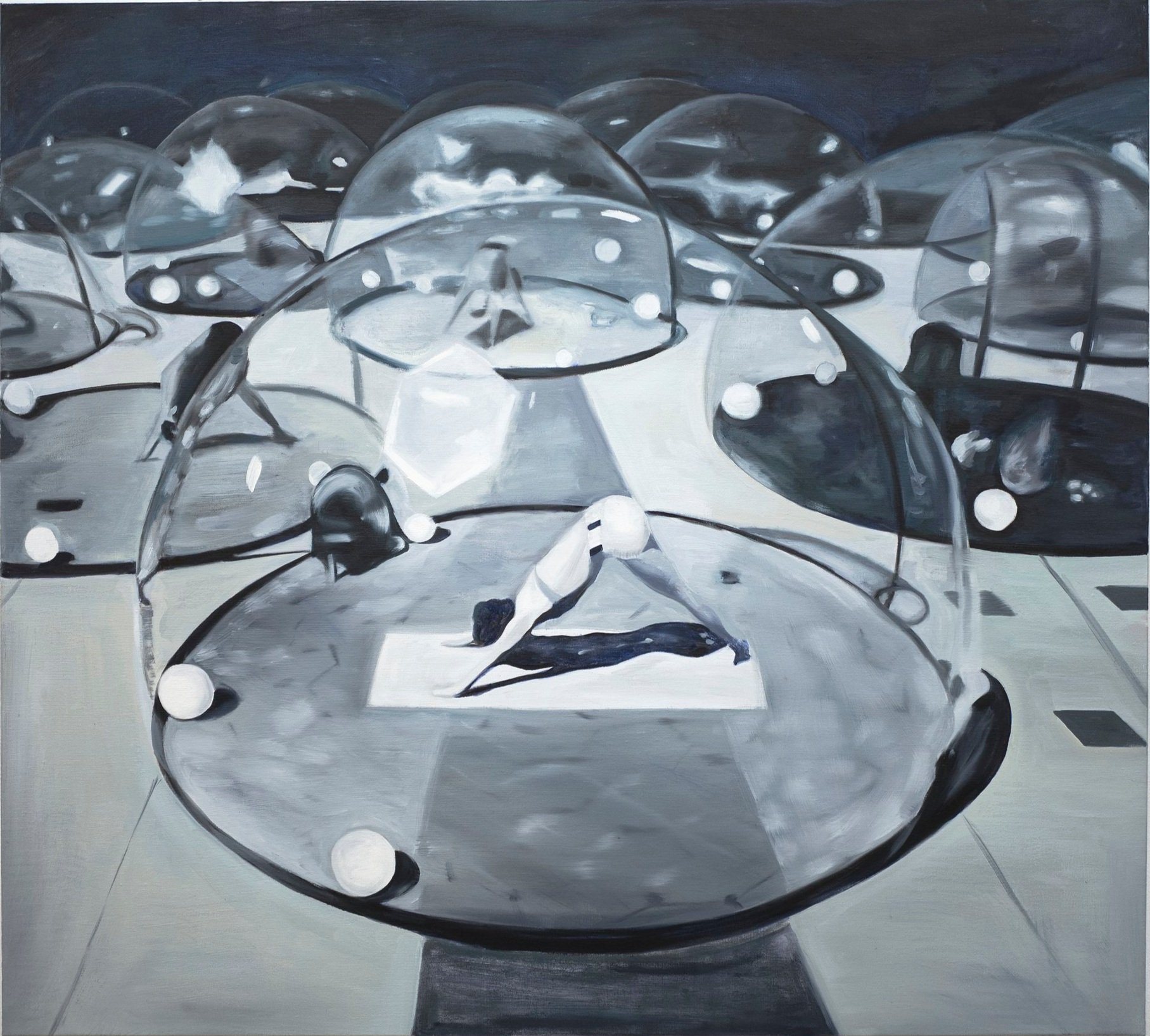
Oil on linen, 91 x 102 cm, 36 x 40 inches. The canvas is nearly square, a format that allows the field of figures to spread across the surface without the vertical compression of a portrait or the horizontal elongation of a landscape. The dimensions suggest a window or a viewfinder, a frame through which a scene is observed rather than a surface on which a subject is arranged, and the composition reinforces this reading: the figures are distributed across the canvas in a pattern that reads as both natural and organized, the way a crowd in a public park reads as both random and structured, each person choosing a spot that feels comfortable while unconsciously maintaining a distance from the next person that social convention, or in this case public health regulation, has prescribed. The palette is monochrome. Tan Mu has removed all color from the scene, replacing the greens of the grass and the blues of the sky and the various skin tones and clothing colors of the practitioners with shades of gray that range from near-white to near-black. The decision is deliberate, and Tan Mu has described it as a way to "strip the image down to its essential structure and emotional core," eliminating "visual distractions" and placing "greater emphasis on posture, spacing, and repetition." The result is a painting that reads like an archival photograph, a document from a future historian's file, a record of a moment when human beings arranged themselves in a grid and performed a ritual of unity under conditions of separation.
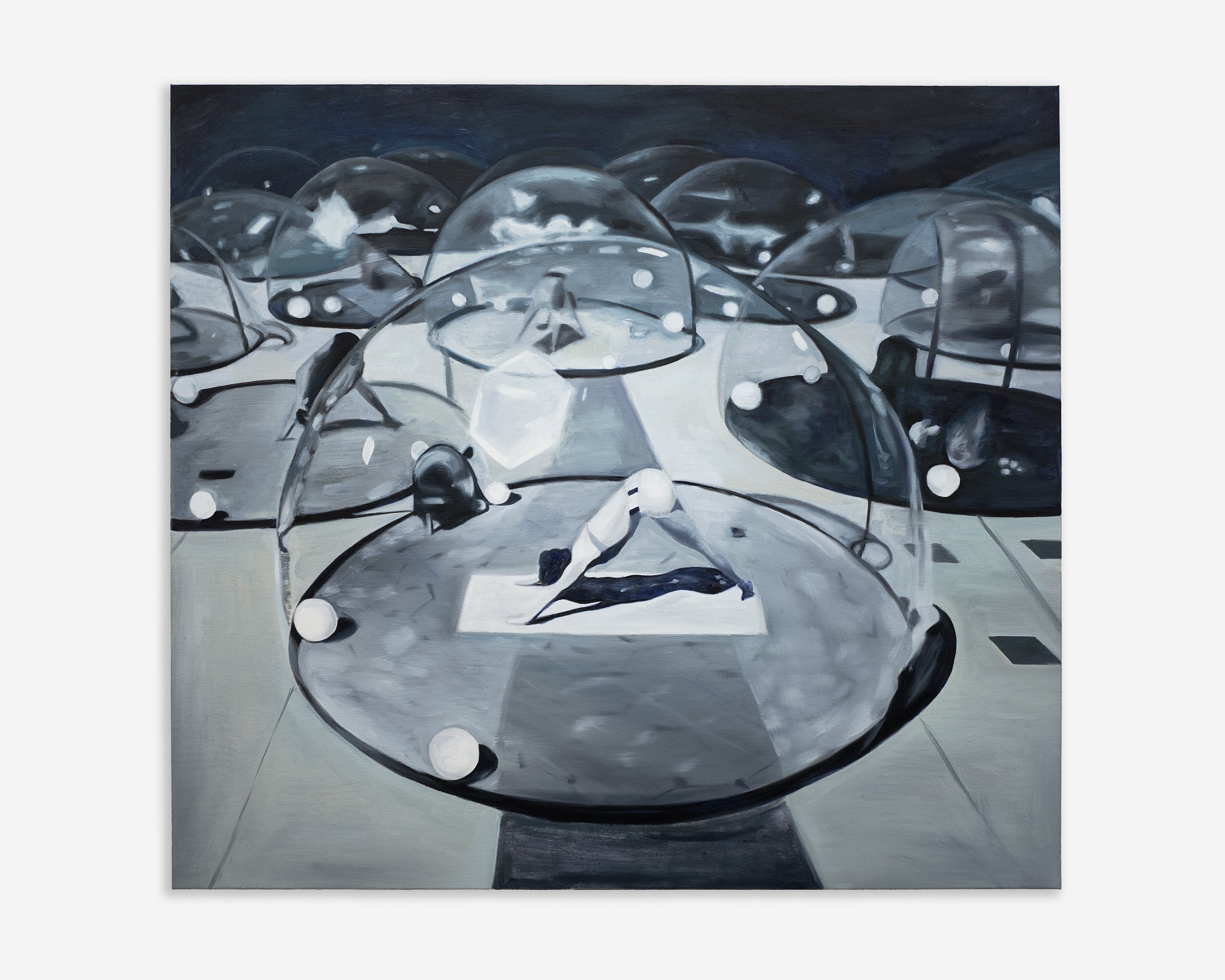
The figures are rendered in tones of gray that make it difficult to distinguish individual bodies from the ground on which they rest. This is not an accident of the monochrome palette. It is its purpose. The gray of the figures and the gray of the ground are close enough in value that the boundary between body and earth becomes uncertain, and the viewer's eye must work to separate the human forms from the surface they occupy, the way the eye must work to separate a figure from a background in a photograph taken on an overcast day when the light is flat and the shadows are soft. The postures are legible. Downward-facing dog, warrior two, tree pose: the standard positions of a vinyasa practice are recognizable even in monochrome, even at a distance, even when the bodies performing them are nearly the same value as the ground beneath them. The recognition is part of the painting's argument. The postures are what make the figures a community rather than a crowd. Without the postures, the scene would be a field of prone bodies, a mass casualty image, a battlefield. With the postures, the scene is a practice, a ritual, a collective act of bodily discipline performed under conditions that make the collective visible only as a pattern of separation.
The surface of the painting is smooth, the brushwork restrained, the paint applied in thin layers that do not call attention to the act of painting. This is consistent with Tan Mu's broader practice of working from photographic sources, where the image arrives already composed and the painter's task is to translate that composition into oil and linen without introducing the kind of gestural expressiveness that would distort the documentary character of the original. The monochrome palette reinforces this restraint. There are no bravura passages, no thick impasto, no visible signs of the painter's hand asserting itself over the photographic source. The painting behaves like the photograph it translates: it records, it documents, it presents the scene without editorializing. But the absence of visible brushwork is itself a form of editorializing. The smooth surface, the thin paint, the monochrome palette: these are choices that remove the painter's body from the scene, the way the pandemic removed the practitioners' bodies from each other, and the way the public health guidelines removed the possibility of touch, of proximity, of the physical contact that yoga, in its traditional context, assumes. The painting's refusal to show the hand that made it mirrors the scene's refusal to show the contact that the practice requires, and this mirroring is not a coincidence. It is the painting's argument, made in the medium of its own making.
Giorgio de Chirico painted The Mystery and Melancholy of a Street in 1914, and the painting has been reproducing itself in the minds of viewers ever since. A young girl rolls a hoop down a paved street that recedes into the distance along the strict lines of one-point perspective. On the left side of the street, arcades with dark shadows stretch toward a vanishing point marked by two distant towers. On the right side, a building with a single lit window looms above the girl, its shadow casting a diagonal stripe across the pavement. The sky is a flat, unyielding yellow. The scene is empty except for the girl and a statue in the distance, and the emptiness is the painting's subject. De Chirico called his paintings "metaphysical," and the term has stuck because it describes exactly what the paintings do: they take ordinary objects and ordinary spaces and infuse them with an atmosphere that makes them feel like relics from a dream, or prophecies from a future that has already happened. The arcades, the shadows, the empty streets: these are the architecture of any Italian town, but in de Chirico's rendering, they become the architecture of a state of mind, a condition in which the familiar is drained of its familiarity and the everyday becomes a puzzle that cannot be solved.
The melancholy in de Chirico's street paintings comes not from what is present but from what is absent. The street should be full of people. The arcades should be bustling. The buildings should have open windows and laundry on the lines and voices coming through the doors. Instead, the street is empty, and the only human figure is a child playing alone, running toward a shadow that she cannot see the source of, in a space that should be shared but is not. Tan Mu's Yoga Isolation inverts this structure. The figures are present. They are not alone. There are dozens of them, arranged across the field of the canvas, each one performing the same postures, each one facing the same direction, each one occupying a clearly marked space. The scene is not empty. It is full of bodies. And yet the melancholy of the painting is the same as the melancholy of de Chirico's street: a feeling of absence in the presence of abundance, a sense that the conditions of togetherness have been hollowed out by an invisible force that has turned proximity into separation. The figures in Yoga Isolation are together but apart, and the distance between them is the distance that de Chirico's empty street imposes on the single figure who rolls her hoop through an arcade that should be full of people but is not. The difference is that de Chirico painted an empty street that feels like it should be full, and Tan Mu painted a full park that feels like it should be closer. Both paintings describe the same condition: a space where the architecture of proximity has been replaced by the architecture of distance, and the people who occupy that space are performing their routines as if nothing has changed, when everything has changed.
June 21, 2020. Three months after the World Health Organization declared COVID-19 a pandemic, two months after most of the world's cities had entered lockdown, and one month after the first tentative reopenings had begun. The outdoor yoga session in Toronto was one of thousands of such events that took place across the northern hemisphere that summer, as communities attempted to resume the communal practices that the lockdowns had interrupted, under the new constraints of physical distance and mask mandates and the constant awareness that the air itself might be carrying a pathogen that could not be seen. The date matters because the painting is based on a specific photograph taken on a specific day, and the specificity is part of its documentary character. The photograph shows people who have been separated from each other for months, who have been told that the air is dangerous, who have been instructed to stay six feet apart from anyone who is not a member of their household, and who have come to a park on the longest day of the year to practice a discipline that is defined by its integration of body, breath, and mind, and they are performing this discipline on mats that are six feet apart, breathing in air that they have been told to fear, and they are doing it together, in the open, under the sky, because the alternative is to stay inside, alone, and to let the practice that is supposed to connect them to each other and to something larger than themselves become another screen-mediated experience, another Zoom square in a grid of faces that are present but not present, there but not there.
Tan Mu describes yoga as "a practice rooted in balance and continuity" that "became a symbol of resilience within an uncertain and fragmented world," and she describes the monochrome palette as creating "an otherworldly and suspended atmosphere, as if the scene exists outside of ordinary time." The "otherworldly" quality that she identifies is the quality that connects the painting to de Chirico's metaphysical streets: the sense that the familiar has been made unfamiliar, that the ordinary has been displaced, that the practices and rituals that structure daily life are continuing but are continuing under conditions that have stripped them of the physical contact that gave them their meaning. The practitioners in the painting are performing yoga. They are in the postures. Their bodies are in the positions. But the breath that is supposed to be shared in a group practice is being taken in isolation, held behind masks or held carefully in air that might be contaminated, and the energy that is supposed to circulate among the members of the class is contained within the boundaries of each individual mat, a six-foot zone of personal space that the pandemic has transformed from a courtesy into a requirement, from an option into a law.
Gustave Caillebotte's Paris Street; Rainy Day (1877) is one of the most famous paintings of modern urban life, and it is famous partly because of the way it treats the distance between people who share a public space. The painting shows a wide Parisian boulevard on a rainy afternoon, with figures walking in pairs and alone across the cobblestones, each one separated from the others by the geometry of the new boulevards that Baron Haussmann had carved through the old neighborhoods of Paris. The boulevards were designed to be wide enough for military columns and open enough to prevent the barricades that had made the narrow streets of the old city so effective during the uprisings of 1848 and 1871, and the figures in Caillebotte's painting move through this space with a self-consciousness that is specific to the modern city: each person is aware of being seen, of being in public, of occupying a position in a grid of social relations that the architecture has made visible and that the rain has made tactile. The umbrellas are the painting's most recognizable motif. Each figure carries one, and the umbrellas create a field of identical objects that separates the individual from the collective, the way the yoga mats separate the practitioners in Tan Mu's painting. The umbrella is a device for maintaining personal space in a public environment. It extends the body's boundary outward, creating a zone of separation around each person that other pedestrians must navigate around, and the field of umbrellas in Caillebotte's painting is a visual representation of the social contract that governs behavior on a modern boulevard: be present, be visible, but maintain your distance.
Tan Mu's Yoga Isolation updates this contract for the pandemic era. The yoga mat is the umbrella. It defines a zone of personal space that others are expected to respect, and the grid of mats across the park is the visual expression of a social order that has been reorganized around the principle of physical separation. Caillebotte's figures walk past each other without touching. Tan Mu's figures practice yoga without touching. The umbrellas and the mats serve the same structural function: they maintain distance while allowing presence, they make proximity visible while preventing contact, and they transform a crowd into a collection of individuals who are together but apart. Yiren Shen, writing on Tan Mu's practice in 2025, observed that her paintings "conjure up a kind of vitality and depth of their own" by refusing to diagnose the modern spectacle from a distance, and Yoga Isolation conjures a vitality that is specific to its moment. The practitioners are not victims. They are not suffering. They are doing what people do when the conditions of their lives change: they adapt, they maintain their routines, they come to the park on a summer day and they unroll their mats and they perform the postures that connect them to a tradition that is older than the pandemic and that will, they hope, be older than the pandemic when it is over. The vitality that the painting conjures is the vitality of continuation under constraint, of practice under prohibition, of a body that continues to move because movement is what bodies do, even when the space between bodies has been declared dangerous.
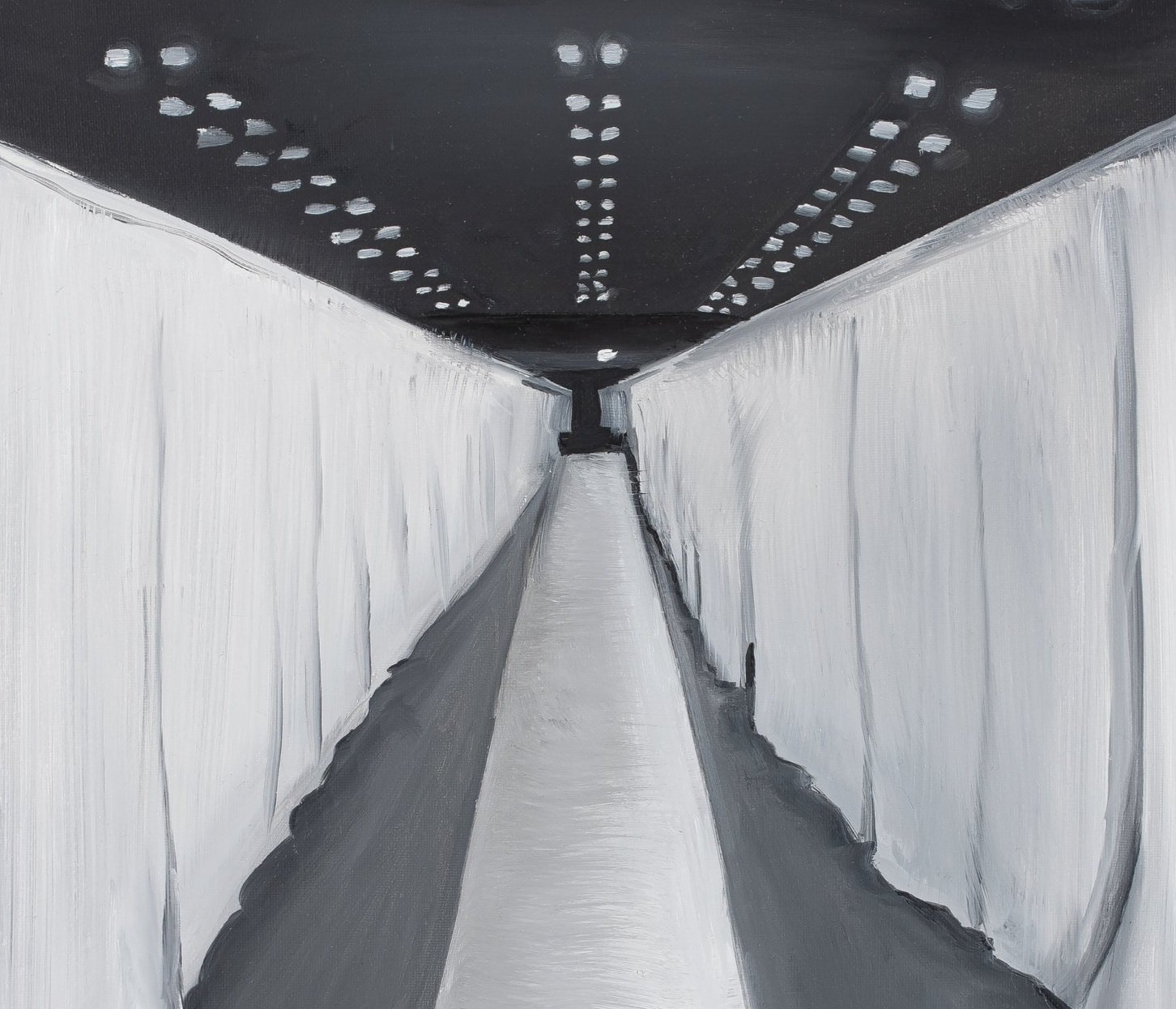
Tan Mu has described Yoga Isolation as "a paradoxical symbol" in which "the practice remains communal in spirit, yet it is performed in isolation, with each individual contained within a clearly defined personal space." The paradox is the painting's subject, and it is a paradox that cannot be resolved, only held, the way the practitioners hold their postures, in a condition that is neither the unity they seek nor the total separation they fear but something between the two, a state of being together apart that has no name in any language that existed before 2020 and that now has a name in every language, because every culture on earth experienced it simultaneously, and every person who lived through it knows what it feels like to be in a room full of people and not be able to touch any of them, to be on a street with hundreds of others and to walk past each one as if they were a column or a tree or a bench, to be on a yoga mat in a park on a summer day and to breathe in the same air as the person on the next mat and to know that the air is the medium of connection and the medium of danger, and that the practice that is supposed to unite the body and the breath and the mind is being performed under conditions that have divided the body from every other body in the park by a distance that is precisely calibrated to prevent the transmission of a virus, and that the distance is the price of being there at all, and that the price is worth paying because the alternative is to stay home, and the painting holds this entire condition in its monochrome field, where the figures are present and distant, together and apart, breathing and separated, practicing and prohibited, and the gray that unifies the bodies and the ground is the gray of a day that is both ordinary and unprecedented, a summer day in a park in Toronto, recorded in oil on linen, held open for as long as the painting lasts, which is longer than the pandemic, longer than the memory, longer than any of the bodies on the mats will last, because the paint does not breathe and does not need to keep its distance and does not catch the virus and does not die, and the postures it preserves will be held forever in a stillness that no living body can sustain.