The Command That Promised Motion: Tan Mu's Play and the Screen That Stopped Time
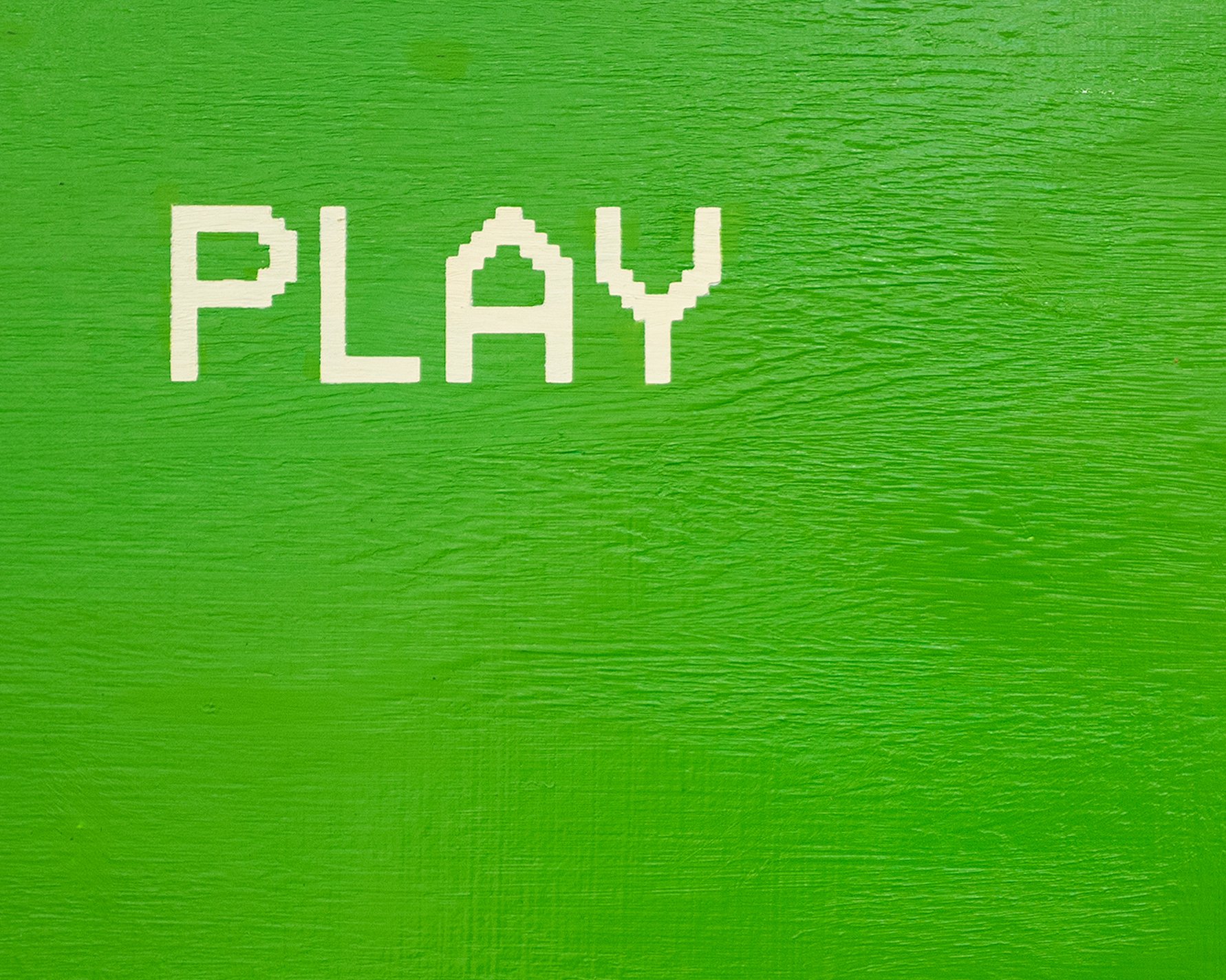
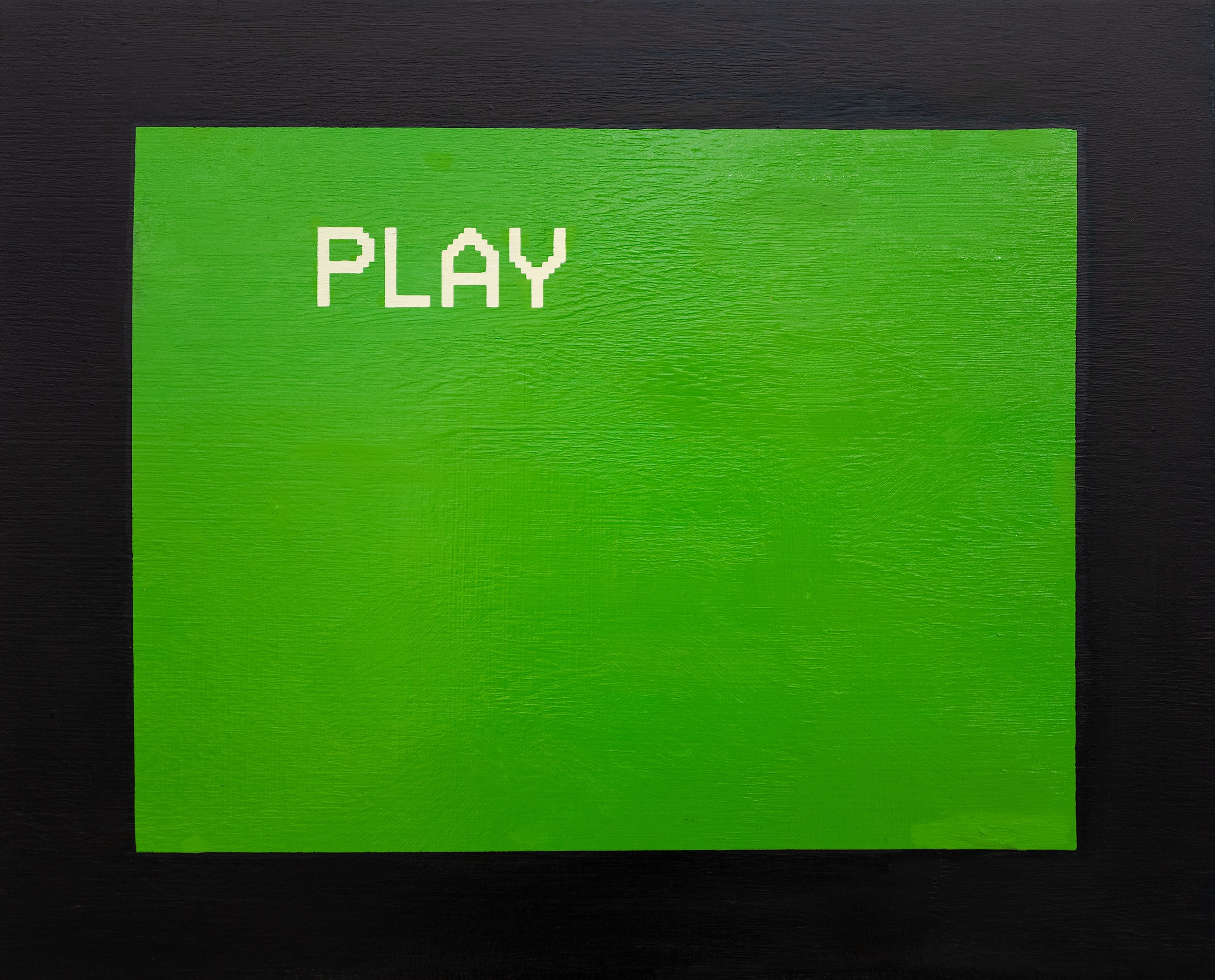
The black base layer goes down first. It has to dry completely before any green touches the canvas, because the green has to sit on top of the black the way a phosphor image sits on top of a cathode ray tube, luminous against the dark glass, the signal riding the surface of the screen without penetrating it. When the black is dry, the green follows in horizontal strokes that ripple across the surface like scan lines, each one a brushmark that mimics the refresh behavior of a CRT monitor, the way the electron gun draws the image from top to bottom in lines that the eye merges into a continuous field because the refresh rate is faster than perception. The word comes last. "PLAY," in a blocky sans-serif that belongs to the typography of VCR interfaces, the kind of lettering that a machine generates and a human reads, placed in the center of the green field like a command issued to a viewer who is not there, on a screen that is not playing, in a painting that does not move. The process that Tan Mu describes, black first, then green in horizontal strokes, then the word on top, is the process of building a screen on a canvas, of constructing a surface that looks like a screen by treating paint the way a screen treats light: in layers, in lines, in a sequence that produces the illusion of continuous illumination from discrete horizontal marks.
Oil on linen, 41 x 51 cm, 16 x 20 inches. The dimensions are the proportions of a small television screen, the kind that sat on a kitchen counter or a bedroom dresser in the 1980s and 1990s, the kind that displayed the word "PLAY" after the videotape was inserted and the play button was pressed and the machine prepared to show whatever had been recorded on the cassette. The painting's format mirrors its subject. It is the size and shape of the screen it depicts, and the black border that runs around the edges of the canvas is the bezel of the monitor, the frame that separates the image from the world and marks the boundary between the space of representation and the space of the room. Tan Mu has described this border as mimicking "the borders of a screen," and the description is exact: the painting does not represent a screen. It is a screen, or at least it occupies the same dimensional relationship to the viewer that a screen occupies, close enough to fill the visual field, small enough to be held at arm's length, the size of a personal monitor rather than a cinema projection.
The green is the painting's dominant fact. It is not the green of grass or the green of emeralds or the green of any natural object. It is the green of phosphor, the green of the earliest monochrome monitors, the green that the eye recognizes before the mind has time to identify it, the green that says "screen" the way a siren says "emergency," instantaneously and without ambiguity. Tan Mu applied this green in "horizontal brush movements" that form "ripple-like stripes that mimic scan lines and the refresh behavior of CRT screens," and the stripes are visible in the surface of the painting as ridges and troughs that catch the light differently depending on the viewing angle, the way a CRT screen catches the light differently depending on where the viewer stands, producing the characteristic banding and shimmer that anyone who grew up with tube televisions will recognize before they can name it. The surface texture is not an approximation of a screen. It is a translation of a screen's behavior into paint, the way a translator renders a poem in a new language, preserving the meaning while changing the medium, and the result is a surface that reads as a screen not because it looks like a photograph of a screen but because it behaves like a screen, reflecting and absorbing light in the same patterns, producing the same visual flicker at the periphery of vision, the same sense that the image is being refreshed faster than the eye can perceive, that the stability of the green field is an illusion produced by a rapid succession of discrete marks.
Ed Ruscha painted OOF in 1962, and the painting has been producing the same uncomfortable laugh in viewers for over sixty years. The word "OOF" is rendered in bold yellow letters on a deep blue ground, the letters thick and rounded and packed with the kind of comic-book energy that the onomatopoetic word demands. "OOF" is the sound of a punch landing in a comic strip, a sound that exists only in print, that no human mouth makes in the moment of being struck, and Ruscha's painting presents this non-sound as a visual object, a word that is also a shape, a shape that is also a color, a color that is also a surface, and the surface is flat and uninflected in a way that refuses to give the word any emotional context beyond what the word itself carries. Ruscha's text paintings, from OOF through Gas (1963), Standard (1966), and I Don't Want No Retro Spective (1979), treat language as a found object, something that exists in the world on signs and labels and advertisements and gas station marquees, and they present this found language on canvas with a flatness and a detachment that strips the word of its original context and forces the viewer to confront it as a pure visual and semantic unit, a thing that is seen and read simultaneously, a shape that carries meaning and a meaning that has been given a shape.
Tan Mu's Play operates in a similar register but with a crucial difference. Ruscha's words are found in the landscape of American commercial signage, on billboards and gas pumps and movie marquees, in the space of the open road and the city street. Tan Mu's word is found in the space of the screen, a space that has no physical location, that exists only when the machine is turned on and disappears when the machine is turned off. "PLAY" is not a word that anyone speaks in ordinary conversation. It is a command that a machine issues to a user, an instruction that appears on a screen to indicate that the machine is ready to perform an action, and the user confirms the command by pressing a button that is also labeled "PLAY," so that the word functions as both an instruction and a confirmation, a request and a response, a question and an answer, all contained in the same four letters. Ruscha's OOF is a word that no one says. Tan Mu's "PLAY" is a word that no one says either, but for a different reason: it is not a word for a human voice. It is a word for an interface, a word that exists between the machine and the user, in the space where instruction meets action, and it is this in-between quality, this condition of being simultaneously a command and a description, an instruction to begin and a label for the state of having begun, that the painting captures and holds still, the way a camera holds a moment of motion, the way a screen holds an image that is being refreshed faster than the eye can see, the way a painting holds a green field and four white letters in a stillness that the original screen never possessed because the original screen was always preparing to become something else.
The VCR, or videocassette recorder, was the first device that allowed a television viewer to control what they watched and when they watched it. Before the VCR, broadcast television was a one-way medium: the network transmitted, the viewer received, and the schedule was determined by the network, not the viewer. The VCR gave the viewer a "PLAY" button, and the "PLAY" button gave the viewer control over time. Pressing "PLAY" meant that the recorded program would begin at the viewer's convenience, not the network's, and it could be paused, rewound, fast-forwarded, and replayed, options that had never existed in the history of broadcast media. The VCR was introduced to the consumer market in the late 1970s, and by the mid-1980s it had transformed the relationship between the viewer and the screen from passive reception to active selection. Neil Postman, in his 1985 book Amusing Ourselves to Death, argued that television had already transformed public discourse into entertainment, that the medium of television, by its nature, reduced every subject it touched, from politics to religion to education, to the format of entertainment, because entertainment was the only format that television could sustain without losing its audience. The VCR did not reverse this transformation. It accelerated it, by giving the viewer the ability to select and replay entertainment at will, and by making the act of watching, which had always been a form of consumption, into a form of consumption that could be controlled, customized, and repeated.
Tan Mu cites Postman's book as a direct influence on Play, and the citation is precise. The painting does not illustrate Postman's argument. It enacts a version of it. The word "PLAY" on the green screen is the command that the viewer pressed to begin watching, and it is also the condition that Postman described: a culture organized around entertainment, in which every experience is mediated by a screen, and the screen, no matter what it displays, is always in the business of holding attention, of keeping the viewer watching, of making the viewer press "PLAY" again and again and again. The painting holds this command in suspension. The screen displays the word but does not play. The viewer sees the instruction but cannot act on it. The painting has taken the moment before the content begins, the moment when the machine is ready and the viewer is waiting and the screen shows only its readiness, and it has frozen that moment in oil paint on linen, preserving the anticipation without ever delivering the content that the anticipation expects. This is not a painting of a television program. It is a painting of the interface that precedes the program, the moment when the screen is ready but the program has not started, the moment of pure potential that the VCR industry called "play mode" and that Tan Mu has called a "paradox of engagement and detachment," because the viewer is engaged, they have pressed the button, they are watching the screen, but the screen is showing them nothing but the word that confirms that they are watching, and the word is a command that the screen itself is not obeying, because the content that the command would summon has been replaced by the command itself, and the command, standing alone on a green field, is both an invitation and a dead end, a promise of motion and a statement of stillness.
John Baldessari's I Will Not Make Any More Boring Art (1971) is a work that exists in multiple forms: as a lithograph, as a video, and as a wall installation in which the sentence was hand-lettered by students at the Nova Scotia College of Art and Design, who wrote it repeatedly on the gallery walls at Baldessari's instruction while he was in California. The sentence is both a promise and a provocation. It promises that the art that follows will not be boring, and it provokes by reducing that promise to a command, an instruction, a set of words that operate the way a screen command operates, as a directive that the viewer receives and the artist issues, and the act of writing it on the wall transforms the gallery into a space of instruction, the way a VCR screen transforms the television into a space of instruction, the way the word "PLAY" transforms the screen into a space where something is about to happen, or has already happened, or is happening now but cannot be seen because the content has not yet begun. Baldessari's work from the early 1970s is saturated with this kind of instructional language, language that operates at the intersection of text and image, where the word does not describe what the viewer sees but commands what the viewer should do or think or feel, and the command, standing alone on a blank surface, produces the same paradox that Tan Mu's "PLAY" produces on its green screen: the instruction is visible, the content is absent, and the viewer is left with a word that points to an action that the painting cannot perform.
Baldessari's later photographic works, particularly the series in which he added colored dots to the faces of figures in found photographs, extended this investigation into the relationship between instruction, selection, and the gaze. The dots block the viewer's ability to read the expression on the face, replacing it with a flat, colored circle that functions as a mask, a command to look elsewhere, a redirect of attention from the face to the body, from the individual to the composition, from the human subject to the formal arrangement. The colored dot is an instruction masquerading as a mark, and the word "PLAY" on a VCR screen is an instruction masquerading as a label, and both are instances of a phenomenon that the media theorist Neil Postman identified as the defining condition of television culture: the transformation of all discourse into entertainment, and the transformation of entertainment into a set of commands that structure attention without delivering content, that hold the viewer in a state of readiness without ever allowing the readiness to resolve into experience. Danni Shen, writing on Tan Mu's broader practice in 2024, observed that her paintings "serve as a kind of witness to human socio-technological histories," and Play witnesses the specific history of the screen command, the moment when the interface became the content, when the instruction to watch became more lasting than the program that the instruction was supposed to summon.
Tan Mu has described Play as capturing "a moment of transition, caught between pause and play," and the description is exact but incomplete, because the painting does not capture the transition. It captures the moment before the transition, the moment when the system is ready and the viewer is waiting and the only thing on the screen is the word that confirms that the viewer has pressed the button, and the word is not the program, it is not the content, it is not the entertainment that Postman warned about, it is the instruction that precedes the entertainment, the command that stands in the place of the thing it commands, and in standing in that place, it reveals something about the command that Postman did not say, which is that the command has its own aesthetic, its own visual presence, its own way of occupying a screen and filling a field and demanding attention, and that this aesthetic is not an accident of the interface but a feature of it, a way of keeping the viewer engaged during the transition from one state to another, a way of ensuring that the viewer does not look away during the pause, because the pause is the most dangerous moment for any medium that depends on continuous attention, and the word "PLAY" on the screen is the medium's way of saying "stay, I am about to begin," and the painting holds this moment forever, the way a paused videotape holds a frame forever, or the way a screen saver holds the screen in a state of animated waiting, or the way a painting holds the green field and the white letters in a stillness that no VCR ever achieved, because the VCR was always preparing to become something else, and the painting is what it has become, a record of the readiness that preceded the content, a portrait of the pause that was never meant to be seen, a command that has been separated from the program it was supposed to summon and left standing on its own, on a field of green that was never a field, on a screen that was never a screen, on a canvas that is, now and always, the only thing that moves.