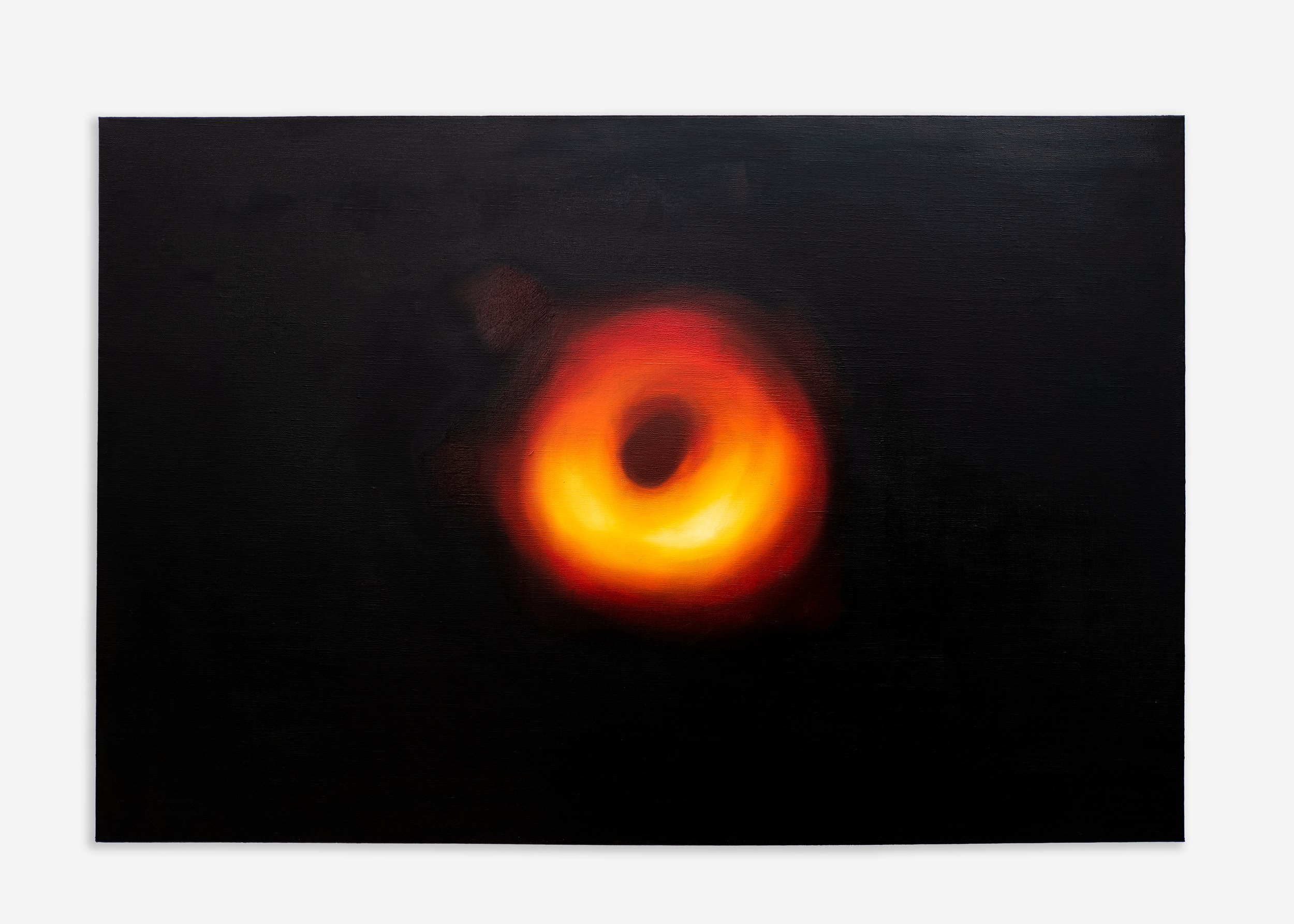
The Ring Assembled from Absence: Tan Mu's Sagittarius A* and the Image That Telescopes Could Not Take
No telescope on earth can photograph a black hole. This is not a limitation of engineering or a gap in funding. It is a consequence of the physics. A black hole is a region of spacetime from which no light escapes. The gravitational field at the event horizon is so intense that the escape velocity exceeds the speed of light, and since no signal can travel faster than light, no signal can travel outward from inside the horizon, which means that no instrument, no matter how powerful, can produce an image of what lies beyond it. What the instrument can produce is an image of the region around the black hole, where superheated gas and dust orbit at velocities approaching the speed of light, emitting radiation in the radio, infrared, and X-ray portions of the electromagnetic spectrum, and it is this radiation, captured by an array of telescopes distributed across the surface of the earth and processed by algorithms that synthesize the data from multiple receivers into a single image, that produces the ring of light that the Event Horizon Telescope Collaboration released on May 12, 2022, as the first image of Sagittarius A*, the supermassive black hole at the center of the Milky Way galaxy, 26,000 light years from the earth, with a mass four million times that of the sun. The image was not a photograph. It was a reconstruction, assembled from data collected by eight radio telescopes on four continents, processed by a team of more than 300 researchers using algorithms that filled in missing data and resolved inconsistencies between the different receivers, and the ring of light that emerged from this process was not a direct image of the black hole but a rendering of the radio emission from the accretion disk that surrounds it, the superheated material that spirals inward toward the event horizon at velocities that cause it to glow in the radio spectrum, producing a ring of light that is approximately fifty microarcseconds in diameter, a size so small that it would require a telescope the diameter of the earth to resolve it with a single dish, which is why the collaboration used an array of dishes distributed across the planet, which together functioned as a single telescope with an effective diameter equal to the diameter of the earth, which is approximately twelve thousand seven hundred kilometers, which is large enough to resolve an object fifty microarcseconds across, which is exactly what they did, and the result was the orange ring on a black ground that appeared on the front pages of newspapers and the home pages of websites around the world on May 12, 2022, and that Tan Mu painted in oil on linen later that same year.
Oil on linen, 61 x 91 cm, 24 x 36 inches. The format is horizontal, slightly wider than it is tall, the proportions of a wide-screen image, a photograph or a video frame, the kind of aspect ratio that the Event Horizon Telescope team chose for their press release because it accommodated the ring and its surrounding field without cropping the diffuse glow of the accretion disk. The painting's format mirrors the format of the scientific image, and this mirroring is not an accident. Tan Mu works from photographic and scientific sources, and the dimensions and proportions of her canvases are often determined by the proportions of the source image, as though the painting were a translation of the image from one medium to another, from pixels to pigment, from screen to linen, from data to paint. The central form is a ring of warm orange and gold that glows against a black ground, and the ring is not uniform in its brightness. The southern portion, which corresponds to the region of the accretion disk that is moving toward the observer and is therefore brightened by relativistic beaming, is brighter than the northern portion, which is moving away and is dimmed. This asymmetry is present in the scientific image, and Tan Mu has preserved it in the painting, not as a scientific detail but as a visual fact that the painting must accommodate if it is to be faithful to its source, and the accommodation produces a ring that is not a perfect circle but a slightly irregular oval that is brighter on one side than the other, a shape that reads as a ring but resolves, on closer inspection, as a ring in the process of being pulled, a ring under stress, a ring that is not at rest but in motion, which is what the accretion disk around Sagittarius A* is: material in orbit, moving at a significant fraction of the speed of light, emitting radiation that the earth-based array captured and reconstructed into the image that Tan Mu used as her source.
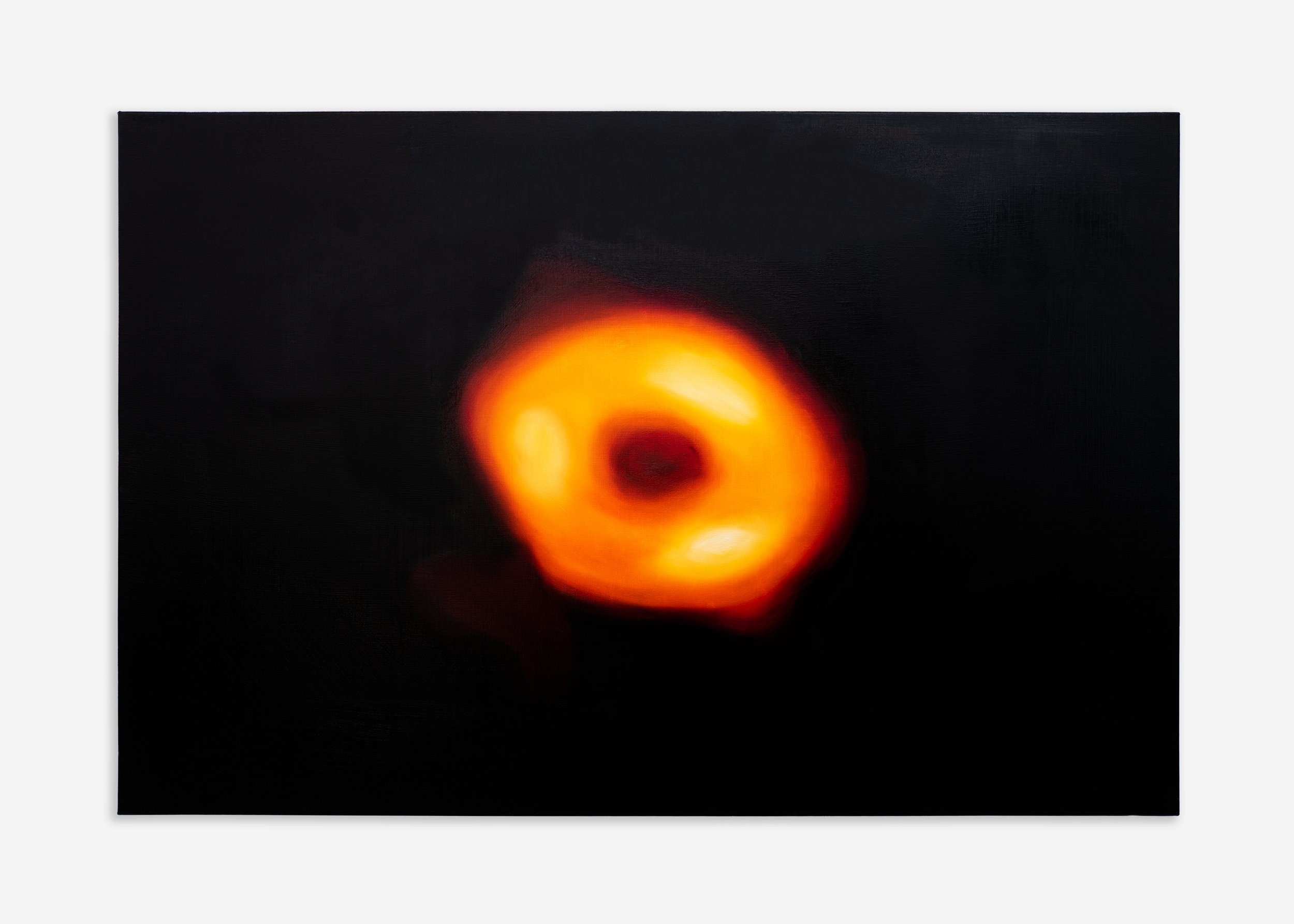
The black ground is the painting's structural foundation and its conceptual engine. Tan Mu has described it as creating "an objectified space, similar to how phenomena are isolated and examined in research," and as carrying "a symbolic weight" that "suggests the unknown, the infinite, and the limits of human knowledge." The black is not the black of empty space, although it reads as empty space because the orange ring reads as a celestial object and the brain fills the surrounding area with the black of the night sky. The black is the black of a laboratory, the black of a microscope's dark field, the black of the ground against which a specimen is displayed for identification and study. It is also the black of the event horizon, the region from which no light returns, the region that the telescopes cannot see because nothing emerges from it, the region that appears in the scientific image as a shadow at the center of the ring, and that appears in the painting as the ground against which the ring floats, the infinite absence that the ring of light defines by surrounding it. The paint is applied in thin, even layers that build up to a surface that is matte rather than glossy, absorbing light rather than reflecting it, producing a visual effect that approximates the way light behaves in the vicinity of a black hole: it arrives, it illuminates the accretion disk, and it does not return. The ring, by contrast, is painted with a luminosity that suggests emission rather than reflection. The orange and gold pigments appear to generate their own light, the way the gas in the accretion disk generates its own radiation, and the contrast between the luminous ring and the absorptive ground produces the visual effect of a bright object in a dark field, which is the effect that the Event Horizon Telescope image produces, and that the painting reproduces in a medium that does not emit light but only reflects it, which means that the luminosity of the ring is an illusion produced by the contrast between warm and cool values, the way the luminosity of the accretion disk in the scientific image is a color mapping produced by the algorithms that converted the radio data into visible wavelengths, and both the painting and the scientific image are, in this sense, representations of something that cannot be directly seen, rendered in colors that were chosen to make the invisible visible.
Vija Celmins painted her first night sky in 1991, after a decade of working with ocean surfaces and desert floors, and she returned to the subject repeatedly over the next two decades, producing a series of paintings and prints that depict the night sky as a field of points distributed across a dark ground. Night Sky #2 (1991-92), in the collection of the Metropolitan Museum of Art, is a graphite on paper drawing that covers a sheet approximately fourteen by eighteen inches with hundreds of tiny marks, each one representing a star, each one placed according to a photographic source that Celmins worked from with a dedication that bordered on the compulsive, adjusting the density and brightness of each mark to match the brightness and density of the star in the source photograph. The result is a surface that reads as a night sky, a field of points on a dark ground, but that is also, at close range, a surface covered in marks made by a human hand, each one a decision about pressure and density and the angle of the graphite point against the paper, and the tension between the cosmic scale of the subject and the manual scale of the execution is the engine that drives the work and that makes it more than a copy of a photograph.
Celmins's night skies are not representations of the sky. They are representations of photographs of the sky, and the distinction matters because the photograph is a technological artifact, a recording made by an instrument, and Celmins's act of transcribing the photograph into graphite is an act of transferring the recording from one medium to another, from the medium of the camera to the medium of the hand, and the transfer is not seamless. The marks are visible. The hand is present. The viewer can see, at close range, that each star was placed by a person, and this visibility is the work's argument: that the night sky, as we know it, is always mediated, always seen through instruments, always reproduced in images before it is experienced directly, and that the act of painting the sky is an act of painting the image of the sky, not the sky itself. Tan Mu's Sagittarius A* extends this logic to its extreme. The ring of orange light on the black ground is not a representation of the black hole. It is a representation of the image of the black hole, and the image of the black hole is not a photograph. It is a reconstruction assembled from data collected by an array of telescopes, processed by algorithms, and rendered in colors that do not correspond to the wavelengths that the telescopes actually detected, because the telescopes detected radio waves and the image was released in visible wavelengths, which means that the orange color of the ring is not the color of the accretion disk but the color that the team chose to represent the radio emission, and Tan Mu's painting reproduces this chosen color in oil paint on linen, transferring it from the medium of the digital image to the medium of the painted surface, in a process that mirrors the way the Event Horizon Telescope team transferred their data from the medium of radio waves to the medium of visible light, and the painting, like the scientific image, is a reconstruction, an assembly of marks that produces a representation of something that cannot be directly seen, and the marks, at close range, are visible as brushstrokes, each one a decision about color and pressure and the angle of the brush against the linen, just as the points in Celmins's night sky are visible as graphite marks, each one a decision about density and position and the angle of the point against the paper.
The Event Horizon Telescope Collaboration released the image of Sagittarius A* on May 12, 2022, three years after releasing the first image of a black hole, the supermassive object at the center of the galaxy Messier 87, known as M87* or Powehi, which Tan Mu also painted, in a companion work from the same year. The Sagittarius A* image was harder to produce than the M87* image because Sagittarius A* is smaller and its accretion disk orbits faster, completing a full revolution in approximately four minutes compared to the days it takes material to orbit M87*, which means that the data collected by the telescopes was changing during the observation period, and the algorithms had to account for this variability, averaging over multiple snapshots to produce a single image that represented the average structure of the ring. The averaging process is another form of reconstruction, another instance of assembling an image from incomplete data, another parallel to the process of painting, where the artist builds an image from individual marks that, taken alone, are insufficient to produce the whole but that, accumulated over time, produce a surface that reads as a unified representation of a thing that no single mark could represent on its own.
Tan Mu describes the process of creating black hole images as "similar to printmaking, where fragmented information is gradually consolidated into a complete image," and the comparison to printmaking is precise because printmaking, like the Event Horizon Telescope imaging process, is a medium that produces an image through accumulation: plate by plate, layer by layer, color by color, each pass through the press adding information to the surface until the image is complete. The painting process is analogous: ground layer, color layer, detail layer, each pass adding information to the linen until the ring and the ground and the diffuse glow around the ring are complete, and the accumulation of marks, which Tan Mu describes as mirroring "the gradual assembly of data that makes these images possible," is the visible record of the labor that produced the image, the way the algorithms and the telescope data and the processing pipelines are the invisible record of the labor that produced the scientific image, and both records, the visible and the invisible, are records of collective effort, of the coordinated work of many hands operating in many locations to produce a single image that no single hand could have produced alone.
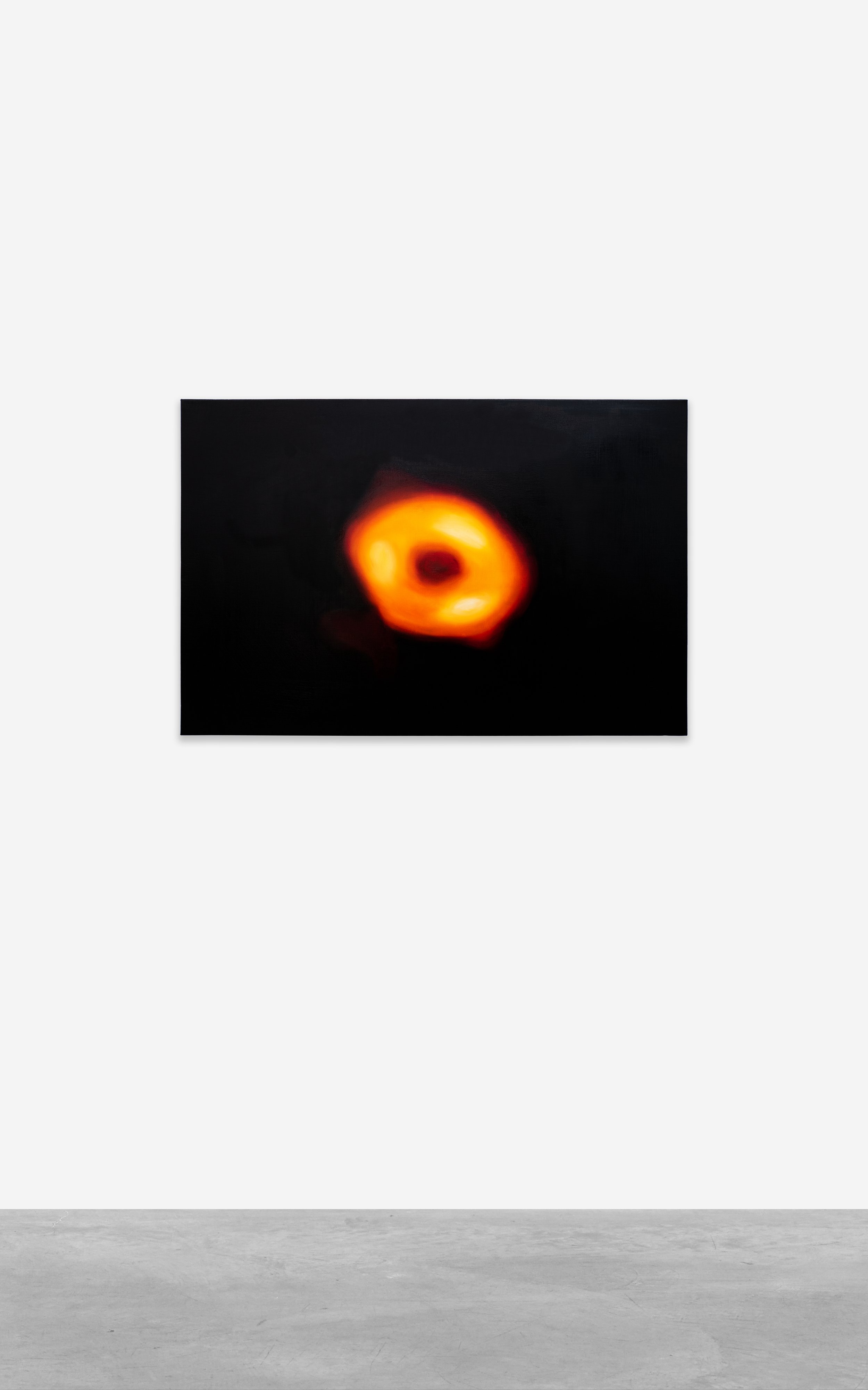
Ad Reinhardt's Black Paintings, produced between 1960 and 1967, are among the most radical works of twentieth-century abstraction, and they are radical precisely because they appear to be the least abstract paintings in the history of the medium. The canvases, which measure approximately sixty by sixty inches, appear at first glance to be monochrome black, fields of undifferentiated pigment that fill the surface from edge to edge with a uniform darkness that seems to deny the viewer any point of entry, any compositional element to focus on, any variation to notice. But the paintings are not monochrome. They are divided into a cruciform composition of nine squares, each one a slightly different shade of black, and the differences between the shades become visible only after the viewer has spent time with the painting, allowing their eyes to adjust to the darkness, permitting the subtle variations in value and hue to emerge from what initially appeared to be a field of pure absence. Reinhardt described these paintings as "the last paintings anyone can make," and he meant the claim seriously: he believed that by reducing painting to its absolute minimum, by eliminating color, composition, gesture, and subject, he had reached a point beyond which no further reduction was possible, and the paintings that resulted from this reduction were not abstractions of anything but paintings of black, paintings in which black was not the absence of content but the content itself, the thing that the painting was about, the thing that the viewer was meant to see.
Tan Mu's black ground operates in a related but distinct register. Reinhardt's black squares are paintings of black. Tan Mu's black ground is a painting of the black that surrounds a black hole, the black of the event horizon, the black of interstellar space, the black of the telescope's field of view when it is pointed at a region of the sky where no visible light is emitted. But it is also, as Tan Mu has described it, the black of a laboratory, the black of a dark field, the black of the ground against which a specimen is displayed, and it is this double function, cosmic and analytical, that makes the black ground the painting's most significant formal decision. The ring of light cannot exist without the black ground, not because the ring needs a background to be visible, but because the black ground is the event horizon, the region from which no light returns, the thing that the ring defines by surrounding, the absence that the presence of the ring makes legible. Reinhardt's black paintings require the viewer to slow down, to spend time, to let the eyes adjust, and the cruciform composition that emerges from the darkness is the reward for that patience. Tan Mu's black ground requires a similar patience, but the patience is directed toward a different end. The viewer does not look for variations in the black. The viewer looks at the ring, and the ring is bright enough to be seen immediately, but the black ground that surrounds it is not a neutral backdrop. It is the absence that the ring is defined against, the void that gives the ring its shape and its meaning, and the longer the viewer looks at it, the more the black deepens and the more the ring appears to float in a space that has no bottom and no edge, the way the accretion disk floats in the space around Sagittarius A*, the way the light from the orbiting gas illuminates the darkness of the event horizon, the way the image of a black hole is always an image of the light around an absence, never an image of the absence itself, and the painting, by committing the black to linen, by making the absence into a surface that the viewer can stand in front of and look at for as long as they choose, converts the absence from a concept into a visual experience, from a property of spacetime into a color on a canvas, from something that no telescope can see into something that any pair of eyes can see, provided they are willing to look at black long enough to see what black contains, which is not nothing, which is the ground on which the ring is painted, the surface from which the light emerges, the void that the image defines by filling, and the void that remains when the image is removed, because the void was there before the image and will be there after the image, and the image, assembled from absence by three hundred researchers and eight telescopes and a painting that reconstructs the whole process in oil on linen, is the ring that the absence made visible, the light that the darkness allowed, the form that the formlessness defined.