The Patience of the Machine: Tan Mu's Large Hadron Collider and the Duration That Made Matter Speak
The Higgs boson did not appear in a single collision. It announced itself over two years of accumulated data, a statistical excess persisting across trillions of proton-proton interactions inside detectors the size of cathedrals. By the time Peter Higgs and François Englert received the Nobel Prize in 2013, the particle that bore his name had been confirmed not by direct observation but by inference: a bump in a histogram, a pattern that would not have held if the particle were not there. The Large Hadron Collider had not captured the Higgs. It had waited long enough for the Higgs to make itself known. This distinction, between capturing and waiting, between force and accumulation, sits at the center of Tan Mu's Large Hadron Collider (2025), and it reshapes what the painting is doing from the ground up. The painting is not a portrait of a machine. It is a record of duration.
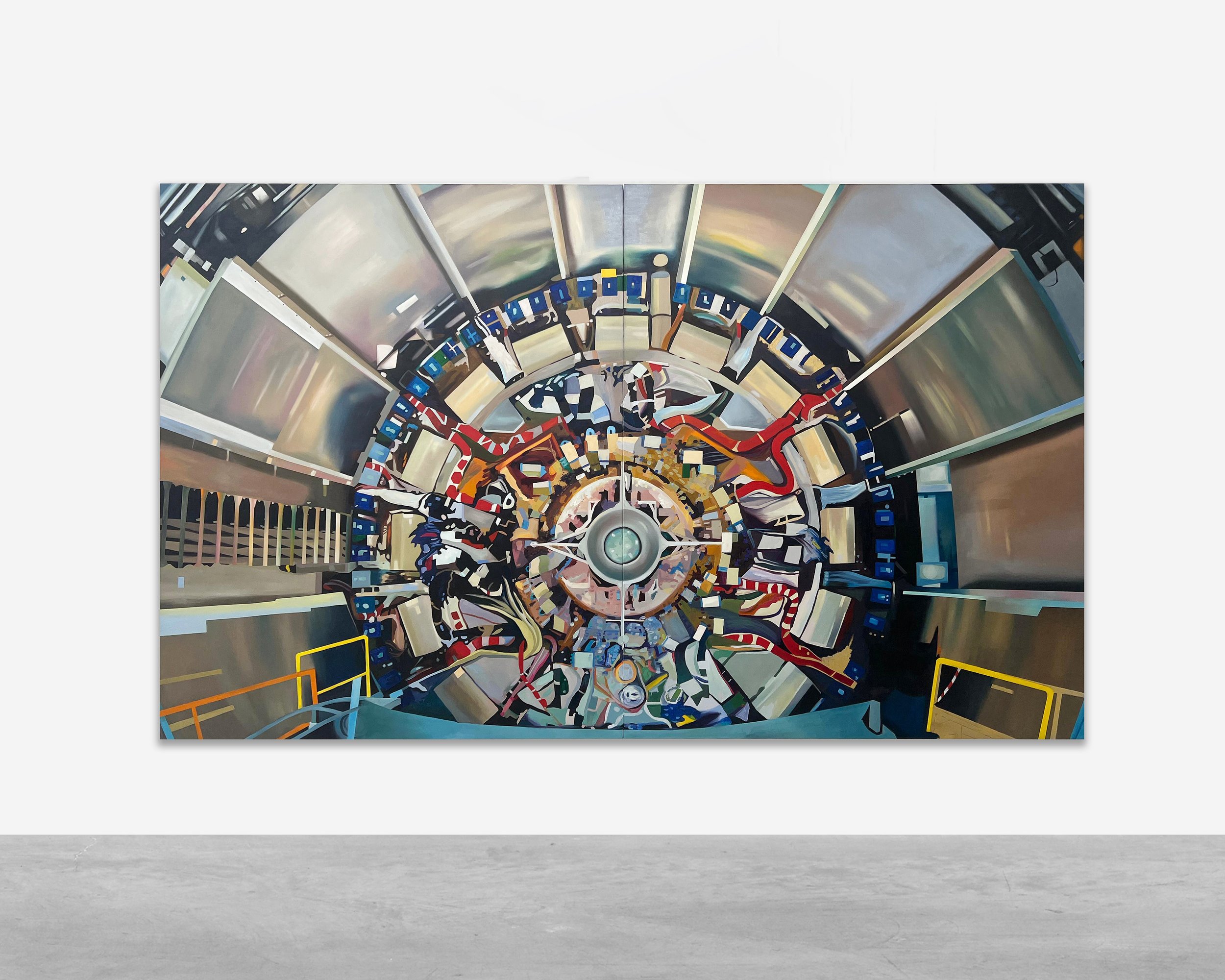
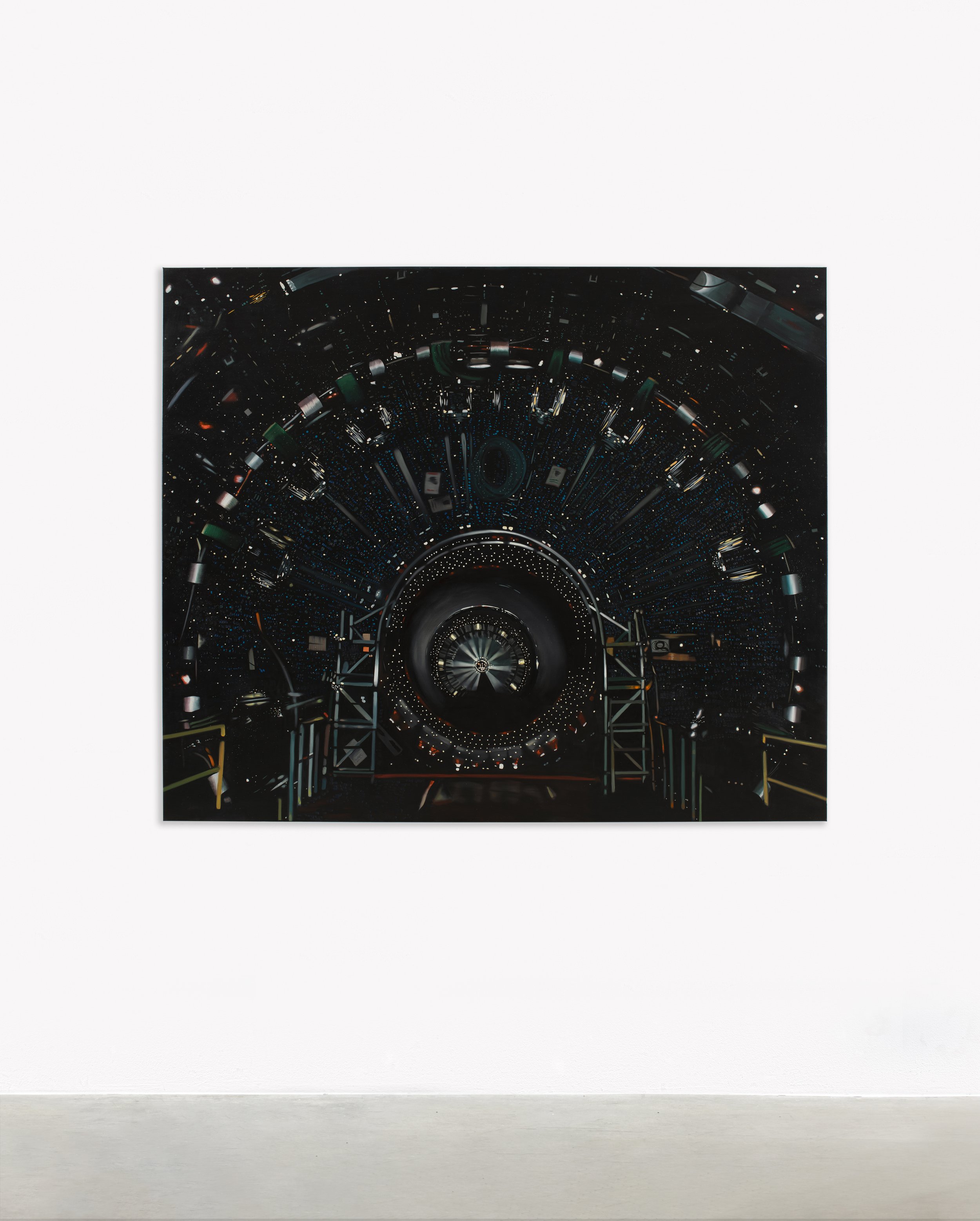
Tan Mu's second painting of CERN's accelerator arrives at 180 x 300 cm (71 x 118 in), oil on linen, a scale that demands physical navigation. Where her 2023 version at 122 x 91 cm (48 x 36 in) approached the collider as apparatus, the 2025 canvas treats it as environment. The painting fills a wall. The viewer cannot take it in from a single position. You step back for the structure, step forward for the surface, and the interval between those positions is where the painting operates. The linen ground, visible in places through the paint, establishes a substrate of woven fibers that the oil marks both follow and resist. The weave is not hidden. It asserts itself as the ground on which everything else is built, the way the tunnel's concrete walls assert themselves as the container for everything that happens inside the accelerator ring.
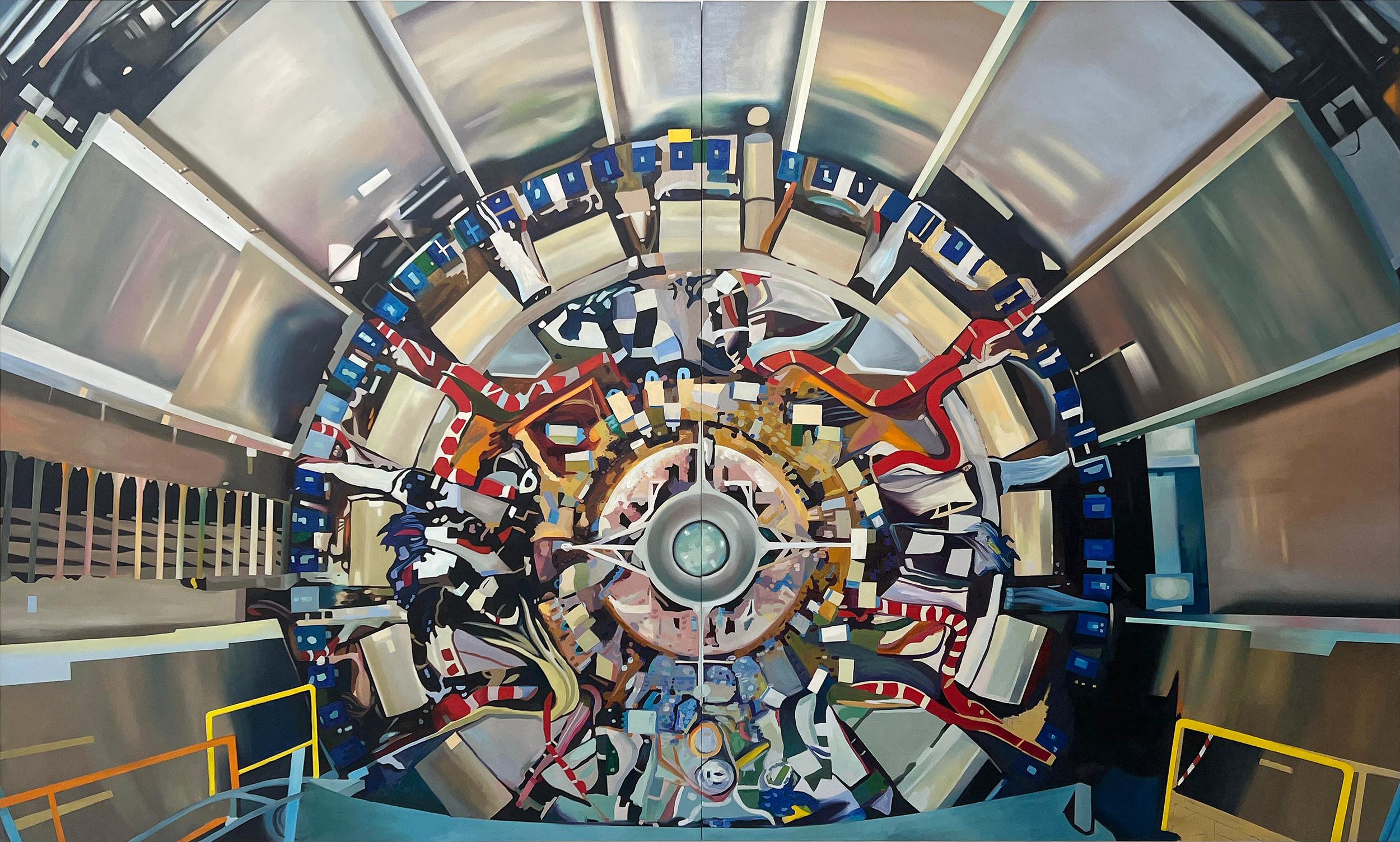
The color registers as a specific decision. Deep blues that are almost black, metallic grays that shift between silver and pewter depending on the light, flashes of white and pale gold at the points where lines converge. These are not the colors of a photograph of the LHC. They are the colors of the experience of standing in front of a representation of something that operates beyond visible light. The collider's detectors do not record what human eyes would see. They record energy deposits, ionization trails, the shadows that particles leave as they pass through layers of silicon and lead tungstate and liquid argon. Tan Mu's palette registers this indirection. She is not painting what the machine looks like. She is painting what it means to look at something whose purpose is to make visible what cannot be seen, and her colors carry that secondary quality, the quality of information that has been translated once already before it reaches the eye.
The surface textures operate at two distances. From across a room, the painting reads as a network: intersecting arcs, diagonal traces, luminous nodes against a dark ground. The composition suggests circuitry, or a celestial map, or the cross section of a structure whose full extent exceeds the frame. At arm's length, the physical intelligence of the marks becomes inescapable. The connection points, as Tan Mu has described in discussing her Signal series, are built up with thick, wax-heavy oil paint, raised above the surface like soldered joints on a circuit board. These tactile nodes catch raking light and cast tiny shadows, making the painting shift as the viewer moves. The broader strokes lay down the architecture of the tunnel, the detectors, the magnetic guiding fields. The finer lines record something else: the paths of particles that existed for a millionth of a second before decaying into cascades of daughter particles, each decay an event so brief that only its trace, recorded by layers of detectors, confirms it happened at all. The painting holds both registers simultaneously: the tunnel you could walk through and the collision you could never witness, the infrastructure of beams and magnets and the vanishing events that infrastructure was built to detect. Between these registers, the surface accumulates marks the way the collider accumulates data: gradually, with patience, each mark a trace left by something that passed through.
Julie Mehretu spent three years painting Mural (2007), a commission for the Goldman Sachs headquarters in lower Manhattan that stretches across eighty feet of wall. The painting's surface is built from thousands of fine marks: arrows, vectors, architectural lines, traces of movement that appear, at first glance, like a compressed city plan or a weather map of forces too complex to track individually. Mehretu described her process as one of accumulation, drawing and erasing and redrawing until the surface carried the memory of its own making. The marks in Mural are not illustrations of anything. They are traces of activity, the residue of a hand moving across a surface over extended time, each mark a decision that subsequent marks either reinforce or partially obscure. The painting does not depict a system. It enacts one. The marks behave the way data behaves: they cluster, they disperse, they align along vectors that suggest intention without revealing what that intention is.
Tan Mu's Large Hadron Collider shares this logic of accumulation, though the systems it enacts are different in kind. Where Mehretu's marks aggregate into something that reads as a single, teeming field, Tan Mu's marks distribute themselves along paths that converge at detectable nodes. The composition is not all-over. It is directional. Lines arrive at points of maximum intensity, and the viewer's eye follows them to those intersections the way a physicist's attention follows particle traces to their vertices. Mehretu's Mural refuses to let the eye rest, pulling it from one mark to the next without resolution. Tan Mu's painting offers resolution at the nodes, but the resolution is not an endpoint. It is a moment of legibility within a larger field of motion. The nodes are where the system produces something detectable, where the accumulation of data yields a signal that rises above the noise. Between the nodes, the lines move through the dark ground like protons through the accelerator's vacuum pipe: they are there, they are moving, but they do not announce themselves until they collide. The painting thus distributes its meaning across two kinds of time: the long duration of the lines as they traverse the surface and the instantaneous moment of convergence at each node. This temporal structure mirrors the collider's own operation: months of circulating beams producing billions of collisions, with the vast majority discarded by the trigger system, leaving only the thousand per second deemed significant enough to record. The painting compresses this ratio of waiting to event into the relationship between its marks and its nodes.
The Large Hadron Collider runs 27 kilometers of superconducting magnets through a tunnel originally excavated for the Large Electron-Positron collider, which operated from 1989 to 2000. The LEP was decommissioned and the tunnel repurposed. The LHC inherited this circular cavity and made it colder, more powerful, more precise. Four main detectors sit at points around the ring where the beams cross: ATLAS, CMS, ALICE, and LHCb. Each is a multilayered instrument with concentric shells of tracking chambers, calorimeters, and muon detectors. When two protons collide, the resulting spray of particles passes through these layers, leaving traces that are reconstructed by algorithms into three-dimensional event displays. A single collision produces roughly one megabyte of raw data. The LHC generates around one billion collisions per second. The trigger system, a hierarchy of custom hardware and software, reduces this torrent to roughly one thousand events per second that are saved for analysis. The rest are discarded forever. For every collision the physicists examine, approximately one million others vanished without record. The collider operates on a principle of radical selectivity: it sees by discarding almost everything it sees. This is not a failure. It is the condition of seeing at this scale. The Higgs boson was identified not by direct observation but by a statistical excess that persisted across enough collisions to pass the threshold of discovery. The smallest things in nature announce themselves not through appearance but through pattern, not through direct sight but through inference accumulated over time.
Tan Mu has described the collider as "a modern altar," a phrase that connects the apparatus to something older than particle physics. The altar is where humans gather to confront what exceeds their grasp. But the word "altar" also carries a temporal dimension that the scientific framing can obscure. An altar is not only a place of confrontation. It is a place of waiting. The supplicant arrives, makes an offering, and waits for a sign. The priest performs the rite and waits for the god to respond. The ritual is structured around duration: the time between the offering and the response, the time between the question and the answer, the time in which nothing appears to happen and yet everything is being prepared. The LHC's data-taking runs last for months, sometimes years, before a result is announced. During those long runs, the machine operates around the clock, circulating beams, recording collisions, discarding the overwhelming majority of what it records, and accumulating the tiny fraction of data that might one day contain a discovery. The physicists wait. The machine runs. The data accumulates. The painting, at 180 x 300 cm, compresses this extended duration into a single surface. The viewer does not see the waiting. But the painting's structure encodes it: the long lines that traverse the dark ground are the passages of time between events, and the bright nodes at their intersections are the events themselves, the moments when accumulation yields legibility.
Hiroshi Sugimoto began his Seascapes series in 1980 and has continued it for over four decades. Each photograph in the series follows an identical format: the horizon line divides the frame precisely in half, with water below and sky above, rendered in silver gelatin prints of extraordinary tonal subtlety. The exposures are long, sometimes lasting hours, and the result compresses the entire duration of that exposure into a single still image. Waves that rose and fell during the exposure smooth into a continuous plane. Clouds that passed across the sky dissolve into a uniform luminosity. What the photograph records is not what the eye would have seen at any single moment during the exposure. It records the accumulated light of the entire duration, a duration that the image holds in suspension. Sugimoto has described the Seascapes as records of time, not of place. The specific location matters less than the specific duration. The photograph becomes a container for a length of time that no single moment of looking could have revealed.
Tan Mu's painting shares this temporal logic, though the duration it compresses is of a different order. Where Sugimoto's long exposures smooth motion into stillness, Tan Mu's extended painting process accumulates marks that register motion, collision, and convergence. The fine lines that trace particle paths across the dark ground are not still. They are taut with movement, the way a Sugimoto seascape is taut with the accumulated motion that the long exposure has compressed. The difference is that Sugimoto's compression produces uniformity: the water and sky settle into continuous fields of gray. Tan Mu's compression produces differentiation: the nodes glow, the lines travel, and the dark ground between them holds the space of waiting. The painting's dark ground is not empty. It is the color of the tunnel interior, the color of rock and concrete that encase the accelerator, and the color of a screen before data appears. It is also the color of duration itself, the long stretches of running in which nothing announceable happens but the system is nonetheless active, circulating, accumulating, waiting for the statistical excess that confirms the particle's existence. The ground is where the waiting lives.
Saul Appelbaum, writing about the Signal series in 2025, introduced the concept of "arbitration" to describe what happens when data passes through multiple notations, forms, and processes before becoming visible. "What matters is not a direct alignment between system and representation," he argued, "but the act of arbitration, the human effort to make sense of a signal as it passes through multiple notations, forms, materials, processes, and consciousnesses." The LHC extends this principle beyond the canvas and into the apparatus itself. The collider does not show particles. It shows traces of traces. The detectors show energy deposits left by particles that decayed before reaching the outermost layer. The algorithms reconstruct those deposits into event displays that no human ever witnessed in real time. The painting, then, is not a representation of the collider as it looks. It is an arbitration of an arbitration: Tan Mu's hand translating a system of translations into a single visual field where machine traces and painterly marks occupy the same surface. The patience of the painting, the hours spent building up the nodes and laying down the fine lines, mirrors the patience of the machine, the months of data-taking before a single result emerges. Both the painting and the collider are structures of duration that produce legibility through accumulation.
Tan Mu spent her university years near the Stull Observatory at Alfred University, one of the oldest private observatories in the United States, with six telescopes housed in domes on a rural hilltop in western New York. She attended weekly observation sessions, training her eye through the eyepiece, learning what it means to wait for a celestial object to rise above the treeline, adjusting the instrument, recording data that arrived as light that had traveled for minutes or millennia before reaching the spectrograph. This experience of observational patience, of watching and recording and accumulating over time, is not a metaphor for what the LHC does. It is the same activity at a different scale. A telescope, like a particle detector, is an instrument that makes the invisible legible. It requires calibration, patience, and the understanding that meaningful observation is not a single moment of revelation but a sustained practice of attention across extended duration. The nights at Stull Observatory taught something that the LHC teaches on a different scale: that seeing is always mediated, and that the mediation is not an obstacle but the condition of the knowledge itself. The observatory's domes, rotating on their mounts to track objects across the sky, perform the same structural function as the LHC's detectors rotating around the collision points: they frame the encounter between the viewer and the invisible, and they do so not in a single instant but over the hours and nights it takes for the data to accumulate into meaning.
The painting's scale, 180 x 300 cm, is not incidental to this argument about duration. At this size, the canvas does not hang on the wall like a window. It functions as a section of the environment that the viewer must physically navigate. You cannot take it in from a single standing point. To see the upper corners, you step back. To see the texture of the connection points, you step forward. To follow a line from one edge to another, your eye travels a distance proportional to the tunnel's own circumference. The painting makes the viewer's body a measuring instrument, just as the detector makes the collider's collisions legible. The time it takes to move from one end of the canvas to the other, to shift focus from the fine lines to the raised nodes, to register the weave of the linen showing through, is the time of the painting. It is a duration built into the encounter, and it mirrors the duration that the collider itself requires: the time of waiting, the time of accumulation, the time between the start of a data run and the announcement of a result. The painting does not depict this duration. It enacts it.
The distinction between depicting and enacting is what separates Tan Mu's approach from illustration. A photograph of the LHC's interior shows the tunnel, the magnets, the pipes carrying superfluid helium at 1.9 Kelvin, colder than the cosmic microwave background. It shows what is there. The painting shows what it takes to see what is there. The raised nodes at the convergence points are not representations of detector readouts. They are the places where the painting itself becomes thickest, most present, most emphatic, just as the collision points in the accelerator are the places where the system produces something detectable. The fine lines between the nodes are not diagrams of particle tracks. They are the marks of a hand moving across a surface over time, accumulating a record of movement the way the collider accumulates a record of collision. The painting thus operates at a structural level: it does not show you the LHC. It shows you what it feels like to wait for something invisible to become legible through sustained attention. The Higgs boson did not appear. It accumulated. And the painting accumulates too, each mark a trace of the hand's passage, each node a moment where the traces converge into something the viewer can hold. The dark ground holds the waiting. The lines hold the movement. The nodes hold the events. And the viewer, standing before all three, holds the duration that it takes to see them.