The Blade That Moves the Ocean: Tan Mu's The Wave 02 and the Propeller Between Worship and Water
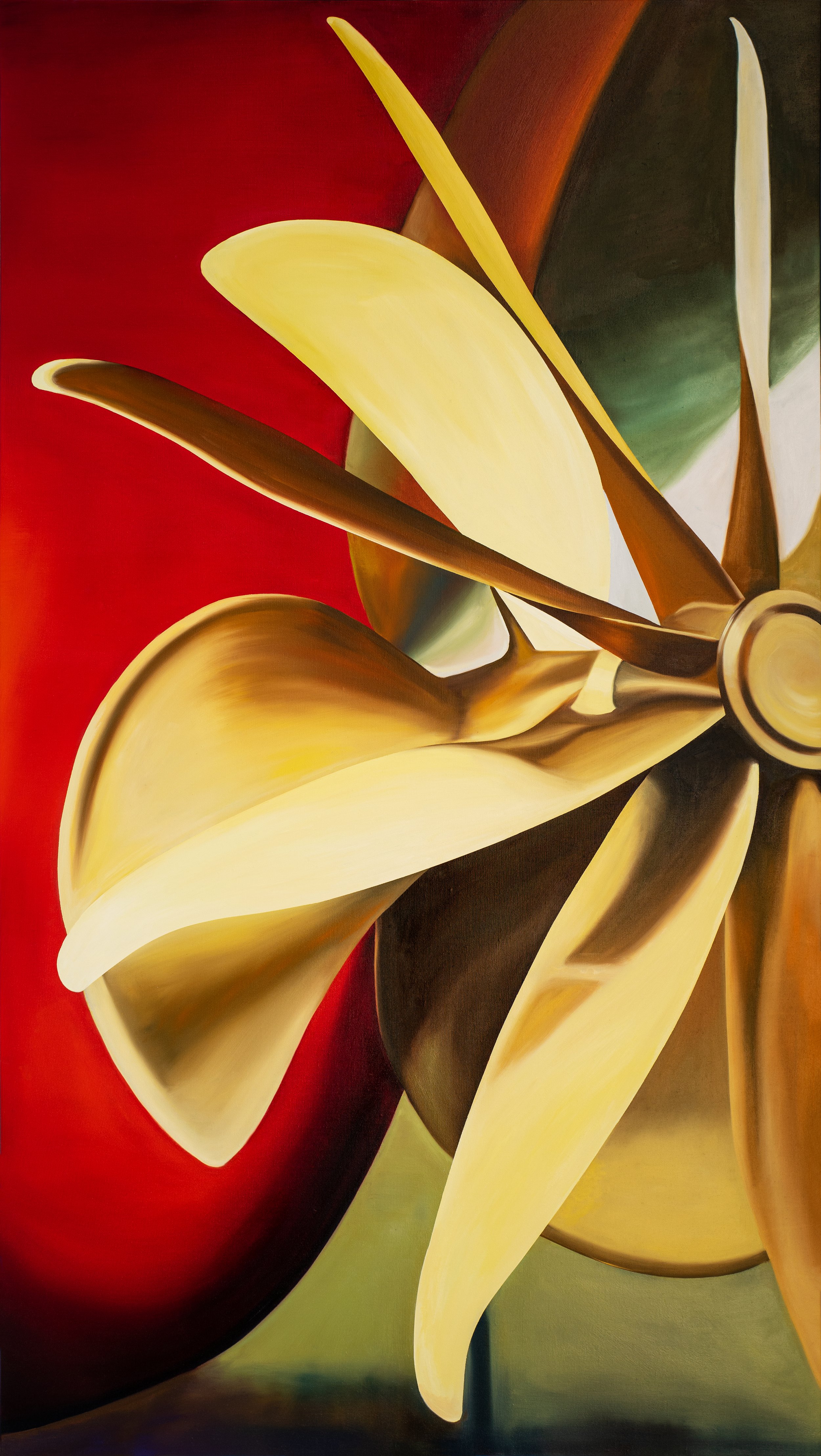
Gold catches before the subject does. The eye lands on the luminous surface, the warm gleam of something polished and deliberate, and only then follows the curve outward to recognize the shape: a propeller, four blades radiating from a central hub in a composition that spirals as it expands. The gold is not decorative. It is the painting's argument rendered in pigment. Tan Mu has said that gold in The Wave series carries symbolic weight, that it transforms the propeller into an object that feels almost sacred, and that the use of gold draws a parallel between ancient totemic worship and modern technological reverence. The painting does not merely depict this parallel. It enacts it. The viewer's first response to the surface is the response the painting intends: awe before the object, before the subject registers. The propeller is a machine. The gold makes it something else.
The painting measures 165 x 92 cm (65 x 36 in), oil on linen, a vertical format that emphasizes the propeller's rotational reach from a central axis upward and downward through the field. The canvas is narrow relative to its height, which concentrates the composition around the hub and forces the blades to curve within the frame rather than extending beyond it. The propeller does not sit in the center of the canvas. It occupies the upper two thirds, with the lower third given over to the water that the propeller displaces: turbulence, wake, vortices rendered in darker blues and greens that churn beneath the golden form. The ratio between machine and water is the painting's structural tension. The propeller generates the wave. The wave exists because of the propeller. And yet the water occupies a third of the surface, pushing back against the machine's dominance, asserting its own material presence through brushwork that is looser, more agitated, less controlled than the precision of the blades above.
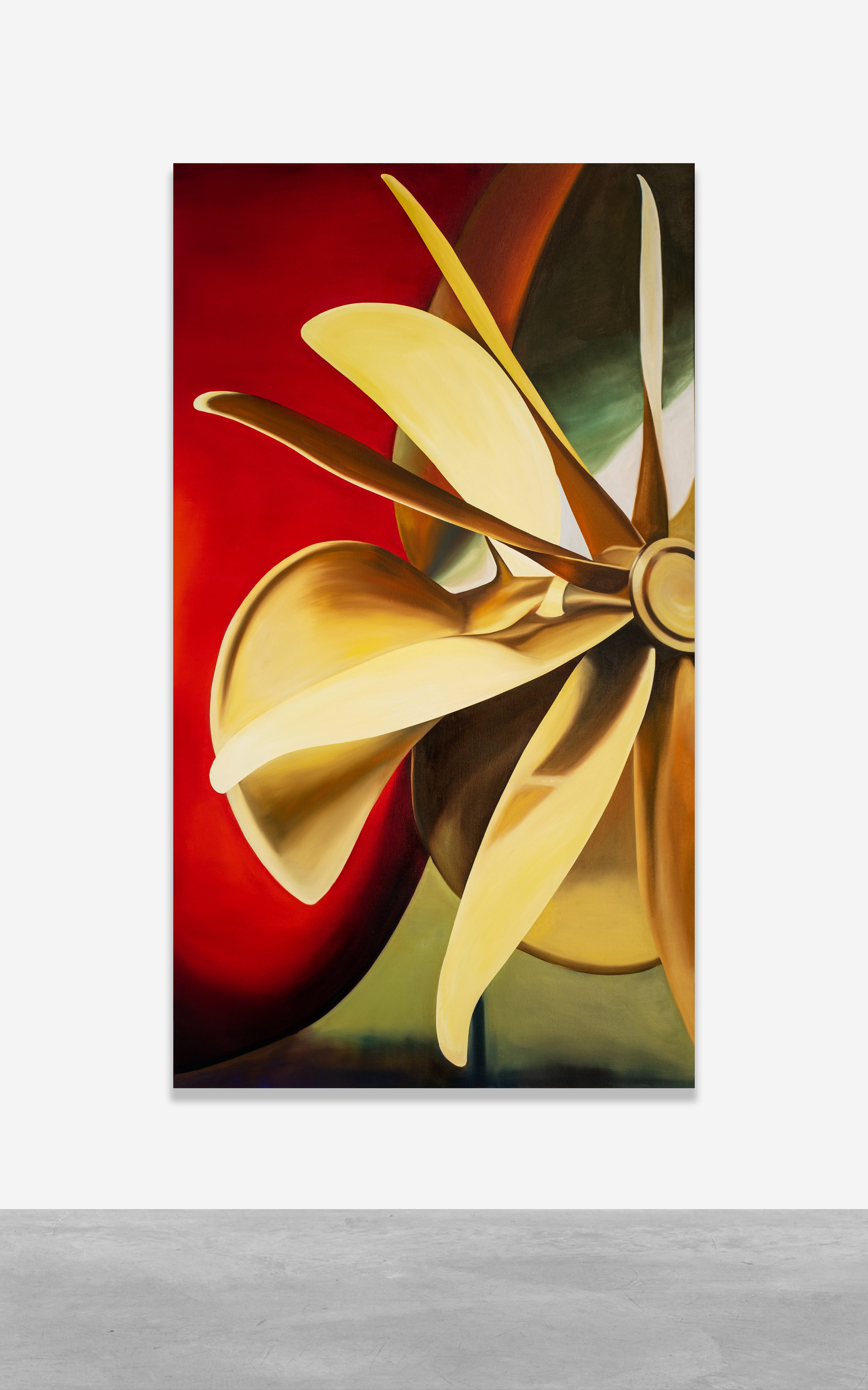
The surface operates at two registers. From across a room, the gold propeller reads as a single luminous form, a mandala of mechanical precision suspended above darker water. The blades appear to rotate, an effect produced by the slight asymmetry of their spacing and the way the highlights shift from one blade to the next, as though a light source were moving across the surface or the propeller itself were caught mid-turn. At arm's length, the gold breaks into distinct passages: thick, wax-heavy oil paint built up at the blade edges where the propeller catches the light, thinner washes where shadow falls across the concave surfaces, and fine lines that trace the leading edges with a precision that borrows from engineering drawing without surrendering to it. The linen shows through in places, its weave establishing a faint grid beneath the composition that both anchors and interrupts the rotational flow. The water beneath is painted with broader strokes, the kind of brushwork that holds motion in suspension. Blues deepen into near-black at the canvas's lower edge, and flashes of pale green and white mark the crests of disturbed water, the points where the propeller's rotation has whipped the surface into foam. The contrast between the controlled gold above and the churning water below is not just tonal. It is temporal. The gold suggests something fixed, an object to be venerated, while the water suggests something in process, a force still unfolding.
In March 1934, the Museum of Modern Art in New York opened Machine Art, an exhibition organized by Alfred H. Barr Jr. that displayed industrial objects on pedestals and against white walls as though they were sculpture. Propellers stood in the galleries alongside ball bearings, cooking pots, and laboratory glassware. The exhibition catalog argued that these objects possessed aesthetic qualities, form following function with a purity that the fine arts could not match. A polished aluminum propeller from the Navy Bureau of Aeronautics, less than a meter in diameter, hung at eye level and rotated slowly on a motorized mount, its blades catching the gallery light with each turn. Barr positioned it as an object of contemplation, not utility. The propeller was not there to power a ship or a plane. It was there to be looked at. The exhibition drew over sixty thousand visitors in its two-month run, and the catalog's photographs, taken by Consuelo Kanaga with the same attention to light and form that she brought to her portraits, circulated widely in architecture and design magazines. The propeller became, for a moment, the face of a modernist argument: that beauty inhered in functional form, that the machine could be admired without apology, that industrial design had achieved what fine art was still struggling toward. What the exhibition did not address was the labor embedded in the propeller's manufacture, the manganese bronze that had to be mined and cast, the foundry workers who poured molten metal into sand molds, the naval architects who calculated blade pitch and skew for maximum efficiency at minimum cavitation. The propeller in the gallery was an object stripped of its history, its material origins, and the human effort that brought it into being. It was pure form, and its beauty depended on this purity. Remove the context and the object becomes sculpture. Restore the context and it becomes something more complicated: a thing made by people to move other things across water, at a scale that exceeds what any single person can comprehend.
Tan Mu cites this exhibition directly. She notes that in 1934, the propellers displayed at MoMA were less than one meter in diameter. Today, some ship propellers reach eight meters. The shift in scale is not incidental. It registers a transformation in the relationship between the human body and the machine. The 1934 propeller could be displayed at eye level, its proportions legible to a standing viewer, its relationship to the human body comfortable and comprehensible. An eight-meter propeller cannot be seen whole from any single vantage point. It exceeds the body's capacity to measure. It must be walked around, estimated in parts, understood through inference rather than direct apprehension. The painting registers this shift. At 165 x 92 cm, the canvas is large enough that the propeller's scale reads as imposing without being overwhelming, but the gold surface and the vertical format push the composition toward the monumental. The viewer looks up at the blades. The machine is above, the water below, and the body is positioned somewhere in between, measuring its own smallness against the object that moves global trade across oceans.
The Wave series, as Tan Mu describes it, examines the mechanics and influence of propulsion technology. The propeller is her subject because it represents a convergence of nature and machinery. Its function relies on fluid dynamics, turbulence, and flow. Its motion echoes natural systems: ocean currents, air circulation, even the helical structure of DNA. This is not a metaphor the painting applies to the propeller from outside. It is a structural fact about how propellers work. A marine propeller operates by accelerating water rearward, creating a pressure differential that drives the vessel forward. The physics of this process are the physics of vortices: spiraling flows of water that detach from the blade tips and trail behind in patterns that mirror, at a different scale, the spiral arms of galaxies, the cochlea of the inner ear, and the cross section of a tornado. The propeller does not impose order on water. It enters into an existing system of fluid behavior and redirects it. The energy it transfers to the water is invisible but immense. A large container ship propeller rotating at ninety revolutions per minute displaces hundreds of cubic meters of water per second, and the tip vortices that spiral off each blade generate localized regions of low pressure so extreme that water vaporizes and collapses in rapid succession, a phenomenon called cavitation. The collapse of each cavitation bubble releases a shock wave that can, over time, erode the metal surface of the blade itself. The propeller is destroyed by the same process that makes it effective. This is not a metaphor. It is a physical fact about how propulsion works at maritime scale, and it is visible in Tan Mu's painting as the churning agitation in the lower third of the canvas, the turbulence that seems to push back against the golden precision above it. The water is not passive. It resists. It bites back. The darker blues and greens at the bottom of the painting register this resistance, the way the ocean does not simply receive the propeller's force but returns it, transformed, in the form of wake, foam, and the spiral trails that persist long after the ship has passed. Tan Mu has said she wants to make this kinetic energy perceptible through painting, and she achieves it through circular compositions, flowing lines, and warm golden tones that suggest rotation and momentum.
The spiral structure of the propeller connects, as Tan Mu notes, to forms that recur throughout her practice: Torus (2020 and 2021), the Gaze series, paintings of cells, atoms, black holes, and cosmic phenomena. These works share a geometry. They depict forms that cycle, that return to their own origin, that operate through continuous rotation rather than linear progress. The torus, the spiral galaxy, the cell dividing, the propeller turning: all are structures in which energy moves in loops rather than lines. This is not a decorative similarity. It is a structural insight about how systems at every scale operate. The propeller is not an exception to this pattern. It is one of its clearest manifestations. The painting places the propeller within this lineage of recursive forms and asks the viewer to see it not as an isolated piece of maritime hardware but as a node in a network of rotational energy that extends from the microscopic to the cosmic.
Katsushika Hokusai's The Great Wave off Kanagawa (c. 1831) is the most reproduced image of a wave in the history of art, and it has shaped how every subsequent artist approaching the subject must contend with its presence. The wave in Hokusai's print rises from the left, curling over fishing boats that are dwarfed by its scale, while Mount Fuji sits in the background, small and stable, the only fixed point in a composition of violent motion. The foam at the wave's crest breaks into claw-like extensions that reach downward toward the boats, and the entire left half of the image is occupied by water in motion, while the right half opens onto calmer sea and distant sky. The composition is organized around a single diagonal tension: the wave's rise on the left versus Fuji's stillness on the right, the fleeting versus the permanent, the event versus the ground against which the event becomes legible.
Tan Mu's The Wave 02 inverts this structure. Where Hokusai gives the wave the left half and the mountain the right, Tan Mu gives the machine the upper two thirds and the water the lower third. The propeller is not the wave's victim. It is the wave's cause. The water in the lower portion of Tan Mu's canvas is not an independent natural force cresting against the horizon. It is the consequence of the machine's rotation, the turbulence generated by blades spinning through liquid. The painting thus reverses the relationship between nature and technology that The Great Wave establishes. In Hokusai, the wave is nature asserting itself over human endeavor. The boats are small, fragile, subject to forces beyond their control. In Tan Mu, the machine generates the force, and the water responds. The propeller is not dwarfed by the wave. The propeller produces the wave. This inversion carries consequences. If the machine creates the turbulence, then the machine also bears responsibility for it. The painting does not make this argument explicitly. It makes it structurally, through the ratio of gold to blue, through the placement of cause above effect, through the vertical format that positions the viewer below the machine and inside the water it displaces.
But the painting also resists this reading in a way that deepens it. The gold surface of the propeller catches light in a manner that transcends its mechanical function. Tan Mu has described gold as carrying symbolic weight associated with reverence, power, and devotion. By rendering the propeller in gold, she transforms it from a functional object into something that invites the kind of attention once reserved for sacred objects. The propeller does not merely move the ship. It commands the kind of looking that altarpieces command. This is where the MoMA Machine Art exhibition returns, not as an art historical footnote but as a structural principle. Barr's exhibition argued that industrial objects could be aesthetically appreciated on their own terms. Tan Mu's painting goes further. It argues that the aesthetic appreciation of the machine is not a neutral act of formal appreciation. It is a form of worship. The gold makes this explicit. The propeller is not being admired for its engineering. It is being venerated for its power. The distinction matters. Admiration is a response to form. Worship is a response to force. The painting makes the propeller an object of both, and the tension between those two responses is where the painting lives.
Nick Koenigsknecht, writing about the Signal series in the BEK Forum catalog, described cables as "not only infrastructure but relic, glowing with the aura of what once physically tethered us together." He positioned submarine cables as objects that are simultaneously functional and devotional, carrying data and carrying the weight of what that data means. The propeller in The Wave 02 occupies a similar position. It is the object that moves ninety percent of global trade across the ocean. It is also, in Tan Mu's rendering, an object that glows with the aura of what that movement costs. The gold surface does not idealize the propeller. It consecrates it. Consecration, in this context, does not mean sanctification. It means setting apart, marking as significant, making visible the weight of what the object carries. The propeller carries goods, fuel, raw materials, and the labor of the people who load and unload them. It carries the oceanic routes established by centuries of maritime trade, routes that Tan Mu's maternal great-grandfather traveled as a sea merchant during the Republican era, moving between China and Korea on international waters that were also the waters of colonial extraction and wartime disruption. The gold remembers all of this. It holds the reverence and the cost in the same surface.
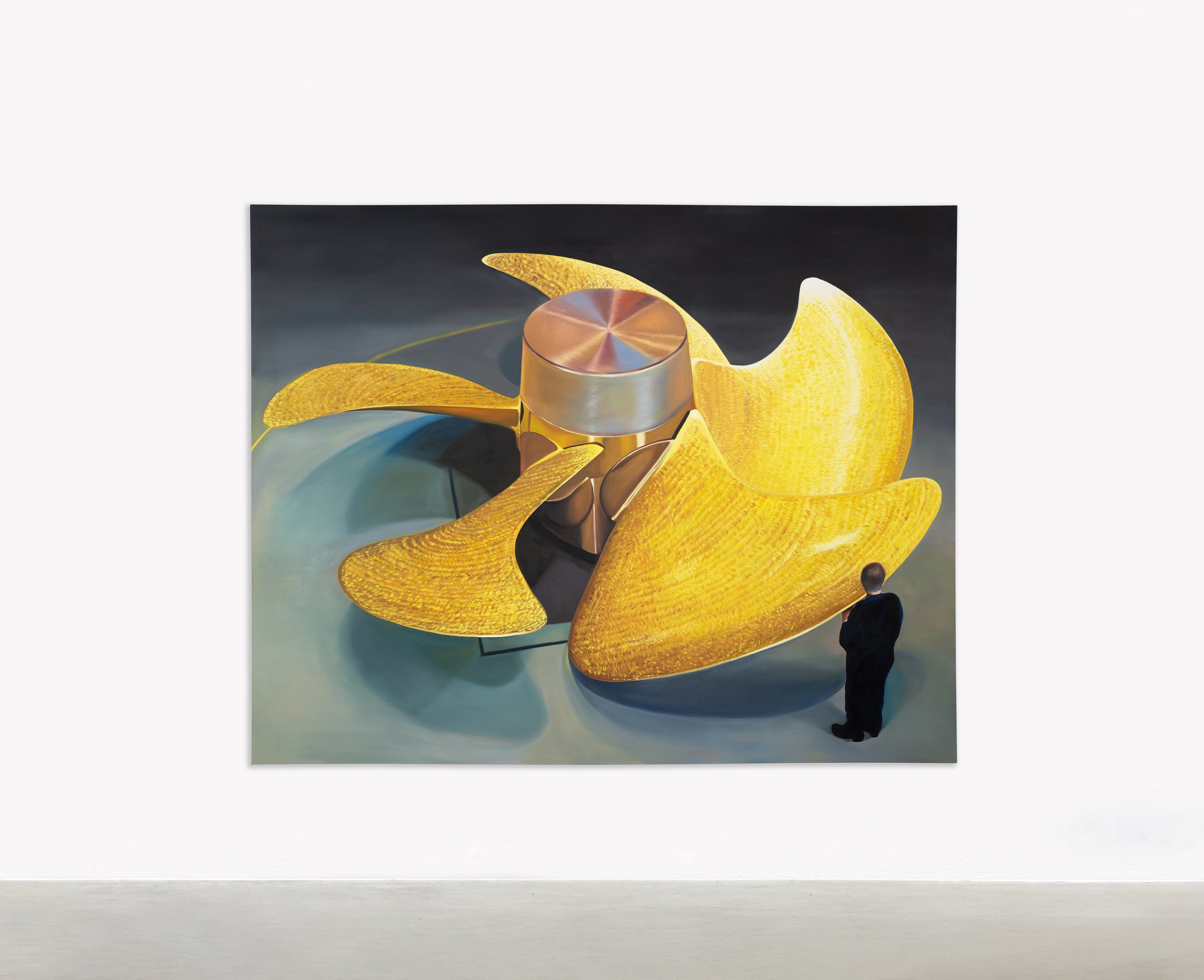
In the first work of The Wave series, Tan Mu placed a small human figure beside the massive propeller. The figure served as a point of reference, allowing viewers to physically sense the magnitude of the machine. The Wave 02 removes the figure. The propeller occupies the canvas alone, without a human body to establish scale. The absence is structural. Without the figure, the viewer has no external reference for the machine's size. The propeller could be one meter or eight. It could be the 1934 MoMA propeller, small enough to hang on a gallery wall, or a contemporary eight-meter blade, too large to see whole from any single vantage point. The painting holds both possibilities in suspension. The gold surface and the vertical format push toward the monumental, but the absence of a figure means the viewer must supply the body that measures the machine. This is the painting's final argument: that the relationship between human and machine is not given. It must be constructed, moment by moment, by each viewer who stands before the canvas and reckons with the scale of what moves them and what they, in turn, worship. The propeller turns. The water churns. The gold holds its light. And the viewer stands below, measuring the distance between reverence and the cost of moving forward.