The Pattern That Hides: Tan Mu's Privacy 1 and the Stamp That Made Concealment Visible
Li Yizhuo, writing about Tan Mu's early paintings in 2022, observed that the canvases "do not aim at diagnosing the modern spectacles from a distance. They conjure up a kind of vitality and depth of their own." The observation was about the DAWN exhibition, but it touches something that runs through the entire practice: Tan Mu does not stand apart from the systems she paints, diagnosing them like a technician reading a monitor. She enters them. She reproduces their logics in paint, on linen, at the scale of the human body, until the system's operations become something a viewer can see and feel rather than merely understand. Privacy 1 (2021) takes this approach further than almost any other work in the practice, because the system it enters is itself a system of concealment. The painting does not depict privacy. It enacts the logic of privacy, and in doing so it makes something visible that is normally defined by its invisibility: the pattern that hides.
The painting measures 36 x 28 cm (14 x 11 in), acrylic and ink on linen, a small format that Tan Mu has used for works of concentrated intensity throughout her practice: TRINITY TESTING (2020), Off (2019), Vision (2020), MRI (2021), Moldavite (2020), all at this same scale. The intimacy of the dimensions matters. A privacy protection stamp, the tool that generated this painting's surface, is itself a small object, something held in one hand and rolled across a document. The painting matches the stamp's scale rather than the stamp's subject. Cybersecurity, data encryption, and the exposure of personal information are vast, systemic, global in their reach. The painting that addresses them is small enough to hold in two hands. This is not a contradiction. It is a structural decision. The stamp operates at the scale of the individual document, the single envelope, the personal letter that needs its address concealed before it is discarded. The painting operates at the same scale. It does not generalize about privacy in the abstract. It shows what privacy looks like when it is applied to a single surface, one document at a time, one roll of the stamp at a time.
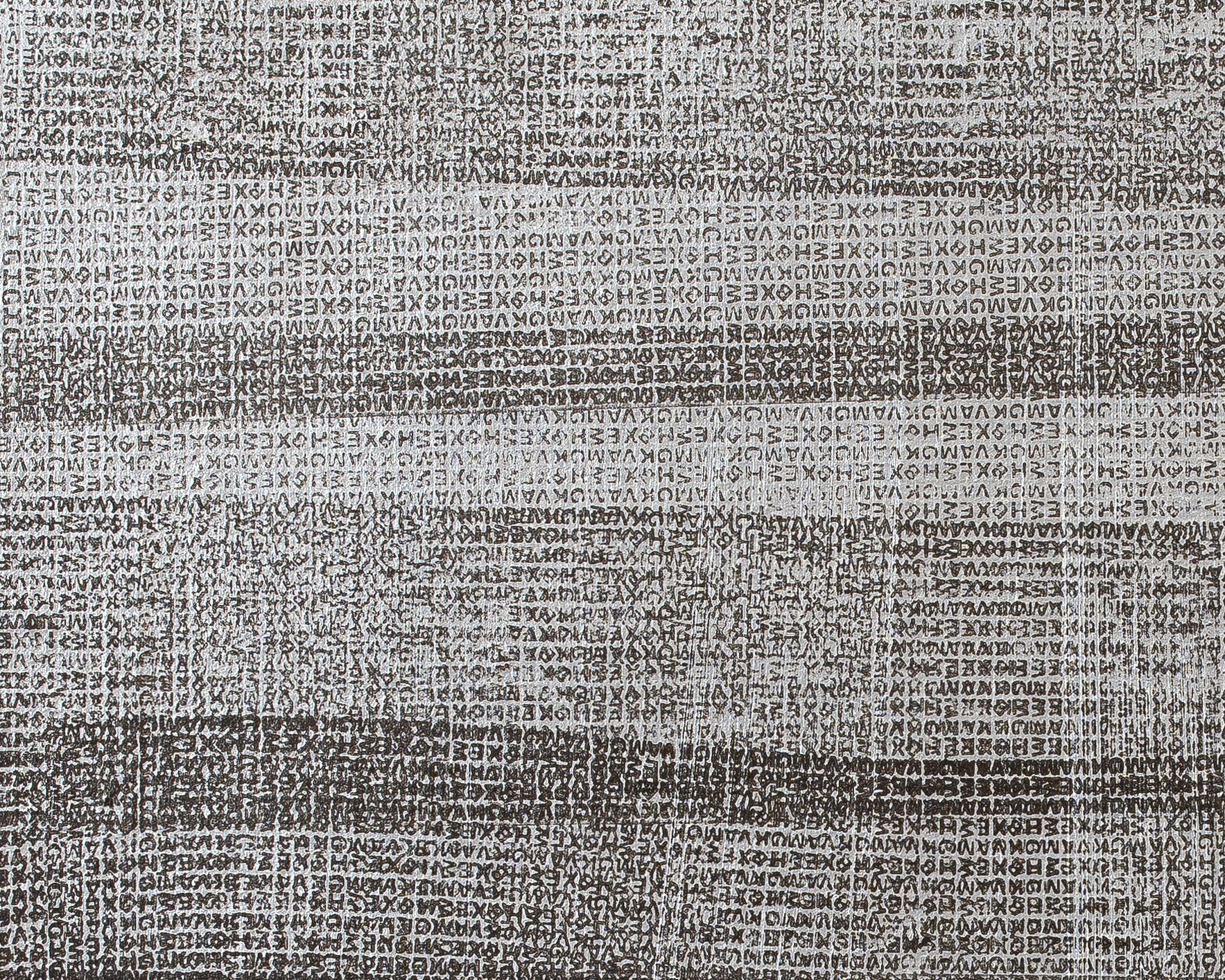
The surface of Privacy 1 is built from two materials that do not behave the same way. The base is gold acrylic, laid down in a luminous field that establishes the painting's ground and sets its tonal register. Over this gold base, ink has been applied using a privacy protection stamp, the kind of rolling stamp found in offices and homes, designed to print a pattern of overlapping letters and symbols over sensitive information so that it becomes illegible. The stamp's pattern is the painting's pattern. Each roll of the stamp deposits a band of inked characters across the gold surface, and these bands overlap, intersect, and layer until the surface reads as a dense, rhythmic field of fragmented text. From across a room, the painting appears ornamental, almost decorative, a grid of repeating marks against a metallic ground. Up close, the individual characters become legible: letters, numbers, and symbols, the remnants of the alphanumeric code that the stamp was designed to print. These characters are not random. They are the stamp's functional output, the pattern that privacy protection tools produce to obscure personal data. Tan Mu has transferred this functional pattern onto linen, and in doing so she has transformed a tool of concealment into a tool of composition.
The gold acrylic base does more than provide a ground. Gold, as Tan Mu has noted in discussing her Wave series, carries symbolic weight associated with reverence, power, and devotion. In Privacy 1, the gold serves a different function. It makes the ink pattern legible by providing maximum contrast. The dark ink of the stamp reads sharply against the bright gold, and this contrast ensures that the pattern of concealing marks is itself never concealed. The painting thus establishes a paradox at the level of its materials: the gold makes the hiding visible. The ink, whose functional purpose is to obscure information, becomes the information. The stamp, designed to make text unreadable, produces a pattern that is itself eminently readable as pattern. The painting turns the act of concealment inside out and displays it as a surface. This is not a metaphor about privacy. It is an enactment of privacy's visual logic, rendered in the specific materials that privacy tools themselves employ.
Jenny Holzer's Redaction Paintings (2006) use declassified United States government documents obtained through Freedom of Information Act requests. The documents, many of them from the Department of Defense and the Department of Justice, arrive heavily redacted: entire paragraphs, names, dates, and locations obscured by broad black bars applied by government censors before release. Holzer reproduces these documents as silkscreen paintings on linen, enlarging them to a scale that makes the redaction bars the dominant visual element. The viewer sees official letterhead, bureaucratic language, and between these fragments of legibility, wide black rectangles where information has been removed. The redaction bars are not Holzer's additions. They are the government's own marks, the visual record of a decision to conceal. By reproducing the documents as paintings, Holzer removes them from the archive and places them in the gallery, where the redaction bars become compositional elements: dark shapes against white paper, their proportions and positions determining the painting's visual rhythm.
Tan Mu's Privacy 1 and Holzer's Redaction Paintings share a structural insight: in both, the mark of concealment becomes the painting's subject. But they differ in a crucial way. Holzer's redactions are imposed from above, by a government authority deciding what the public may not see. The black bars are the trace of institutional power, the visual residue of a decision made by someone other than the viewer or the subject of the document. Tan Mu's stamp marks are imposed by the individual, on their own documents, for their own protection. The privacy stamp is a tool of self-redaction. It is the individual who rolls it across a bank statement or a prescription label before discarding it, choosing what to hide and when. The stamp democratizes concealment. It gives anyone the power to obscure their own information, and it does so through a pattern that is neither personal nor unique but standardized, mass-produced, identical from one roll to the next. This is the paradox the painting makes visible: the tool that protects individual privacy does so through a pattern that belongs to no one in particular, a generic mask applied to specific secrets. The stamp's pattern is the same whether it conceals a Social Security number, a prescription for blood pressure medication, or a love letter. The concealment is personal. The pattern is collective.
The painting's subject, as Tan Mu describes it, is the intersection of control, chance, and obscured information. The privacy protection stamp, a device that became widely available in the early 2000s as identity theft concerns accelerated, operates by printing a layered pattern of characters, usually a random-looking string of letters, numbers, and symbols, over the sensitive area of a document. The pattern is designed to be optically dense enough that the underlying text cannot be read by the naked eye or reproduced by a scanner, while the ink itself bonds with the paper fibers so that the concealment cannot be peeled away. Early versions of these stamps used simple cross-hatching, but as scanning resolution improved, manufacturers added alphanumeric characters to increase the visual noise, making the pattern harder for optical character recognition software to penetrate. The result is a tool whose effectiveness depends on the same principle that governs encryption: the pattern is public and standardized, but the specific information it obscures is rendered inaccessible by the density and overlap of the concealing layer. The stamp generates patterns that sit at the boundary between randomness and order. The letters and symbols are real alphanumeric characters, drawn from the stamp's inked roller, but their arrangement on any given surface is determined by the pressure of the hand, the angle of the roll, the overlap of successive passes. No two applications produce exactly the same pattern, even though the stamp itself is mechanically identical each time. This balance between randomness and order mirrors the structure of encryption. In cryptography, the encryption algorithm is public, standardized, and known to all parties. The key, the specific value that determines how the algorithm scrambles the plaintext, is what makes each encryption unique. The stamp functions similarly. The pattern it produces is the algorithm. The specific application, the pressure and angle and overlap, is the key. The painting captures this interplay between the standardized and the particular, the mechanical and the manual, the pattern that is always the same and the application that is always different.
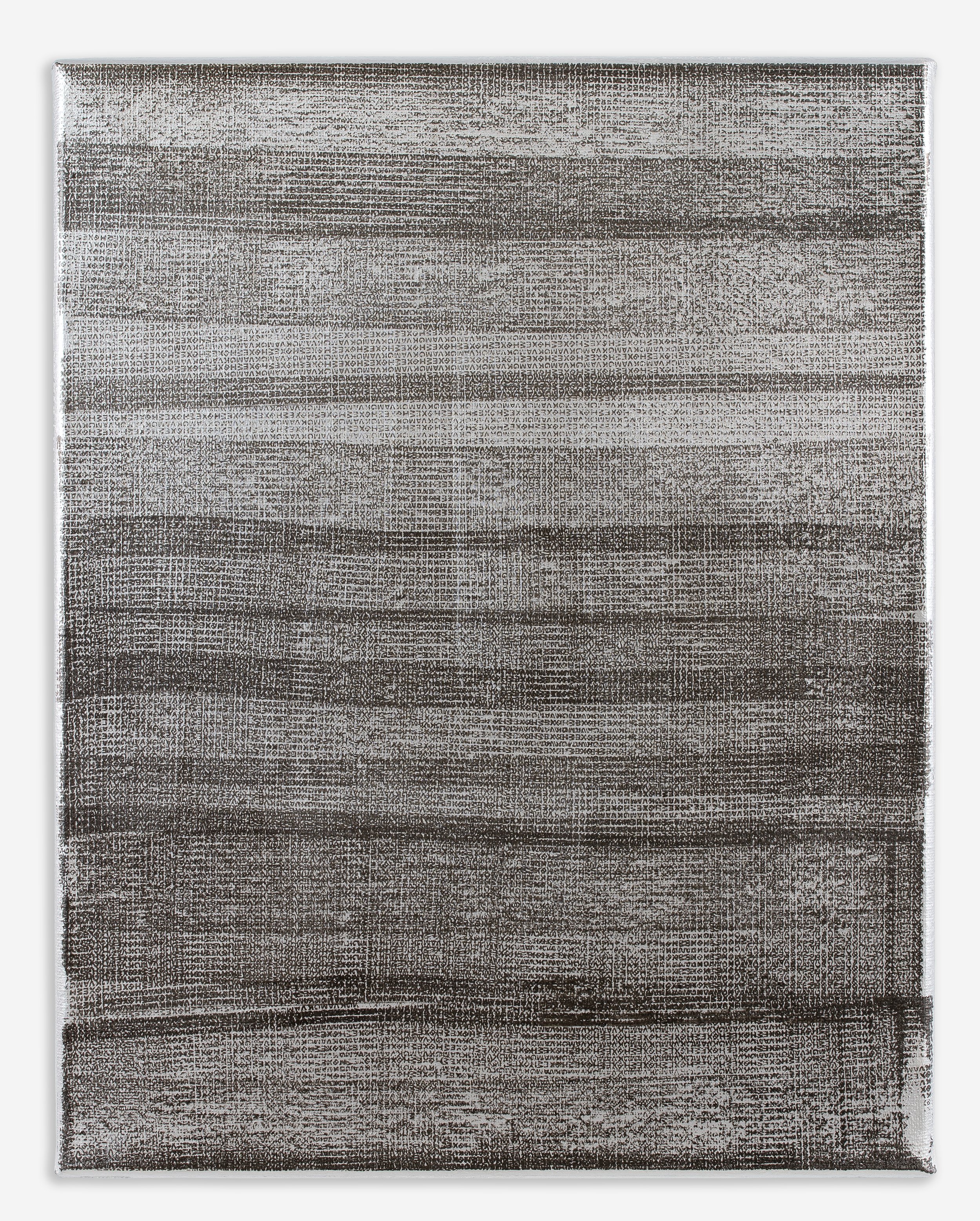
Tan Mu has described how the series emerged from her concern with privacy protection and information security in the digital age. "As personal data becomes increasingly exposed," she notes, "the act of protecting information has taken on new urgency." The Privacy series includes two works, one in gold and one in silver. In the silver work, she explains, letters and symbols remain legible when viewed up close, while in the gold work, the information becomes more difficult to decipher. The difference between the two is not in the stamp pattern, which is the same, but in the ground. Gold provides higher contrast, pushing the ink marks toward visual density, making the individual characters harder to read. Silver, reflecting less sharply, allows more of the underlying characters to show through. The two works thus demonstrate that the legibility of concealed information depends not on the concealing pattern alone but on the surface against which it is read. The same stamp, applied with the same pressure, produces different levels of concealment depending on whether the ground is gold or silver. Privacy is not an absolute condition. It is a relationship between the mark and the ground, between the information and the context in which it appears.
Sigmar Polke began making his Rasterbilder, or raster paintings, in the mid-1960s. These works use the halftone dot grid of newspaper and magazine reproduction as their primary visual element. Polke would select a photographic image from mass media, enlarge its halftone screen until the individual dots became visible, and then paint the dots by hand on canvas, sometimes altering their size, spacing, or color. The raster dot, in Polke's hands, became both subject and method. It was the mechanical means by which images were reproduced for mass consumption, and it was the visual element that, when enlarged past the point of legibility, dissolved the image into pure pattern. The raster paintings oscillate between representation and abstraction, between the photograph they depict and the dots that constitute it, and this oscillation is not a failure of the painting but its content. Polke was showing that the image is always mediated, that the dots are not an obstacle between the viewer and the photograph but the material through which the photograph exists.
Tan Mu's stamp marks function in a related way. The privacy stamp's pattern of letters and symbols operates as a kind of halftone screen for sensitive information. Just as the halftone dot both constitutes the newspaper image and obscures its photographic detail when enlarged, the stamp pattern both constitutes the visual surface of Privacy 1 and obscures the specific information it was designed to protect. But where Polke's raster dots reveal the mechanics of mass reproduction, Tan Mu's stamp marks reveal the mechanics of concealment. The halftone dot makes the image possible. The stamp mark makes the hiding visible. Polke enlarged the dot until it became the painting. Tan Mu layers the stamp until it becomes the composition. Both artists take a mechanical, functional, mass-produced visual element and treat it as material for painterly investigation. Both refuse the distinction between the tool and the art. The stamp is not the means by which the painting depicts privacy. The stamp is the privacy, transferred from its functional context onto linen, where its pattern, its rhythm, its balance of randomness and order, become available to the eye in a way that they never are on a discarded envelope.
The stamp, as Tan Mu describes it, is both a functional and a symbolic instrument. "By transferring this everyday security tool into painting," she explains, "I wanted to elevate an invisible protective gesture into a visible visual structure." The phrase "invisible protective gesture" identifies exactly what is at stake. When someone rolls a privacy stamp across a document, the gesture is private in every sense: it is done alone, it is done to protect something personal, and the pattern it produces is designed to be glanced at and then discarded along with the document it protects. No one frames a stamp-rolled envelope. No one hangs it on a wall. The stamp's pattern exists to be thrown away. Tan Mu takes this disposable, private, throwaway pattern and renders it permanent and public. She takes the invisible gesture of protection and makes it the visible subject of the painting. The gold ground reinforces this elevation: a material associated with value, preservation, and permanence now underlies the marks of a tool designed for the trash. The painting holds what the stamp was meant to discard.
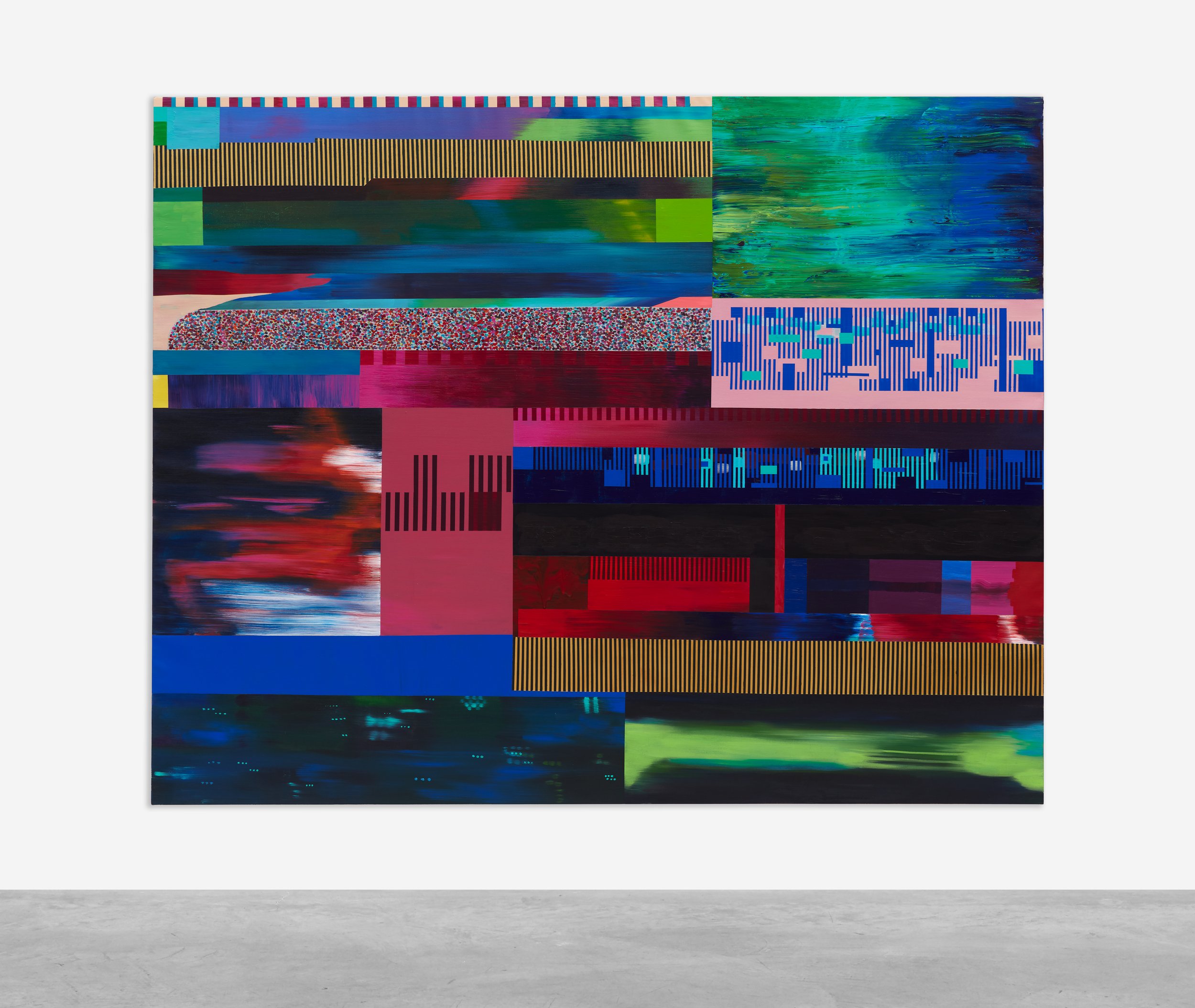
Tan Mu positions Privacy 1 within a broader framework of information systems. Works like NO SIGNAL (2019), Off (2019), and LOADING... (2019) address moments of disconnection and uncertainty, while Share (2021), Signal (2024-2025), and Memory (2019) focus on the transmission and accumulation of information. The Privacy series and The Glitch (2022-2023) concentrate on data security and vulnerability. The Glitch reflects moments when systems fail, leak, or break down. Privacy emphasizes concealment, protection, and control. Together, these works form what Tan Mu describes as an ongoing examination of cybersecurity and the ethics of information technology. The framework is not incidental. It connects Privacy 1 to the same systems that govern submarine cable networks, quantum computers, and satellite imagery across the practice. Information is transmitted, stored, interrupted, or protected. Privacy 1 occupies the "protected" position in this sequence, and the painting's visual logic reflects this. The stamp marks create a surface that is complete, that covers everything beneath it, that denies access to the information it conceals. It is the visual equivalent of a closed system: no gaps, no leaks, no moments of transparency. The gold ground ensures that this closure reads not as absence but as density. There is nothing empty about this painting. The pattern fills the surface. The concealment is total, and its totality is the point.
The scale of the painting, 36 x 28 cm, returns the viewer to the intimacy of the gesture. This is the size of a personal document, a letter, a bank statement, a page from a medical record. The painting does not monumentalize privacy. It keeps it at the scale of the individual hand, the individual stamp, the individual document that needs protection before it goes into the trash. This is where the painting's argument becomes most precise. Privacy, in the digital age, is discussed as a systemic issue: data breaches, surveillance capitalism, the harvesting of personal information by platforms and governments. These are vast, structural forces that operate at scales no individual can control. The stamp operates at the opposite end of this spectrum. It is the individual's tool, the small, cheap, handheld device that one person uses to protect one piece of paper. The painting does not deny the systemic forces. It situates the individual gesture within them. The stamp is inadequate to the scale of the problem. It cannot protect a database. It cannot encrypt a transmission. It cannot stop a government from collecting metadata on millions of phone calls. But it is what the individual has. It is the tool that fits in the hand, and the painting, at 36 x 28 cm, fits in the hand too. The pattern that hides, rendered in ink on gold, at the scale of a document, is not a solution to the crisis of privacy. It is a record of what protection looks like when it is small enough to hold.