The Infinite That Fits on a Canvas: Tan Mu's Fractal 2 and the Paradox of Simple Rules
The Mandelbrot set is generated by a rule that a child could follow. Pick a complex number, call it c. Square it, add c, square the result, add c again, and repeat. If the sequence of numbers stays bounded, if it never flies off toward infinity, then c belongs to the set. If it escapes, c does not belong. That is the entire procedure. No calculus, no differential equations, no physical measurement. One arithmetic operation repeated until it either settles or runs away. The set that this rule produces, however, contains structures of such staggering complexity that mathematicians have been exploring it for over four decades and have not reached its boundary. Every magnification reveals new detail, new filaments, new miniature copies of the whole embedded in the boundary region, each one surrounded by its own halo of ever-finer structure. The set is finite. It fits inside a circle of radius two. And it is infinite. No amount of magnification exhausts its detail. Tan Mu's Fractal 2 (2019) takes this paradox as its subject: the infinite that emerges from the simple, the boundless detail that arises from a rule you could write on a napkin.
The painting measures 72 x 60 inches (182.9 x 152.4 cm), oil and acrylic medium on linen, a horizontal format that spreads the composition wide across the wall. This is the largest of the three Fractal paintings, all executed in 2019, and the scale matters. The Mandelbrot set, when rendered on a computer screen, fills a rectangular frame whose edges are arbitrary, dictated by the limits of the monitor rather than the limits of the set itself. Tan Mu's canvas enacts a similar constraint. The composition fills the rectangle, but the structures at its edges do not terminate. They suggest continuation beyond the frame, as though the painting were a window into a mathematical object that extends in all directions without end. The horizontal format emphasizes this lateral spread, the way fractal structures propagate outward from a central mass, sending branches and filaments into the surrounding space that mirror the parent structure at decreasing scales.
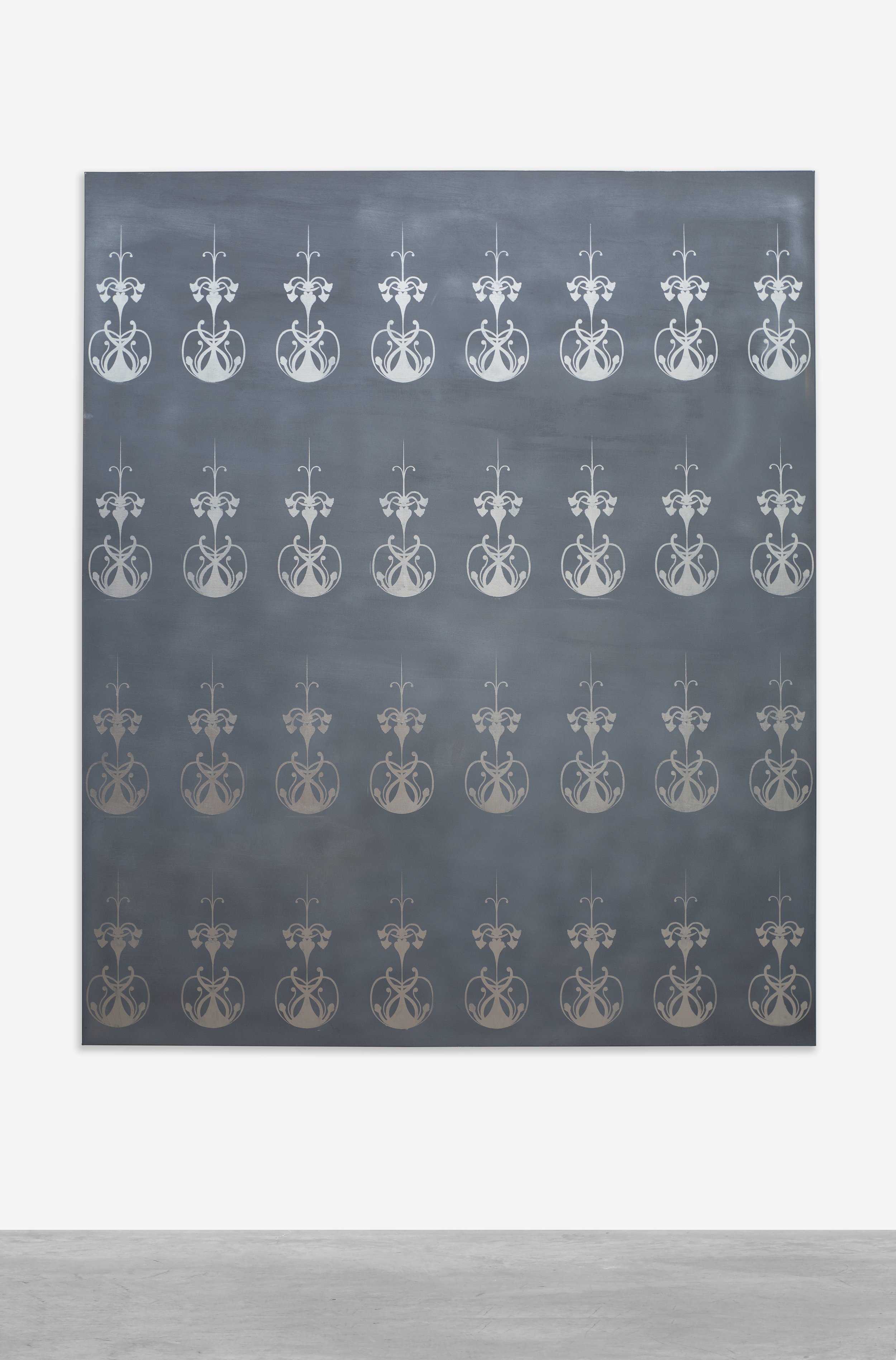
The surface is built from two materials that behave differently. The oil paint provides depth, saturation, and the capacity for fine detail. The acrylic medium provides transparency, build-up, and the ability to layer without muddying the colors beneath. Together they create a surface that operates at multiple depths. The dark central mass, corresponding to the interior of the Mandelbrot set where the iteration stays bounded, is built from layers of deep blue-black oil paint, dense and luminous, absorbing light rather than reflecting it. The surrounding filaments and branches, corresponding to the boundary region where the iteration escapes at different rates, are rendered in acrylic medium mixed with pigment, producing translucent veils of color that float above the darker ground. Blues, greens, and violets predominate, punctuated by flashes of warmer tones at the points where the iteration accelerates, where the boundary becomes most intricate. These warm accents are not decorative. They correspond to the fastest-escaping regions of the set, the points where the mathematical process runs away most quickly, and they register as visual intensity precisely because the mathematics registers them as velocity. The painting translates the rate of escape into color temperature. The result is a surface that feels alive with pressure, as though the mathematics were still running, still iterating, still generating new detail beyond the resolution of the canvas.
At arm's length, the acrylic layers reveal their translucency. The dark ground shows through, and the boundary structures read as luminous filigree over a deep field, the way the Mandelbrot set's boundary looks in high-resolution renderings: a dark interior surrounded by bands of color that shift from warm to cool as the escape velocity changes. The acrylic medium allows Tan Mu to build these bands as semi-transparent washes, each one carrying information about a different rate of escape, layered over the ground so that the eye reads the accumulation rather than any single stratum. The linen substrate shows through in places, its weave establishing a faint grid beneath the composition, a reminder that the infinite structure is rendered on a finite material support. The weave is the painting's confession: no matter how much detail the brush accumulates, the canvas has a grain, and the grain is the limit beyond which the painting cannot go. The mathematics, of course, has no such limit. Each magnification generates new structure ad infinitum. The painting knows this. It offers as much detail as its surface can hold, and the linen grain, visible in the thinnest passages, marks the boundary where the finite medium yields to the infinite subject.
Hilma af Klint painted The Ten Largest in 1907, a series of ten monumental canvases depicting the cycle of life from youth to old age. The works range in size up to 320 centimeters tall, and their surfaces are covered with spiraling forms, concentric circles, radiating discs, and organic shapes that suggest both botanical structures and celestial mechanics. Af Klint, who had been producing abstract paintings since 1906, several years before Kandinsky's first acknowledged abstractions, described her work as receiving messages from higher spirits, and she understood the spiral as a fundamental form of cosmic and biological development. In The Ten Largest, No. 7, Adulthood, the dominant motifs are large disc forms bisected by vertical and diagonal lines, surrounded by smaller circles and radiating petal shapes, all rendered in a palette of pale blues, yellows, pinks, and greens against a luminous white ground. The painting does not illustrate a theory. It presents a visual logic in which growth, expansion, and interconnection are structural principles rather than narrative events. The disc is not a symbol of adulthood. It is the form that adulthood takes when its organizing logic is made visible.
The connection between af Klint and Fractal 2 is not one of style. Af Klint's palette is pastel and her ground is white; Tan Mu's palette is deep and her ground is dark. Af Klint's forms are discrete, floating in space; Tan Mu's forms emerge from a continuous mathematical process that produces them as boundary phenomena. The connection is structural. Both artists are working with the visual logic of recursion: the principle that the same pattern of growth or organization appears at multiple scales, that the large form contains the small form, that the part mirrors the whole. Af Klint arrived at this logic through spiritualist practice and botanical study. Tan Mu arrives at it through mathematics. The Mandelbrot set's defining property is that its boundary contains miniature copies of the entire set, each one surrounded by its own boundary of ever-finer detail. This is self-similarity: the same structure at every scale. Af Klint's discs and spirals operate on the same principle, not because she derived them from mathematics but because the visual logic of growth, whether biological or cosmic, follows recursive patterns. The embryo divides, the spiral galaxy rotates, the fractal boundary iterates. Different sources, same structure. The painting makes this structural kinship visible without reducing it to a single explanation.
The Mandelbrot set, as Tan Mu describes it, demonstrates how extremely simple mathematical rules can generate endlessly complex structures. The Buddhabrot, a variation on the Mandelbrot set that maps the probability distribution of trajectories escaping the fractal, adds a further dimension to this complexity. Where the standard Mandelbrot rendering colors each point according to how quickly its iteration escapes, the Buddhabrot accumulates the paths of all escaping trajectories, producing an image that resembles the seated posture of a classical Buddha figure. Tan Mu notes this resemblance explicitly: the Buddhabrot's distribution of trajectories "often resembles the posture and symbolic presence of classical Buddha figures, creating an unexpected connection between mathematics, visual form, and spiritual contemplation." This is not a decorative coincidence. The Buddhabrot's resemblance to a meditating figure emerges from the same iterative process that generates the Mandelbrot set's boundary complexity. The mathematics does not know about Buddha figures. It does not know about anything. It iterates a function and records which points escape and which do not. The fact that the accumulation of these trajectories produces a shape that the human eye recognizes as a seated figure is a property of the mathematics itself, not an interpretation imposed on it. The shape is there in the numbers. Painting it does not add a spiritual reading that the mathematics lacks. It reveals the spiritual reading that the mathematics already contains.
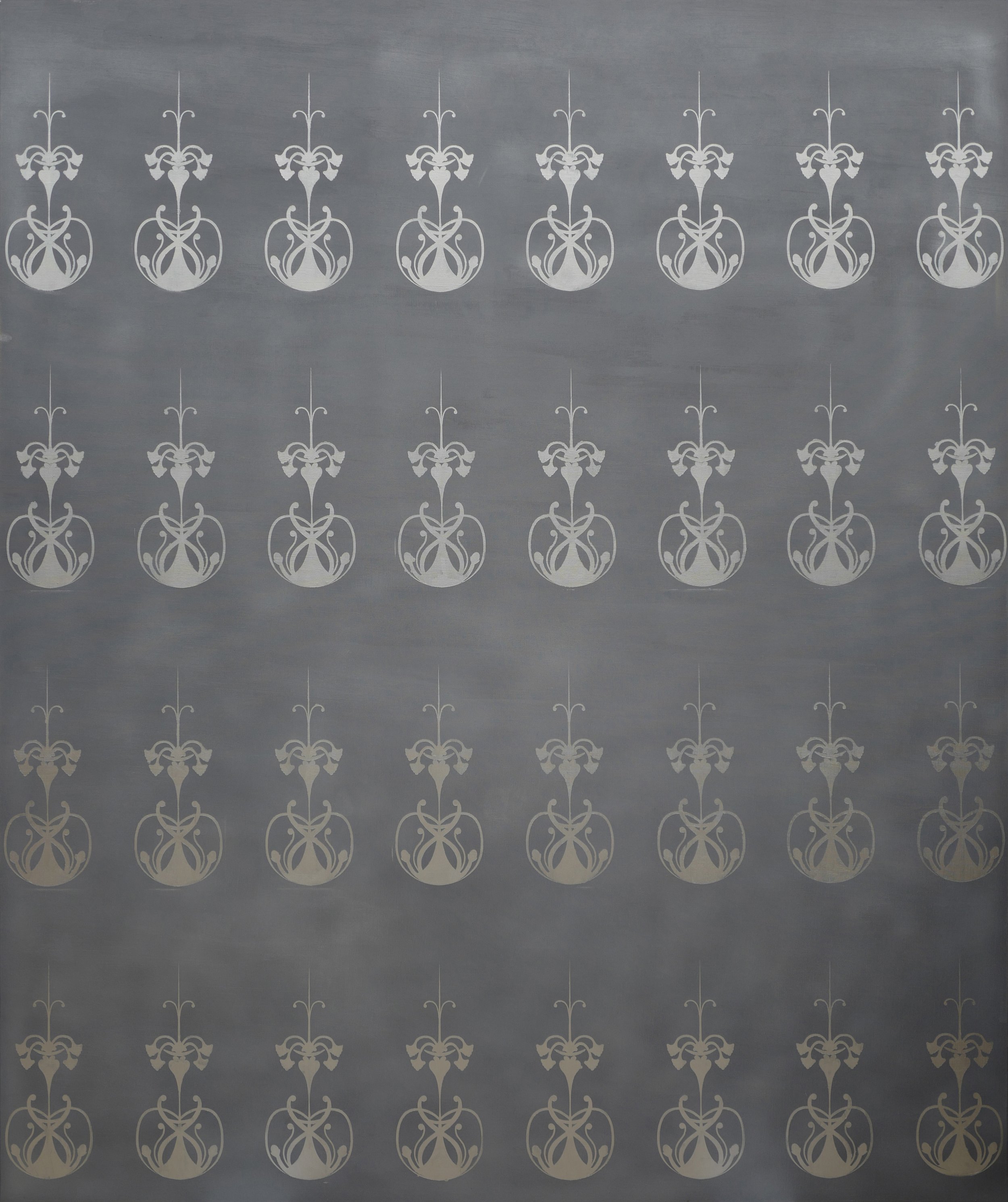
The set's defining paradox, that an object generated by a procedure simple enough to state in one sentence contains detail sufficient to occupy mathematicians for decades, is also the painting's defining paradox. Tan Mu has described how each magnification of the Mandelbrot set is "not simply a closer look at something fixed but the generation of an entirely new image." This observation has direct implications for how Fractal 2 operates as a painting. A landscape, seen from closer, reveals more detail about the same fixed object. A fractal, seen from closer, generates new structure. The closer you get, the more there is. This is why the painting rewards sustained looking. The acrylic layers, with their semi-transparency and their variation in color temperature, produce an effect of depth that is not perspectival but iterative. The eye does not look through the painting to a distant horizon. It looks into the painting, the way one looks into a Mandelbrot set rendering, always finding more structure at the edge of resolution. The warm flashes at the boundary, the cool bands further out, the deep interior that absorbs light: these are not color choices applied to a pre-existing composition. They are translations of the iteration's behavior into visual terms, and their arrangement on the canvas follows the logic of the set, not the logic of compositional balance.
Agnes Martin spent most of her career painting grids. Not the agitated grids of urban architecture or data visualization, but luminous, barely-there grids drawn in pencil on fields of pale wash, horizontal and vertical lines that extend to the edge of the canvas and stop. Martin described her grids as representations of innocence, of freedom from the demands of the ego, of the experience of joy that precedes thought. Untitled #10 (2001), one of her last paintings, presents a field of horizontal bands in pale blue and white, so subtle that the colors shift depending on the light in the room and the angle of the viewer's position. The painting refuses to declare itself. It is there, and it is almost not there. The grid lines, drawn in graphite, are visible only at close range. From across the room, the painting reads as a single expanse of atmospheric color, a blue that is also a white that is also a silence.
Martin's grids and Tan Mu's fractals share a commitment to the visual logic of recursion, but they arrive at it from opposite directions. Martin reduces. She strips away everything that is not the grid: narrative, representation, gesture, the trace of the hand. What remains is the simplest possible statement of structure, a structure so reduced that it borders on disappearance. Tan Mu multiplies. She begins with a simple rule, the iterative function that generates the Mandelbrot set, and allows it to produce as much complexity as the canvas can hold. The result is not reduction but proliferation: more detail, more boundary, more filigree, more structure at every scale. Both approaches lead to the same insight, which is that the simplest structures, when allowed to operate, produce results that exceed any individual act of composition. Martin's grid, drawn line by line with a ruler, generates a visual field that no single line could produce on its own. Tan Mu's fractal, painted stroke by stroke with oil and acrylic, generates a visual field that no single stroke could produce on its own. The painting is the accumulation. The rule is simple. The result is not.
Yiren Shen, in her 2025 conversation with Tan Mu for 10 Magazine, described the artist's approach as one of mapping: "each composition of lines and dots full of tension and anticipation." The Fractal series does not map a territory in the geographic sense. It maps a mathematical process, and the territory it maps is the set of all points that stay bounded under iteration. This territory has no physical location. It exists in the space of complex numbers, a two-dimensional plane where every point is a number and every number is a potential test case for the rule. The painting is a rendering of a portion of this abstract space onto a physical surface. The rendering requires choices: how deep to iterate, how to assign colors to escape velocities, how to frame the set within the rectangle of the canvas. These are painterly choices, not mathematical ones. The mathematics does not specify a color palette. It does not mandate oil and acrylic on linen. It does not suggest a horizontal format. The painting is the intersection of a mathematical object and a series of decisions about how to make that object visible. Tan Mu's decisions, her choice of deep blues and greens for the boundary, her use of acrylic medium for translucency, her placement of warm accents at the points of maximum complexity, constitute an interpretation of the set, not a transcription of it. The mathematics provides the structure. The painting provides the experience of looking at that structure, and the experience is not the same as the structure itself. The painting is the mathematics translated into the register of perception, and the translation, like all translations, is also a transformation.
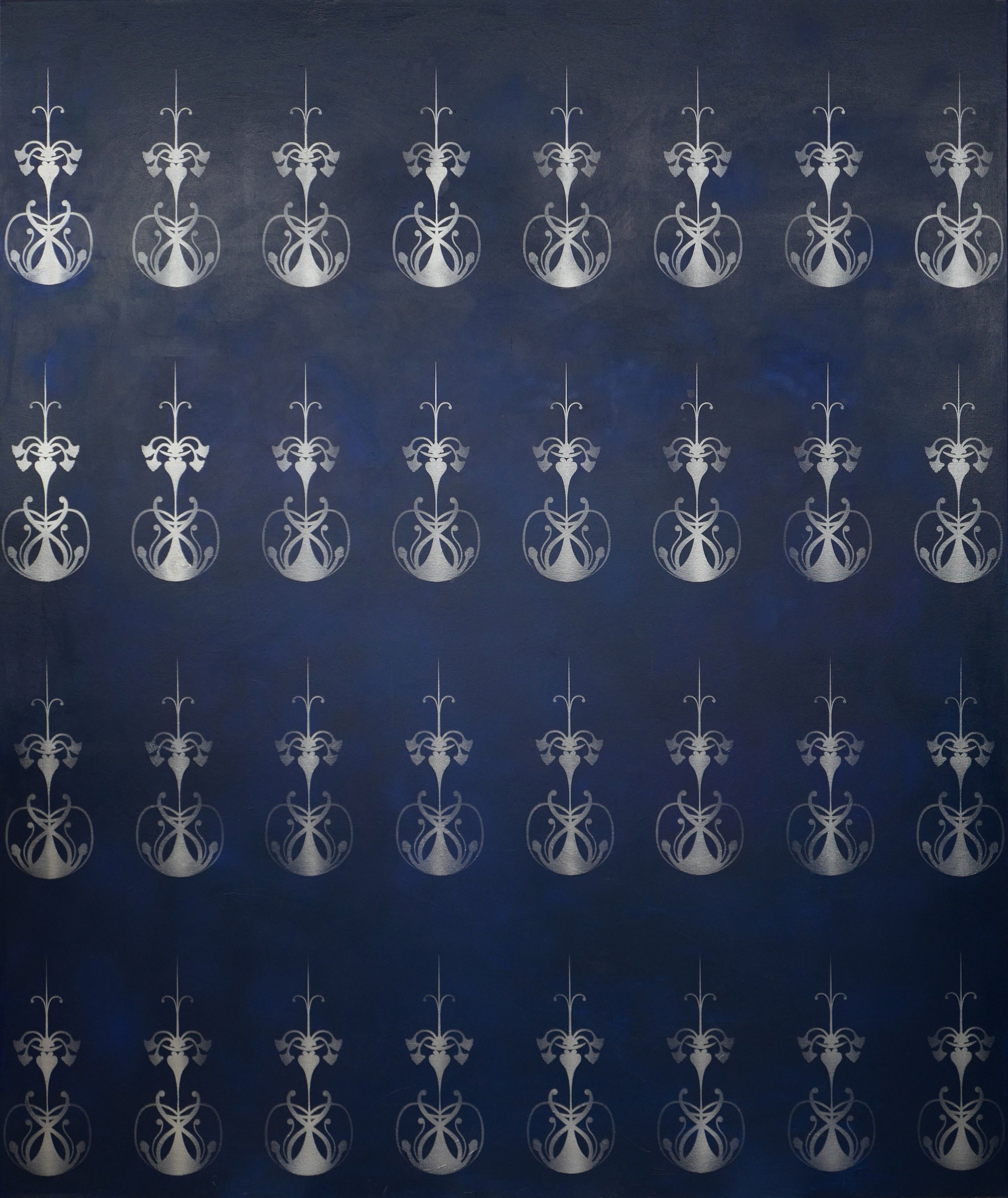
Tan Mu describes the recursive logic of fractals as reflecting how the universe operates: "The microscopic structures of atoms or neural networks echo the vast scale of galaxies and cosmic systems. It suggests a deep interconnectedness, where humans are not separate from the universe but embedded within it." This is the philosophical principle of ge wu zhi zhi, investigating things to extend knowledge, that she absorbed during her training at the China Central Academy of Fine Arts. The principle holds that understanding the particular, the small, the specific, leads to knowledge of the universal. A fractal embodies this principle with mathematical precision. Each part mirrors the whole. The detail at one scale predicts the detail at every other scale. To understand one filament of the Mandelbrot boundary is to understand the logic that generates all filaments. The painting makes this principle visual. The viewer who looks closely at a boundary region in Fractal 2 sees the same pattern of branching and rebranching that characterizes the set at every scale. The part is the whole, compressed. The whole is the part, extended. The canvas, finite as it is, holds an image of something that has no boundary. The linen grain, visible in the thinnest passages, is the reminder that the medium has limits the subject does not. And yet the subject fits on the canvas, because the Mandelbrot set is bounded. It fits inside a circle of radius two. The infinite complexity is contained within a finite boundary. The painting, 72 x 60 inches of oil and acrylic on linen, holds an image of the infinite that fits in a room, that can be looked at from across the room and then from inches away, each distance revealing a different resolution of the same recursive process. The simplicity of the rule and the boundlessness of the result are not in tension. They are the same fact, seen from different scales. The painting knows this. The dark interior and the luminous boundary are not two separate things. They are the same iteration, iterating.