The Grid That Harvests the Sun: Tan Mu's Solar Farm and the Landscape That Became a Machine
Driving on the highways near her home in Florida, Tan Mu noticed them first as peripheral geometry: dark blue rectangles arranged in long rows across flat land, their surfaces catching the sun at angles that shifted the color from near-black to electric violet depending on the hour and the direction of approach. Solar farms. Vast installations of photovoltaic panels mounted on steel racks, planted in fields that had once grown crops, stretching across acres of terrain that the Florida sun renders exceptionally productive for energy harvesting. She saw them from the car window and she saw them from the air, near airports, where the descent pattern brought the plane low enough that the panels resolved from an abstract pattern into a distinguishable grid, and then back into an abstract pattern again as the plane climbed. She photographed them with her phone. Later, she painted them. The sequence matters. The phone came first. The landscape arrived through the screen, as a screenshot, as a captured frame, before it arrived through the slower channels of oil on linen.
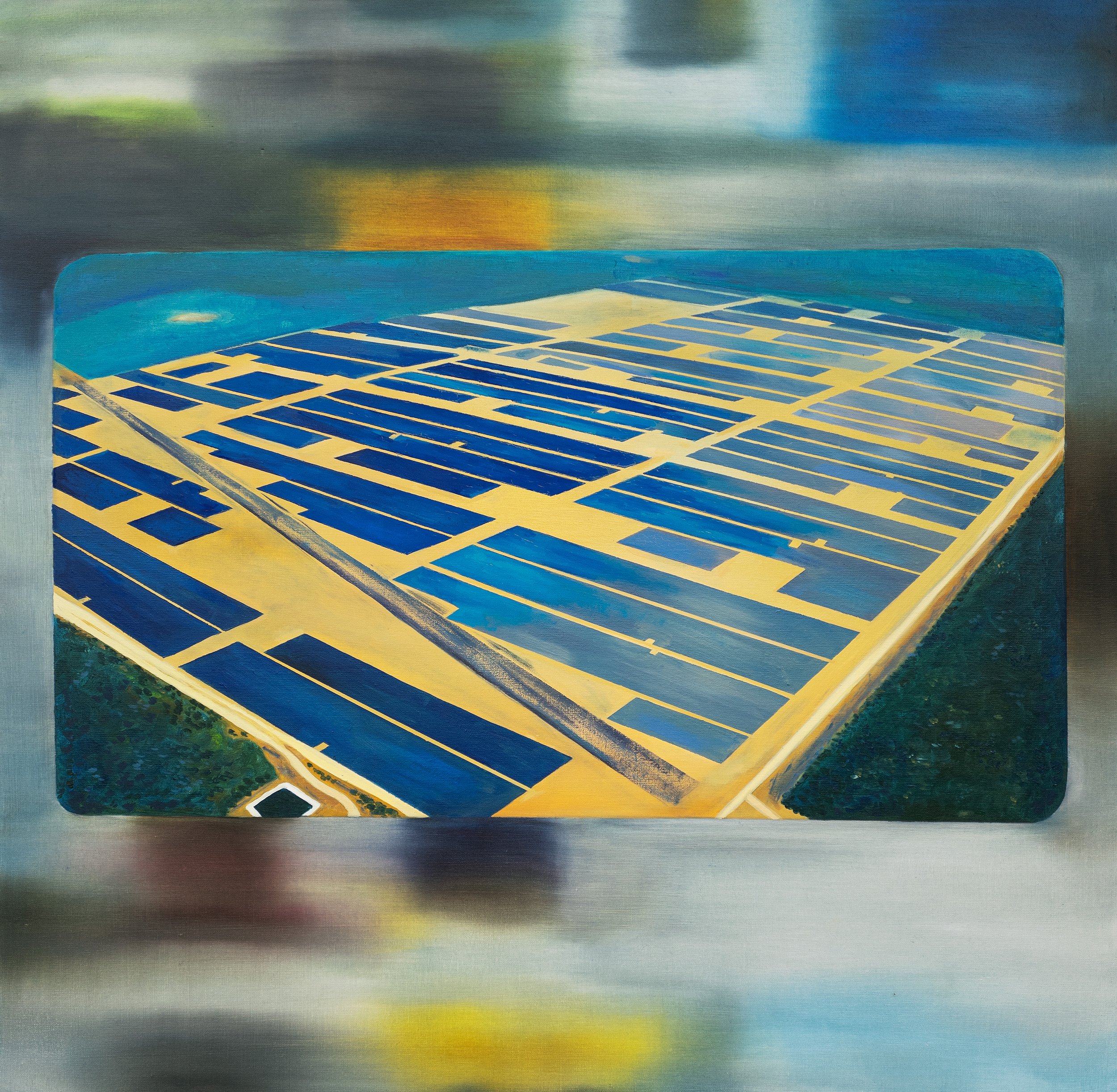
Solar Farm (2022) measures 76 x 76 cm (30 x 30 in), oil on linen, a square format that mirrors the geometry of its subject. The painting presents an aerial or slightly elevated view of a solar panel installation, the panels arranged in regimented rows across a flat terrain. The composition is structured by two competing systems of order. The panels impose a rigid grid of straight lines and right angles across the land, a geometry that belongs to engineering, efficiency, and the maximization of surface area for light capture. The surrounding environment, rendered in blurred and softened passages, resists this geometry with organic irregularity. The contrast between the two systems is not subtle. The panels are precise. The landscape is diffuse. The painting holds both in tension, and the tension is its subject: the moment when land that was once organized around the logic of agriculture is reorganized around the logic of energy extraction, and the visual field that results from that reorganization.
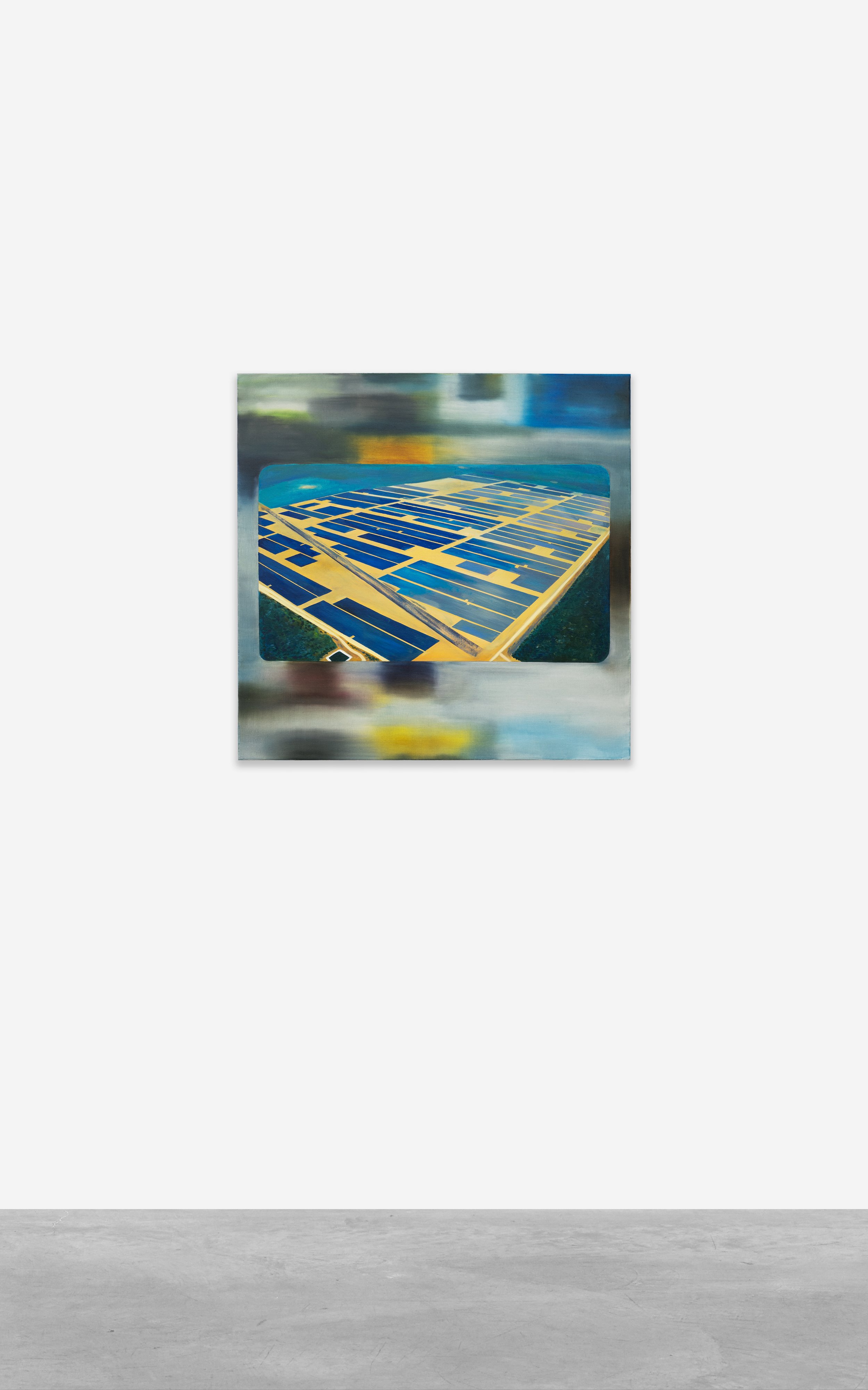
The surface of Solar Farm operates at two distances that correspond to two ways of seeing. From across a room, the painting reads as a grid: dark rectangles in regular rows against a lighter ground, the overall pattern suggesting an aerial photograph of an installation seen from a drone or a satellite. The panels appear uniform, their surfaces reflecting a consistent blue-black tone that could be mistaken for a single color field repeated across the canvas. This is the view from altitude, the view that collapses individual panels into a pattern, the view that makes the solar farm legible as a system rather than as a collection of objects. It is also the view that the phone screen delivers: compressed, flattened, legible at a glance. At closer range, the surface reveals its material intelligence. The individual panels are not painted as flat rectangles. Each one carries subtle variations in tone and reflection, shifts from deep blue to indigo to violet that register the way sunlight refracts differently across each panel depending on its angle and position. The oil paint is built up in thin layers, some translucent enough that the linen shows through, others more opaque where the reflection is strongest. The surrounding terrain, by contrast, is painted with broader, looser strokes, the greens and browns of the land dissolving into passages of blurred color that suggest the landscape as it appears through a phone screen with slight camera shake, or as it registers in peripheral vision when the eye is focused on the panels rather than the ground beneath them. The painting does not resolve this duality. It maintains it. The panels stay sharp. The land stays soft. The two systems coexist without merging.
Tan Mu has spoken about the source image for the panels being captured with a phone camera, while the surrounding environment is rendered in a more abstract and blurred manner. This contrast, she explains, reflects the way modern reality is mediated through technology. The sharpness of the panels is the sharpness of the digital image, the screenshot, the captured frame. The blur of the landscape is the blur of everything that falls outside the screen's focus, the information that the phone compresses, discards, or renders at low resolution. The painting thus becomes a record not just of a landscape but of a way of seeing that landscape: through a screen, at speed, with the selective focus that a screen imposes. The phone camera frames the panels and lets the land fall away. The painting reproduces this framing and then makes it visible as a framing, rather than allowing it to pass as the natural way the world looks. The blurred edges are not a failure of representation. They are a record of what the screen excluded.
In 1877, Claude Monet exhibited three paintings of the Gare Saint-Lazare at the Third Impressionist Exhibition. The most celebrated of these, Arrival of the Normandy Train, Gare Saint-Lazare, presents the interior of one of Paris's principal railway stations as a cathedral of iron and steam. The great glass vault of the train shed fills the upper half of the canvas, its iron ribs cutting through clouds of locomotive smoke and steam that billow upward from the engines below. The trains themselves are partially obscured by the steam, their forms dissolved into the atmospheric haze that Monet renders in blues, violets, and grays. The platforms, the figures, the architecture: all are secondary to the steam, which is the painting's true subject. Monet was not documenting a train station. He was documenting the way that industrial modernity transformed the visual field, filling it with a new kind of atmosphere, a new kind of light, a new kind of air that was not air but the byproduct of combustion.
Tan Mu has identified Monet's Gare Saint-Lazare paintings as a direct antecedent for Solar Farm. "I often think about Impressionist painters such as Claude Monet," she explains, "who documented industrial transformations in their time. His paintings of train stations and factories not only captured new technologies but later became valuable historical records. Scholars now study those works to understand environmental conditions and technological shifts of the nineteenth century." The comparison is precise. Monet painted the steam that the locomotives produced. Tan Mu paints the light that the solar panels capture. Both artists address a transformation in the relationship between human technology and the natural world. Monet's steam changes the air. Tan Mu's panels change the land. Both changes are structural, not incidental. The steam is not a temporary condition of the station. It is the station's reason for being. The panels are not a temporary installation on farmland. They are the farmland's new purpose. Monet's painting records the moment when the train station became the dominant visual experience of its neighborhood. Tan Mu's painting records the moment when the solar farm became the dominant visual experience of its terrain. Both paintings treat the technology not as an intrusion into a pre-existing landscape but as the landscape's new organizing principle, the force that determines what the eye sees first and what falls into the background.
The shift from agriculture to solar energy that Solar Farm documents is not merely a change in land use. It is a change in the kind of value that the land produces. Agricultural land converts sunlight into food through photosynthesis, a biological process that operates at the speed of growing seasons and the scale of individual organisms. Solar land converts sunlight into electricity through photovoltaics, a physical process that operates at the speed of electrons and the scale of industrial grids. The solar panel does not replace the crop. It replaces the entire logic of the crop. Where agriculture organized the land around the needs of plants, their root systems, their water requirements, their vulnerability to weather, solar farming organizes the land around the needs of the panel, its angle of incidence, its spacing for maximum coverage, its orientation toward the sun. The grid that results, the regimented rows of identical rectangles stretching across flat terrain, is the visual signature of this new logic. It is not an aesthetic overlay. It is the land's new structure, and it produces a new kind of beauty, the beauty of efficiency, of maximized surface, of the geometric regularity that results when the variable that matters most is the angle at which photons strike a semiconductor. Tan Mu describes the rigid geometry and reflective surfaces of solar panels as imposing "a new aesthetic order onto the land. It is systematic, efficient, and rational, yet undeniably artificial." The painting does not judge this order. It documents it. The panels are painted with the same precision that their manufacturing demands. The landscape around them is painted with the softness of something that has been de-prioritized, something that the new system treats as backdrop rather than subject.
Charles Sheeler's American Landscape (1930) presents the Ford Motor Company's River Rouge plant as a pristine, depopulated industrial vista. The painting is composed with the precision of a photograph. The factory buildings stretch across the horizontal canvas in a sequence of geometric volumes, their smokestacks, water towers, and conveyor systems rendered in sharp focus against a pale sky. A slag barge moves across the foreground water, small but unmistakable, the only indication that the enormous complex is operational. There are no workers visible. No smoke billows from the stacks. The water is calm. The sky is clear. The factory complex reads as a permanent fixture of the landscape, as inevitable and as organized as the river that flows past it. Sheeler, who worked as a photographer for Ford before painting this canvas, brought the camera's selectivity to the painting. He chose the angle, the light, and the crop that presented the plant at its most orderly, its most integrated with the terrain, its most landscape-like. The result is a painting that makes industry look like nature, or makes nature look like industry, or makes the distinction between the two irrelevant, because in Sheeler's composition the factory and the river and the sky all belong to the same visual order, and that order is geometric, rational, and serene.
Tan Mu's Solar Farm shares this compositional logic. The panels are arranged in rows that follow the logic of the grid, not the contours of the land. The grid is Sheeler's geometry extended to a different energy technology. Where Sheeler's factory processes iron and coal into automobiles, Tan Mu's panels process sunlight into electricity. Both paintings present the technology as the landscape's organizing principle, the force that determines what the eye sees and how the composition is structured. But where Sheeler's painting eliminates the human presence entirely, producing an image of industry without labor, Tan Mu introduces a different kind of absence. The blur that surrounds the panels is not the absence of human activity. It is the presence of the screen. The soft, dissolving passages at the edges of the composition are the visual equivalent of what happens to information when it falls outside the frame of a phone camera. The sharpness of the panels and the blur of the land replicate the selective focus of the screenshot, where whatever the camera has locked onto stays sharp and everything else falls away. This is not the absence of the human. It is the presence of the human as mediated through a device. The phone screen is the lens through which the landscape arrives, and the painting records the properties of that lens as much as it records the landscape beyond it. The blur is not a painterly effect. It is a documentary record of how the image was captured.
Danni Shen, writing about Tan Mu's practice in Emergent Magazine in 2024, positioned the paintings as reflecting "the trajectory and continuum of bodily and mediated presence through human technical developments." The phrase "mediated presence" names exactly what Solar Farm enacts. The painting does not present the solar farm as it would appear to a person standing in the field. It presents the solar farm as it appears to a person looking at it through a phone screen, which is how Tan Mu first saw it and how most people first see such installations: not in person, but as a thumbnail, a screenshot, a compressed image transmitted through a network. The painting takes this mediated experience and translates it into oil on linen, a medium that operates at a completely different speed. Where the phone image is instantaneous, captured in a fraction of a second, the painting accumulates over hours and days, each panel and each blurred passage built up through successive layers of paint. The painting does not reject the mediation. It absorbs it. The blur is preserved. The selective focus is preserved. The way the phone frames the panels and lets the land dissolve is preserved. But the speed of the phone image is replaced by the duration of the painted image, and this replacement is not a nostalgic gesture. It is a reframing. The phone delivers the landscape in an instant and discards it the next instant, swiped away to make room for the next image. The painting holds the landscape in place long enough for the viewer to notice what the phone screen excluded: the blur, the soft edges, the terrain that the grid has relegated to background.
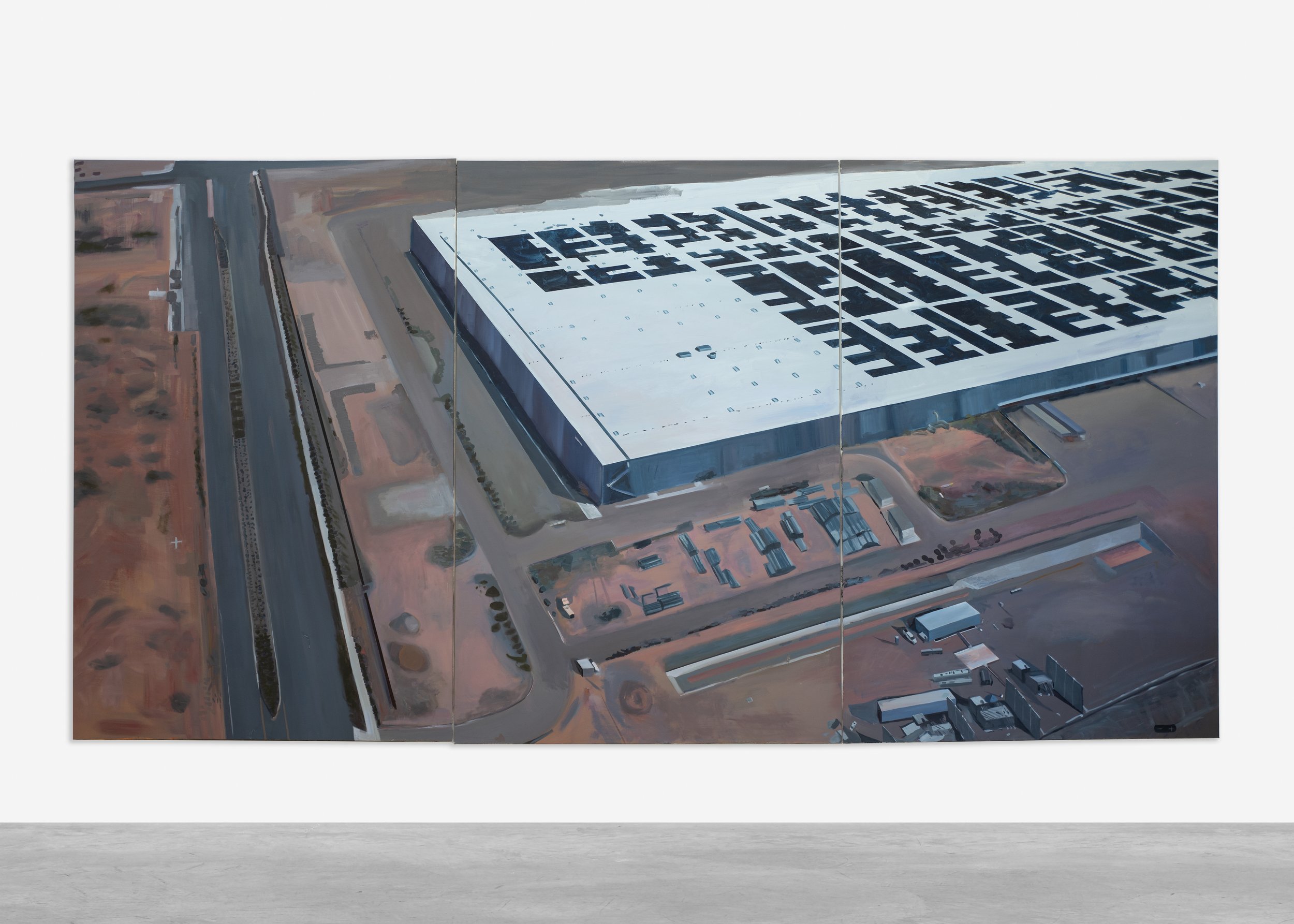
Tan Mu has described Solar Farm as the second time she depicted solar panels, following Memory (2019), which showed the rooftop of a data center covered with panels. The first painting sparked her deeper interest in the visual form of solar panels, the process of energy conversion, and their interaction with the surrounding environment. The progression from Memory to Solar Farm tracks a movement from the rooftop to the landscape, from panels as an architectural feature to panels as a geographical transformation. A rooftop is an addition to an existing structure. A solar farm is a replacement of an existing land use. Where Memory treated the panels as one element in a composition that also included the building beneath them, Solar Farm treats the panels as the composition's primary subject, with the landscape serving as the context they have absorbed and reorganized. The square format, 76 x 76 cm, reinforces this absorption. A square has no preferred orientation. It does not direct the eye left or right, up or down. It presents its contents as a field, and the field is the grid of panels, extending in all directions, limited only by the edges of the canvas. The square says: this is what the landscape looks like now. The grid is not an intrusion. The grid is the landscape.
The painting's final claim is archival. "As technology continues to evolve," Tan Mu observes, "works like Solar Farm may one day function as archaeological records of our current energy infrastructure." The word "archaeological" is precise. Archaeology studies the material remains of systems that have since been replaced or abandoned. To call a contemporary painting an archaeological record is to anticipate a time when the solar farm, like the railway station before it, will belong to a past phase of technological development, replaced by something the present cannot yet imagine. Monet's Gare Saint-Lazare paintings now serve precisely this function. Scholars study them to understand the atmospheric conditions of 1870s Paris, the design of the iron architecture, the visual impact of steam on the urban skyline. Solar Farm may one day serve the same purpose. The arrangement of the panels, the angle of their installation, the way they dominate the terrain, the way the phone screen frames them and discards the landscape around them: all of this is specific to a moment in the history of energy extraction, and the painting preserves it with the deliberateness that only a slow medium can provide. The phone image is instant and disposable. The painting holds the image in place and says: look at this longer. The grid is harvesting the sun. The screen is harvesting your attention. The painting is harvesting the moment when both of those things became the same landscape, and asking you to stay with it until you can see what the screen left out.