The Shell Around the Star: Tan Mu's Dyson Sphere and the Ambition That Outgrew the Planet
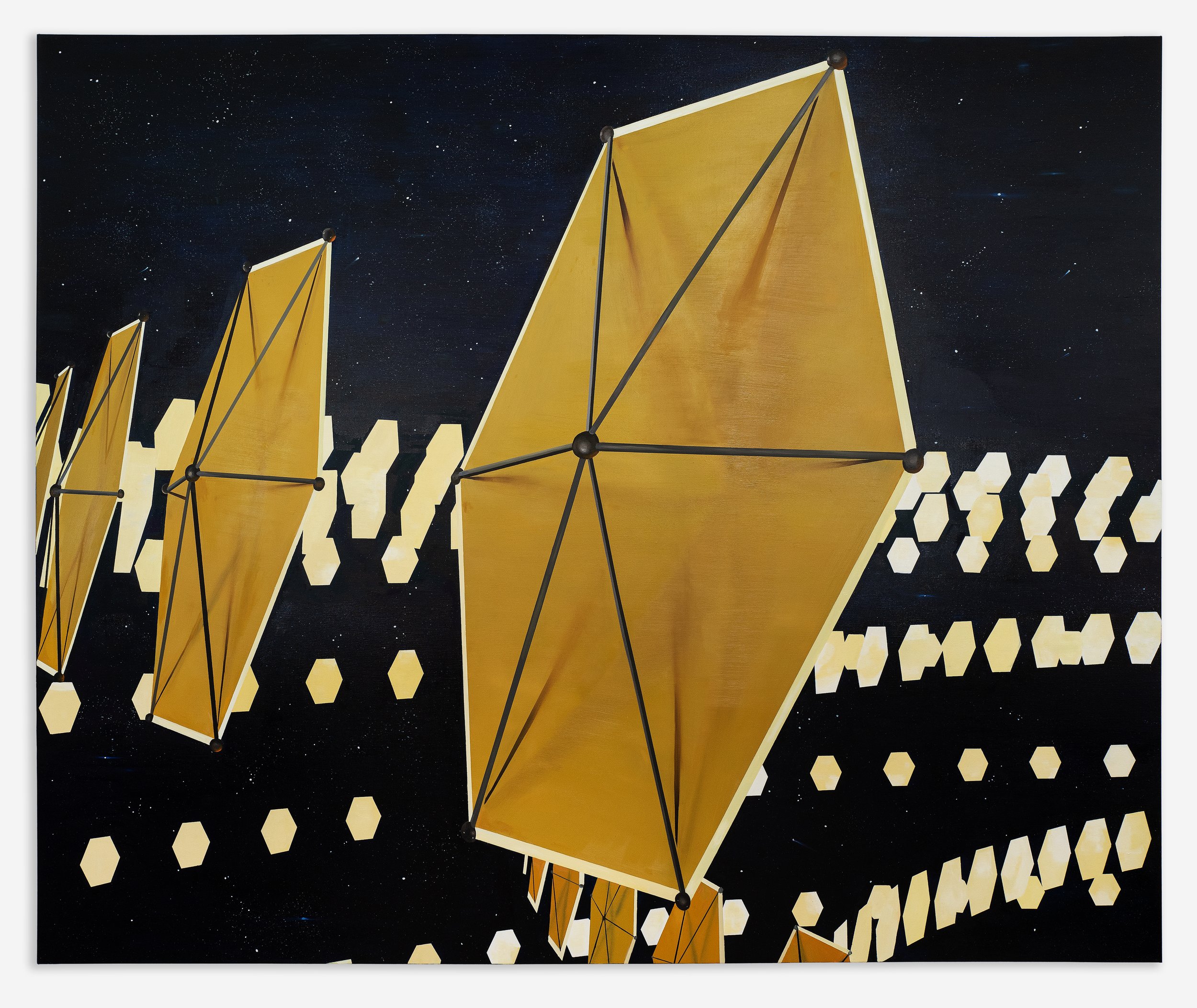
Point by point, the sky accumulated. Tan Mu has described painting Dyson Sphere (2023) as her first sustained attempt to depict the starry sky, each point of light placed individually on the canvas, building a field of luminous marks against a deep ground until the surface held what she called a sense of wonder rather than technical certainty. The process was incremental, patient, and at odds with the subject's own scale. The Dyson Sphere, as Freeman Dyson proposed it in 1960, is a structure that encloses an entire star. It would require more material than exists in all the planets of the solar system combined. Its surface area would exceed Earth's by a factor of several billion. It is the largest object anyone has ever imagined building, and Tan Mu painted it point by point, one star at a time, on a canvas measuring 152 x 183 cm (60 x 72 in). The gap between the subject's magnitude and the painting's method is not an oversight. It is the painting's argument.
The canvas is dominated by a field of golden panels that curve across the composition in sweeping arcs, their surfaces reflecting light from the star they enclose. The panels are rendered in warm gold tones that shift from pale amber at their edges to deep, almost coppery gold at their centers, where the reflected stellar light is strongest. Between the panels, and filling the spaces where no panel obstructs the view, the dark ground of deep navy and black is populated by the dense points of the starry sky, each one a small mark of pale yellow or white oil paint placed individually against the dark ground. The composition reads as a view from inside the sphere, or from its surface, looking outward through the gaps between the energy-collecting panels at the stars beyond. The panels curve and overlap, suggesting rotation and depth, their arrangement implying a structure that wraps around the viewer in all directions. The edges of the canvas do not contain the sphere. They cut through it, as though the painting were a window into a structure that extends in every direction beyond the frame.
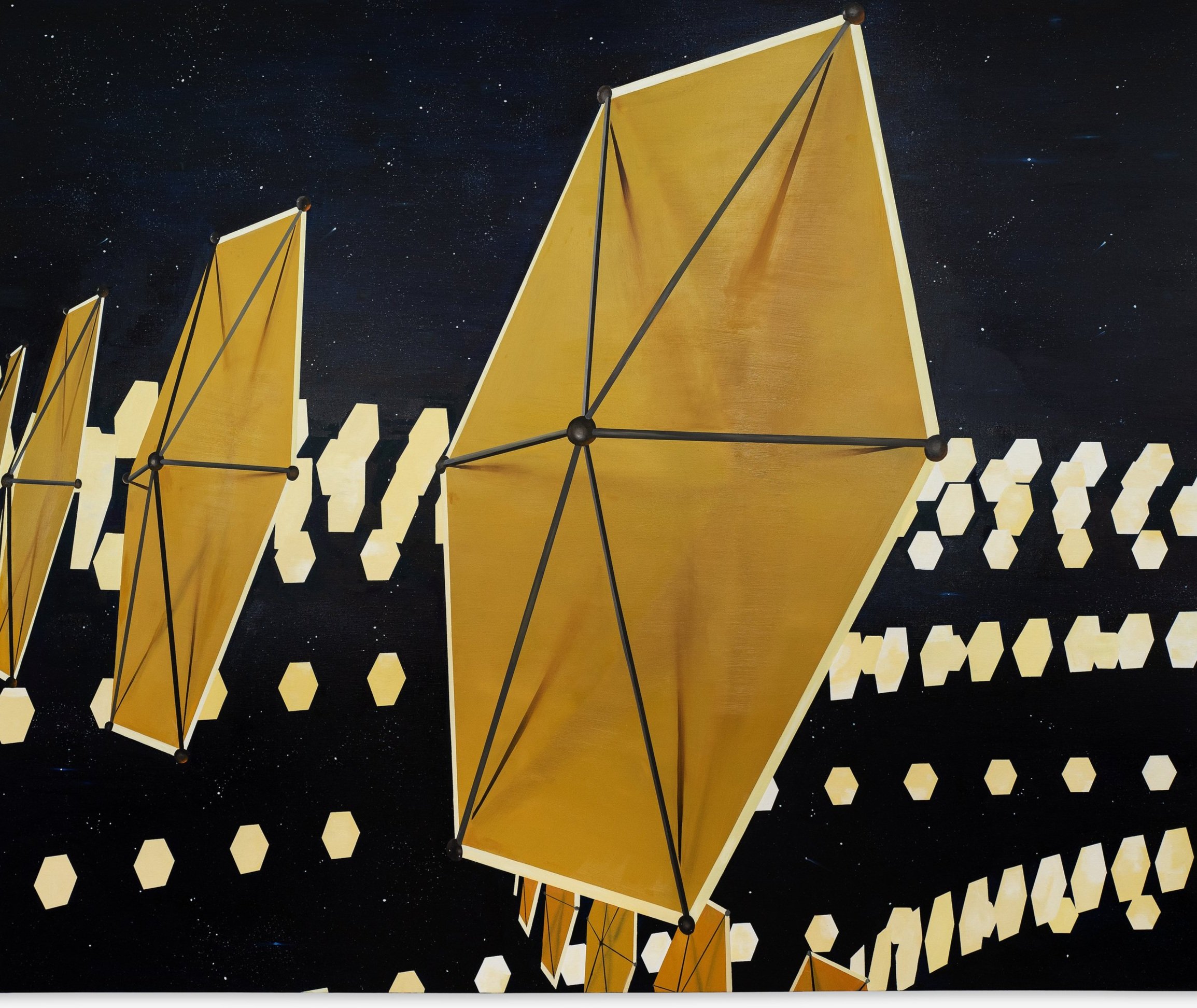
The surface texture operates in two distinct registers that correspond to two kinds of content. The golden panels are built up with layered brushstrokes, some thick and impasto where the light catches the panel's surface, others thin and translucent where the panel's edge dissolves into the dark ground. These strokes carry the warmth of the star's reflected energy. They are the painting's assertion of presence, its declaration that something vast and luminous occupies this space. The starry sky, by contrast, is built from hundreds of individual points, each one a single touch of the brush, each one small enough that no individual star dominates the field. The points cluster more densely in some areas and thin out in others, creating a sense of depth and variation that mimics the actual distribution of stars in the night sky. This was, as Tan Mu has noted, her first large-scale use of dense points to represent the starry sky, and the technique would become foundational for later works in the Horizons and Signal series. The method of applying each point individually, one brush touch at a time, mirrors the method by which a Dyson Sphere would theoretically be assembled: not in a single gesture but through the accumulation of countless individual units, each one small relative to the whole, each one necessary for the structure to function. The painting does not depict a completed sphere. It enacts the process of building one, mark by mark, point by point, on a surface that is itself built mark by mark.
Kasimir Malevich's Suprematist Composition (1916) suspends geometric forms against a white ground that represents, in Malevich's own writing, the infinite void of space. The rectangles, squares, and circles in red, blue, black, and yellow float at varying angles, their positions suggesting neither gravity nor architecture but a state of pure relational tension. The forms are not illustrations of objects. They are objects themselves, or more precisely, they are the residues of feeling stripped of all representational content. Malevich described Suprematism as the "supremacy of pure feeling" in painting, a system in which color and form operate according to their own laws, independent of the visible world. The white ground was not empty space. It was the space of feeling, the infinite field against which the colored forms establish their relationships. In later writings, Malevich extended this spatial logic to the cosmos, describing Suprematism as a movement toward the "space of the non-objective," a realm beyond the earth, beyond the object, beyond the constraints of gravity and material need. The floating forms in his canvases were not abstractions of earthly things. They were inhabitants of a different order of space, the space that human ambition might one day reach.
Tan Mu's Dyson Sphere shares Malevich's aspiration toward the cosmic, but it arrives there through a different door. Where Malevich stripped away representation to reach pure form, Tan Mu strips away representation to reach pure energy. The golden panels in Dyson Sphere are not representational in any conventional sense. They do not depict photovoltaic cells or solar collectors with photographic fidelity. They are geometric forms rendered in warm metallic tones, their edges and curves suggesting rotation and depth without specifying any particular engineering configuration. Their function is not to show what a Dyson Sphere looks like. No one knows what a Dyson Sphere looks like, because no one has built one. Their function is to show what a Dyson Sphere feels like: vast, luminous, enclosing, a structure that wraps the viewer in golden light and makes the stars appear only through the gaps between the collecting surfaces. The panels are the painting's version of Malevich's colored forms. They are the elements that establish the composition's relationships. They are also, in the terms of the Dyson Sphere concept itself, the elements that harvest energy, and the painting translates this function into visual warmth. The panels do not just occupy space. They fill it with light. They do not just float in a void. They transform the void into a resource, the way a Dyson Sphere transforms the star's radiation into usable power. The painting does not depict the Sphere. It performs the Sphere's logic on the canvas: the collection of diffuse energy into concentrated warmth, the conversion of the infinite into the usable.
Freeman Dyson proposed the concept in a 1960 paper titled "Search for Artificial Stellar Sources of Infrared Radiation," published in the journal Science. His argument was deceptively simple. Any sufficiently advanced technological civilization would require vast amounts of energy. The most efficient way to obtain that energy would be to enclose the civilization's home star in a shell of material that could capture its entire energy output, rather than allowing it to radiate uselessly into space. The shell would absorb the star's light and re-radiate it as infrared, which is why Dyson suggested that astronomers searching for extraterrestrial intelligence should look for stars emitting an unusual amount of infrared radiation. The structure he proposed, later called a Dyson Sphere, would have a surface area roughly 600 million times that of Earth. It would provide its builders with energy on a scale that makes all terrestrial energy sources, including nuclear fusion, look negligible by comparison. Dyson acknowledged that the construction of such a sphere would require disassembling at least one planet for raw materials. The ambition, in other words, is planetary in its scale of destruction as well as creation. To build a Dyson Sphere, you must first unbuild a world.
The concept has since branched into several variants. Dyson's original proposal described what is now called a Dyson Shell: a solid enclosure around the star, a continuous surface that would require extraordinary material strength to resist gravitational collapse and would produce gravitational instabilities that make the design physically unworkable. Later physicists and engineers proposed more plausible alternatives: the Dyson Swarm, a cloud of independent solar-collecting satellites orbiting the star in loose formation, and the Dyson Ring, a band of collectors confined to a single orbital plane. The swarm and the ring are both theoretically feasible with materials and engineering that do not violate known physics, though they remain far beyond current capabilities. The distinction between the shell, the swarm, and the ring matters because it reveals something about the ambition itself. The Dyson Shell, the version that most people picture when they hear the term, is the most dramatic and the most impossible. It is also the version that most closely resembles an act of cosmic enclosure, a structure that wraps the star in a complete envelope and captures every photon it emits. The painting depicts this version, the impossible one, the one that encloses rather than merely orbits.
Tan Mu has described Dyson Sphere as existing "between rational speculation and poetic imagination, preserving a sense of wonder rather than technical certainty." This description locates the painting precisely in the space that Dyson's paper opened and then closed. Dyson's proposal was rational speculation: a logical argument based on energy requirements, material constraints, and the assumption that advanced civilizations would seek to maximize their energy capture. The paper is dry, mathematical, and short. It contains no imagery, no wonder, no sense of what it might feel like to live inside a structure that encloses a star. The feeling of the Sphere, the experience of its magnitude, the visual and emotional consequences of enclosing a sun: these are things the paper does not address. The painting addresses them. The golden panels fill the composition with warmth. The starry sky, visible through the gaps, provides the counterpoint of cold distance, the reminder that the stars exist on a scale that makes even a Dyson Sphere look small. The painting holds both the rational and the poetic in the same frame, and the tension between them, the sense of wonder that results from knowing what the structure is for and feeling what it would be like to stand inside it, is the painting's specific contribution to the subject.
Albert Pinkham Ryder spent years on each of his paintings, building up the surfaces in layer after layer of dark, resinous pigment that he applied over grounds of bitumen and varnish. The Race Track (Death on a Pale Horse), which he worked on from approximately 1895 until 1910, depicts a skeletal figure on horseback galloping across a dark landscape under a sky filled with swirling clouds. The surface of the painting is thick, cracked, and dark, the result of Ryder's practice of applying paint before the previous layer had dried, which caused the later layers to pull the earlier ones apart as they dried at different rates. The cracks are not damage to the painting. They are the painting's texture, the record of Ryder's process, the visible evidence of the years he spent building and rebuilding the image. The horse and rider are small against the landscape, almost swallowed by the darkness that surrounds them. The sky above is a churning mass of brown and black pigment, relieved by a single streak of pale light that cuts across the upper right corner like a wound in the darkness.
Ryder's obsessive layering and Tan Mu's point-by-point accumulation share a structural logic: both build the image through a process that mirrors the subject's own nature. Ryder's Race Track is about death as an inexorable force that cannot be outrun, and the painting's surface is built through a process of accumulation and collapse that mirrors that inexorability. The layers do not resolve into clarity. They resolve into darkness. Tan Mu's Dyson Sphere is about a structure assembled unit by unit over time, and the painting's surface is built through a process of unit-by-unit accumulation that mirrors that assembly. Each point of starlight is a single brush touch. Each golden panel is built from multiple layers. The painting does not depict a Dyson Sphere in a single gesture. It accumulates the way the Sphere would accumulate, through the patient addition of individual components until the whole becomes visible. The difference is that Ryder's layers press downward, toward the darkness of death, while Tan Mu's points press outward, toward the luminosity of collected energy. Both processes are slow. Both resist the instantaneity of the photograph or the digital image. Both produce a surface that bears the record of its own making. The cracks in Ryder's painting are the image's proof that time passed during its creation. The individually placed points in Tan Mu's painting are the image's proof that time passed during its creation. The Dyson Sphere, if it were ever built, would also bear the record of its own assembly, each panel a trace of the labor that installed it, each adjustment a mark of the civilization that built it. The painting holds this parallel between process and subject without stating it. The point-by-point sky and the layered panels are the argument, not an illustration of the argument. The way the painting was made is what it means.
Saul Appelbaum, writing about the Signal series in 2025, described Tan Mu's paintings as transforming data cables into "gestural constellations that oscillate between calculation and intuition." The phrase applies with equal force to Dyson Sphere. The golden panels oscillate between calculation and intuition. They are placed with enough precision to suggest a rotating structure, but not with the regularity of an engineering diagram. They curve and overlap in ways that feel both logical and organic, as though the structure they describe were not a rigid shell but a living system that bends and breathes. The starry sky behind them, built from individually placed points, oscillates in the same way. Each point is a deliberate mark, a calculation of position and brightness. But the aggregate, the field of accumulated points, produces an effect that exceeds any individual mark: the sense of looking out through a partially enclosed structure at an infinite field of stars. This oscillation, between the calculated and the intuitive, between the rational and the poetic, is what Tan Mu has identified as the tension she felt while painting. "While painting, I felt a constant tension between scientific logic and emotional intuition," she has said. "That tension is essential to the work." The painting does not resolve it. The panels are too warm, too luminous, too emotionally persuasive to be purely scientific. The starry sky is too precise, too carefully distributed, too individually placed to be purely intuitive. The painting holds both. It is a Dyson Sphere made of oil paint. It is also a field of stars made of brush touches. It is a structure that encloses a star. It is also a surface that accumulates marks. The enclosure and the accumulation are the same gesture, seen from different scales.
The starry sky that first appeared in Dyson Sphere did not remain in this painting alone. Tan Mu has described how the point-based visual language developed here became foundational for her later work. In the Horizons series, the starry sky evolves from background to symbol of expanded perception. In the Signal series, it merges with the ocean floor to form what she calls "digital constellations," where the stars echo the routes of submarine cables transmitting data, memory, and emotion. In Epithelial Cells (2024) and Chromosomes (2022), the same point-based language represents the circulation of biological information. Across these works, the starry sky becomes a bridge between scales, connecting the microscopic and the cosmic, the biological and the technological. Dyson Sphere is where this bridge first took visible form. The painting is not just a depiction of a hypothetical megastructure. It is the moment when a visual language was born, a language of individually placed points against a dark ground that would carry meaning across the entire subsequent body of work, from ocean floors to cell walls to fiber-optic cables. The Sphere encloses the star. The painting encloses the method. And the method, once developed, outgrew the painting that created it, the way the ambition to harness a star's energy, once conceived, outgrew the planet that conceived it.