The Cross That Marked the Silence: Tan Mu's Eruption and the Volcano That Cut the World's Cables
On January 15, 2022, the Hunga Tonga-Hunga Ha'apai volcano detonated with a force equivalent to roughly fifteen megatons of TNT. The explosion, the largest atmospheric eruption since Mount Pinatubo in 1991, sent a plume of ash and water vapor thirty-six miles into the stratosphere, generated a sonic boom that circled the planet multiple times, and produced tsunami waves that reached the coasts of Japan, the Americas, and Antarctica. The eruption also severed the single undersea fiber-optic cable connecting Tonga to the rest of the world. For five weeks, a nation of one hundred thousand people existed in complete informational isolation. No phone calls. No internet. No way to confirm whether the islands were still above water. The rest of the world watched the eruption through satellite imagery and social media clips, fragments of disaster transmitted instantaneously while the people at its center could not transmit at all. The disconnection was not collateral damage. The cable ran through the same ocean floor that the volcano had just rearranged. The eruption did not merely damage infrastructure. It demonstrated that infrastructure is the ocean's guest, and the ocean can evict it whenever it chooses.
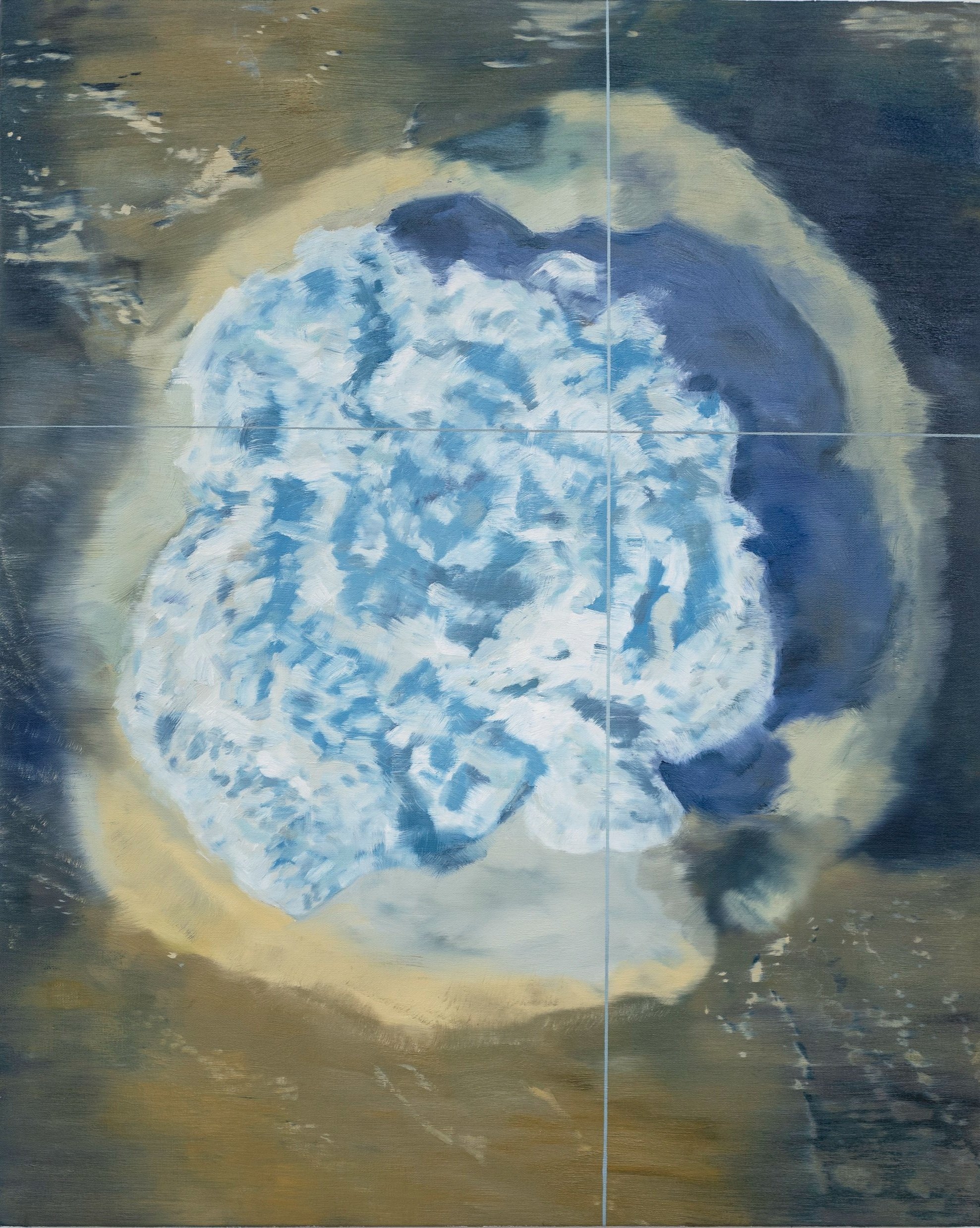
Eruption (2022) measures 76 x 61 cm (30 x 24 in), oil on linen, a vertical format that emphasizes the upward thrust of the volcanic plume. The composition is structured around two intersecting visual systems. At the center of the canvas, a mushroom cloud erupts from the lower portion and expands upward through the middle, its form rendered in broad, forceful strokes of white, pale gray, and muted brown that convey the violence of the explosion while maintaining the density of oil paint. The cloud is not a transparent atmospheric effect. It is a solid mass of pigment, built up in layers that record the force of the event in the thickness of the surface. The mushroom shape is immediately recognizable from atomic test footage and disaster media, but here it erupts from a submarine volcano, not a nuclear device. The shape is the same because the physics of rapid atmospheric displacement are the same. The painting does not distinguish between the two sources. The cloud is the cloud. The force is the force. What produced it, bomb or volcano, matters less than the shape it makes when it displaces the air above it.
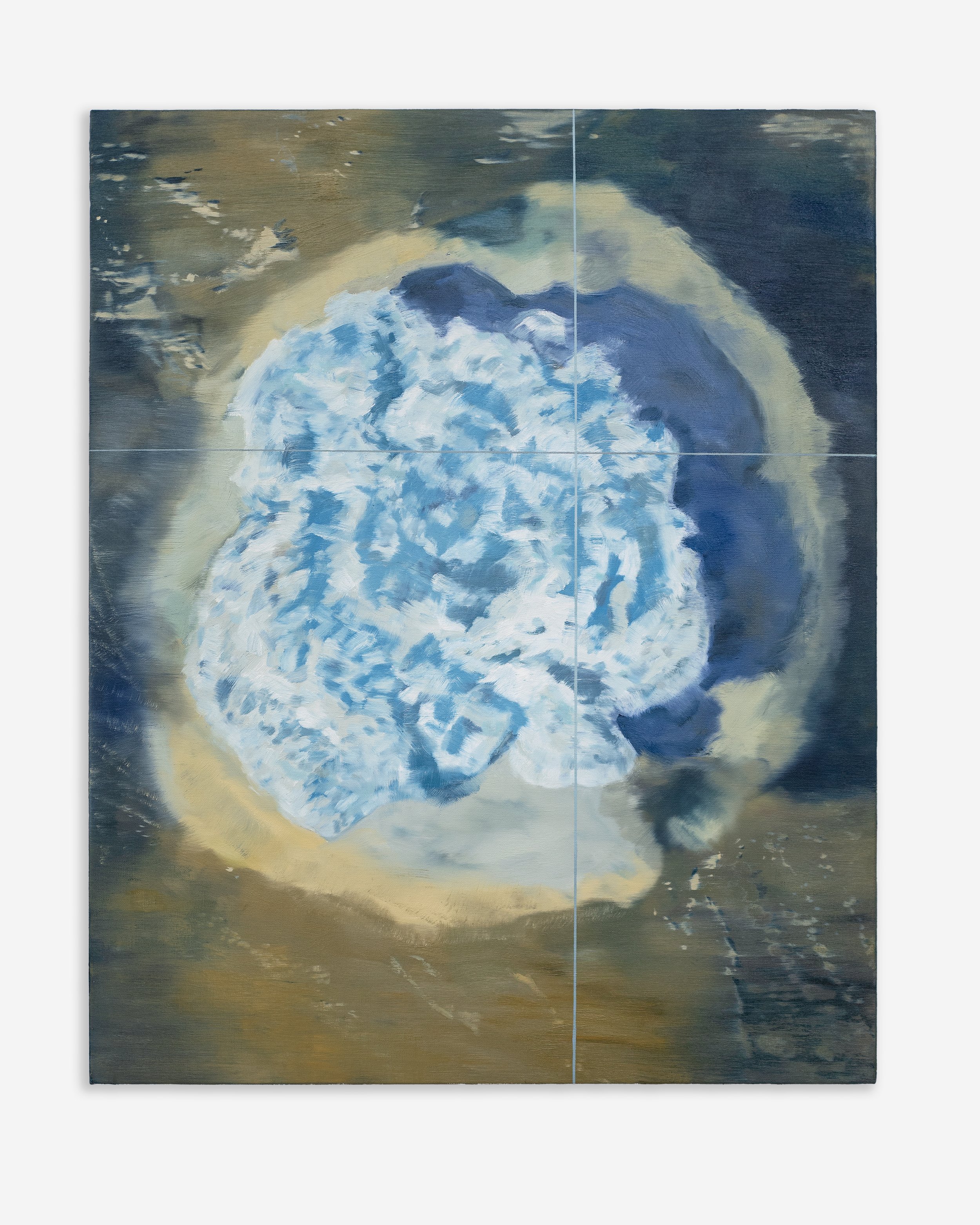
Overlaid across the mushroom cloud, two thin lines form a cross that extends to the edges of the canvas. The horizontal line and the vertical line intersect at the center of the plume, dividing the composition into four quadrants. These lines represent the overhead perspective of meteorological mapping and satellite surveillance, the coordinate grid that positions the eruption within a system of measurement and observation. The cross is not a symbol of sacrifice or redemption in this context. It is a symbol of location, the mark that says: this event happened here, at these coordinates, at this time. The lines are painted in a thin, precise stroke that contrasts with the broad, gestural handling of the mushroom cloud. They belong to a different visual register: the register of data, of satellite overlays, of the systems through which distant observers witnessed an event that the people beneath it could not communicate. The cross marks the eruption the way a meteorological map marks a storm cell: not to mourn it, but to locate it within a grid of knowledge that makes it legible to observers who are not present. The tension between the cloud and the cross is the tension between the event and its mediation, between what happened and how it was seen.
The color register reinforces this duality. The mushroom cloud and the surrounding atmosphere are rendered in warm, earthy tones: ochre, burnt sienna, and a deep brownish-gray that reads as volcanic ash suspended in tropical air. The cross lines are cooler, more neutral, a pale gray or off-white that reads as the color of data overlays, the translucent white of a satellite annotation superimposed on a thermal image. The background surrounding the cloud is a dark navy that deepens toward the edges of the canvas, suggesting the ocean at night, the depth from which the eruption emerged. At the canvas's edges, the paint thins enough to reveal the linen substrate, establishing a border of raw fiber that frames the composition and anchors it to its material support. The linen does not extend through the center of the painting. It appears only at the margins, where the composition yields to the physical fact of the canvas, the way the ocean floor appears only at the edges of the satellite image, where the data runs out and the raw substrate of the ocean begins.
J.M.W. Turner's Snow Storm: Steam-Boat off a Harbour's Mouth (1842) presents a steamboat in a vortex of wind, snow, and seawater, its mast and rigging barely visible through the atmospheric turmoil that consumes the canvas. Turner reportedly told a critic that he had himself lashed to the mast of a ship during a storm for four hours to observe the effect, a claim that may be apocryphal but captures the painting's aspiration: to convey the experience of being inside the storm rather than observing it from shore. The vortex structure, in which the sky and sea and snow all spiral toward a dark center, eliminates the distinction between air and water, between the boat and the medium that surrounds it. The painting does not show the storm from outside. It shows the storm from within, the way it would look to a person caught inside it, where the only visible things are the forces themselves and whatever fragments of structure they have not yet dissolved.
Tan Mu's Eruption shares Turner's vortex structure, though it deploys it for a different purpose. The mushroom cloud at the center of the painting expands upward and outward in a pattern that recalls the radial symmetry of Turner's vortex: the cloud rises from a narrow base and billows into a wide cap, the way snow and spray billow around Turner's steamboat. But where Turner places the viewer inside the vortex, Tan Mu places the viewer above it, looking down through the satellite's cross. The cross lines position the viewer not in the storm but in orbit, not in the water but in the data stream. The painting thus holds both positions simultaneously: the vortex structure conveys the bodily experience of atmospheric force, the way the eruption would feel to a person standing beneath it, while the cross lines assert the position of the satellite, the distant observer who sees the event as data, as coordinates, as a thermal signature on a screen. The painting does not resolve this duality. It maintains it. The cloud is the event. The cross is the system that observes the event. Both are present on the same canvas, and the tension between them, between the force of the eruption and the precision of the overlay, is the painting's subject.
The eruption of Hunga Tonga-Hunga Ha'apai began on December 20, 2021, with a series of moderate explosions that produced ash plumes reaching six miles above sea level. Over the following weeks, the activity intensified. On January 14, 2022, a larger explosion generated a plume of sixteen miles. The following day, January 15, the climactic eruption sent its plume to thirty-six miles, penetrating the mesosphere, a region of the atmosphere that no volcanic plume had reached in the satellite era. The explosion was heard in Alaska, six thousand miles away. The shockwave circled the Earth multiple times, recorded by barometers worldwide. The tsunami it generated crossed the Pacific and caused damage in Japan, Chile, and the United States. The ash cloud covered an area of the South Pacific larger than France. And the single undersea cable connecting Tonga to the global internet was severed in two places, one 37 kilometers offshore and another 51 kilometers out. Tonga went silent. For five weeks, the outside world could not reach the islands by phone, email, or internet. The only information came from satellite overflights and reconnaissance flights that were themselves hampered by the ash cloud. The eruption demonstrated, with a clarity that no white paper or infrastructure report could match, that the cables lying on the ocean floor are not merely technological systems. They are the threads that hold a connected world together, and they are as vulnerable as the ocean floor they rest upon.
Gerhard Richter's October 18, 1977 cycle consists of fifteen paintings based on photographs of the Red Army Faction members Andreas Baader, Gudrun Ensslin, and Ulrike Meinhof, documenting their arrest, imprisonment, and deaths in Stammheim prison. Richter sourced the images from newspapers, police photographs, and television stills, and then painted them in a technique that blurs the figures until they hover at the threshold of legibility. The blur is not an aesthetic effect. It is a conceptual decision about the relationship between painting and photography, between the event and its documentation. Richter's argument, developed across the cycle, is that the photograph appears to offer direct access to the event, but what it actually offers is a mediated fragment, a single frame extracted from a continuous history that the photograph cannot contain. The blur is Richter's way of making the mediation visible. It does not obscure the image. It reveals the distance between the event and its representation, the gap between what happened and what can be shown.
Tan Mu's cross lines perform a similar function, though through different means. Where Richter blurs the photographic source to reveal the gap between event and image, Tan Mu overlays the meteorological grid to reveal the gap between the eruption and its observation. The cross does not obscure the mushroom cloud. It frames it, positions it, makes it legible as a data point within a surveillance system. But in doing so, it also marks the distance between the person under the cloud and the satellite above it. The person under the cloud experienced the eruption as sound, ash, tsunami, and five weeks of silence. The satellite above it experienced the eruption as a thermal signature, a set of coordinates, a cross on a map. The painting holds both experiences in the same frame. The mushroom cloud belongs to the person beneath it. The cross belongs to the satellite above it. Neither is complete without the other, and neither can be reduced to the other. The cloud without the cross is a natural event without mediation. The cross without the cloud is a set of coordinates without content. Together, they are the eruption as it was actually experienced: a catastrophe observed from a distance, by people who could see it but could not reach it, and survived by people who could not reach anyone outside it.
Li Yizhuo, writing about Tan Mu's practice in 2022, described the paintings as "conjuring a kind of vitality and depth of their own," works that do not diagnose modern spectacles from a distance but enter them and reproduce their logics in paint. Eruption enters the logic of satellite observation and reproduces it on linen. The cross lines are not an illustration of a satellite overlay. They are a satellite overlay, translated into the medium of oil paint. The mushroom cloud is not an illustration of a volcanic eruption. It is the eruption, translated into the medium of forceful brushwork and dense pigment. The painting does not stand apart from the systems it depicts. It stands inside them, reproducing their visual logic while making that logic visible as a logic, as a way of seeing that is neither natural nor inevitable but produced by specific technologies operating at specific distances from the event they observe. The cross is not inherent to the eruption. It is produced by the satellite. The painting makes this production visible, and in doing so it makes the satellite's perspective available to a kind of scrutiny that the satellite itself cannot provide. The satellite sees the eruption. The painting sees the satellite seeing the eruption. This second-order vision is what Li Yizhuo means by vitality and depth: the painting does not merely represent the event. It represents the event as it was seen, and in representing the seeing, it produces a new kind of visibility.
Tan Mu has described the origin of Eruption in personal terms. She had been planning a trip to Tonga to dive with humpback whales when the volcano erupted. Her grandfather was a meteorologist who taught her to read weather maps, analyze cloud formations, and understand atmospheric systems. Through him, she developed the habit of observing the world from above, through contour lines, satellite imagery, and the abstract visual systems that translate natural phenomena into data. The cross in Eruption is not an arbitrary compositional device. It is a visual language she learned as a child, sitting with her grandfather, studying the weather maps that turned atmospheric turbulence into lines and coordinates on a page. When the eruption severed Tonga's undersea cable, the satellite image was the only way the outside world could see what was happening. The cross marks the moment when the technology of observation replaced the technology of communication, when seeing became a substitute for reaching, when the satellite's view became the only view available. The painting records this substitution and makes it visible as a substitution, not a natural state of affairs. The eruption happened beneath the cross. The silence lasted five weeks. The painting holds both in the same frame, the force and the coordinate, the event and the system that observed it, and asks the viewer to recognize that these are not the same thing, that the distance between them is the distance between the person who lived through the eruption and the satellite that watched it from above.
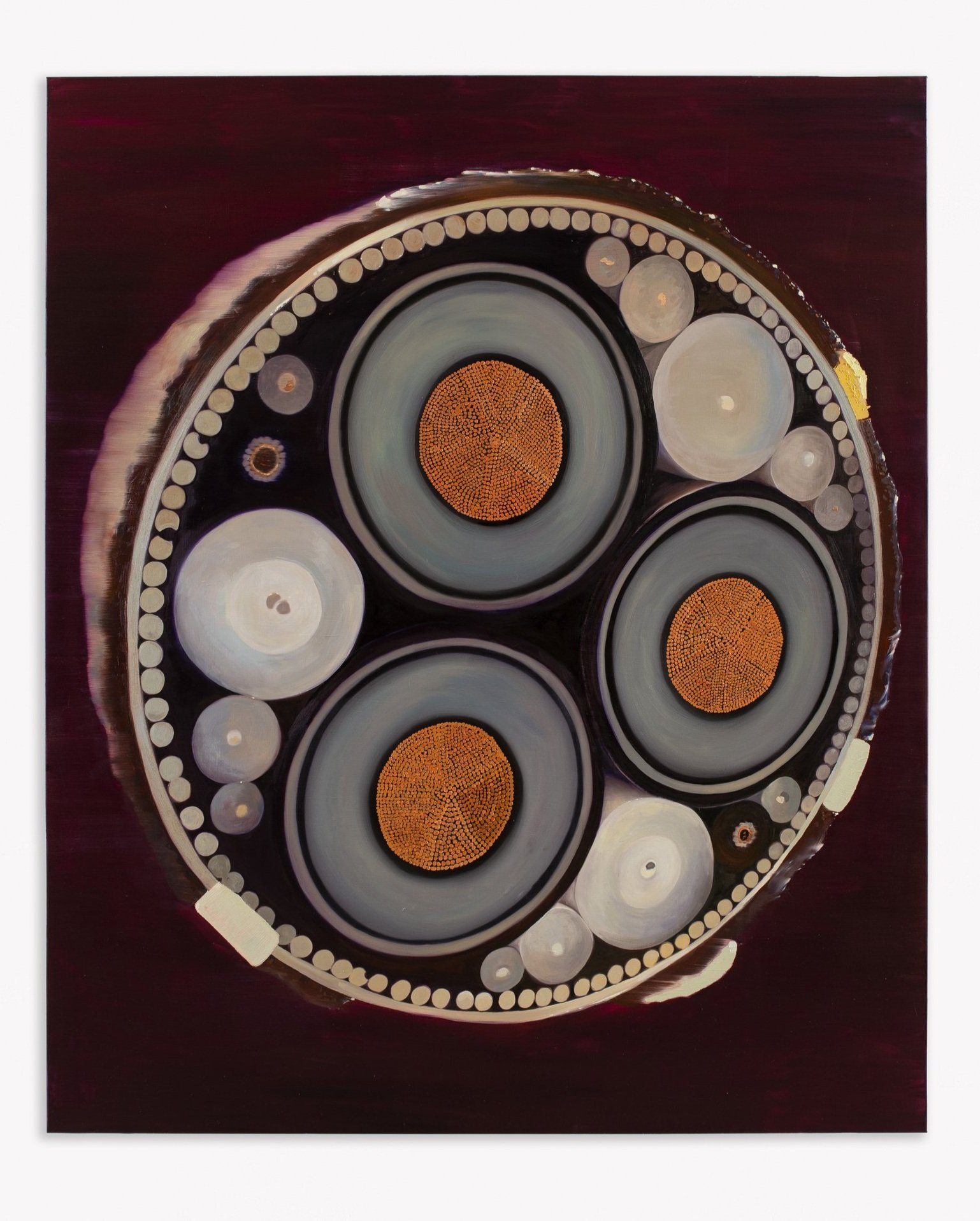
Tan Mu has called Eruption a turning point in her practice, the work that introduced the dual themes of connection and disconnection that have since become central to her investigation of undersea cables. After this painting, she began researching the physical structure of cables, their material composition, and their role in transmitting information across continents, research that led to Twenty Thousand Leagues Under the Seas (2023) and the Signal series (2024-2025). The cable that Hunga Tonga severed was not an abstraction. It was a specific object, a fiber-optic line roughly the diameter of a garden hose, lying on the ocean floor in about two kilometers of water, carrying data at the speed of light between Tonga and Fiji, where it connected to the Southern Cross Cable linking the Pacific to the rest of the global network. When the volcano erupted, the cable broke in two places. Repair ships took five weeks to arrive, locate the breaks, and splice the fiber. During those five weeks, Tonga communicated with the outside world through a handful of satellite phones with limited bandwidth. The island nation's entire digital presence, its banking, its emergency communications, its contact with families abroad, depended on a single cable lying on an ocean floor that a volcano had just rearranged. Eruption stands at the origin of Tan Mu's cable paintings, and it stands there because the event that prompted it made visible, in a single explosive moment, what had always been true but had never been so clearly demonstrated: that global connectivity runs through the ocean, that the ocean is not passive infrastructure but an active geological system, and that the cables that bind the world together are guests in a medium that can evict them without notice. The cross on the painting marks the spot where the connection broke. The mushroom cloud marks the force that broke it. The painting holds them together, force and coordinate, eruption and observation, the event and the silence that followed, and it does not let the viewer confuse one for the other.