The Hands at the Console: Tan Mu's DEC's PDP-10 and the Social Body of Early Computing
In 1966, a researcher at MIT sat down at a teletype terminal connected to a PDP-10 across campus, typed a line of code, and received a response in less than a second. The transaction was unremarkable by any technical standard, yet it represented something unprecedented: two people, in two different rooms, sharing the same machine at the same time. The PDP-10 did not simply compute. It hosted. It allowed multiple users to occupy the same computational space simultaneously, each unaware of the others except in the aggregate load they placed on the processor. This was time-sharing, and it was the technical seed from which networked computing grew. When Tan Mu paints the PDP-10 in 2021, she paints a room in which computing was still a social act. The figures in the archival photograph she works from sit together around the machine, their hands on keyboards, their faces turned toward screens that display numbers rather than images. They are present to each other and to the machine in a way that the solitary laptop user, decades later, cannot replicate. The painting holds that moment of collective attention and refuses to release it.
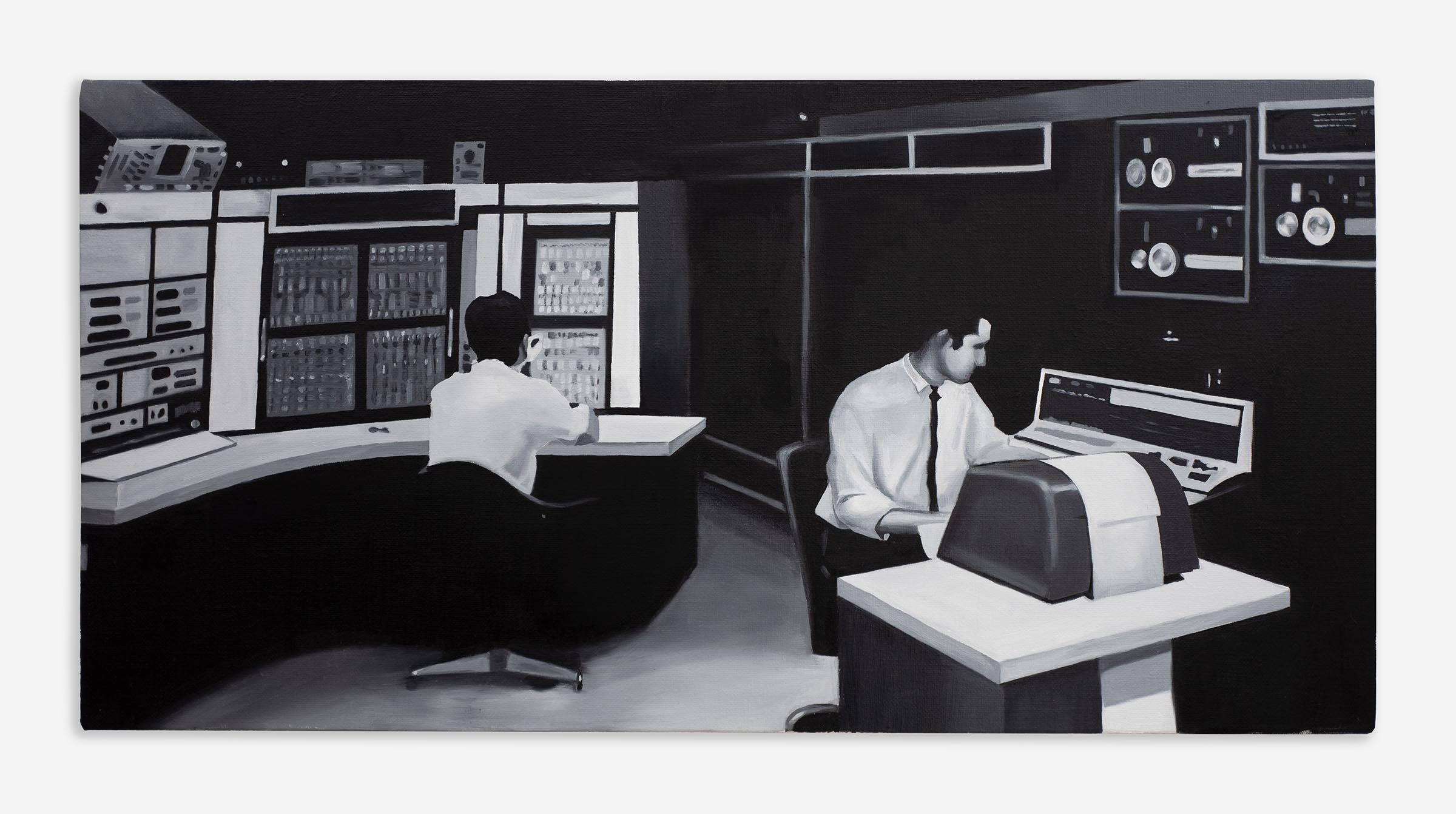
Oil on linen, 31 x 61 cm (12 x 24 in). The format itself is worth pausing on. Tan Mu's horizontal canvases often function as panoramic windows, their width exceeding their height by a ratio that suggests a screen or a landscape. Here, the proportions approximate those of the machine's own output: wide enough to contain a row of terminals, a bank of cabinets, the geometry of a room that was never designed for beauty but that, in Tan Mu's hand, acquires an unexpected formality. The paint is applied in thin, controlled layers over the linen ground. The dominant register is grayscale, modulated between warm graphite and cool silver, with passages of cream that read as institutional light reflecting off metal surfaces. The linen weave is visible in the lighter areas, lending the surface a textile quality that parallels the woven cables and patterned text the image depicts. At arm's length, the brushwork resolves into discrete marks, each one a decision about where a shadow falls or an edge turns. At two meters, the marks coalesce into the photograph's tonal logic: the flat, documentary evenness of 1960s institutional photography, where flash eliminates atmosphere and every surface receives the same indifferent illumination. Tan Mu does not romanticize this light. She reproduces it, and in reproducing it, makes visible the way early computing environments were designed without any concern for the human body that would inhabit them.
The people in the painting are rendered with the same tonal fidelity as the cabinets beside them. This is not indifference. It is the painting's argument. In the original photograph, the human figures and the machine share a single tonal range: skin and metal, fabric and plastic, all translated into the same grayscale continuum. Tan Mu preserves this tonal democracy. No figure is given more emphasis than any terminal. The operator's hand on the keyboard receives the same weight of attention as the cable running along the floor. The result is a composition in which the human and the computational occupy the same visual plane, neither subordinate to the other, both elements of a single system. The PDP-10 was designed to serve multiple users, and in this painting, the users serve the machine in return. Their posture, their attention, their very presence in the room is organized around the demands of the processor. Tan Mu paints this mutual dependency without sentimentality. The hands at the console are not heroic. They are simply where they need to be.
Ben Shahn spent the 1930s and 1940s painting American workers in the spaces where labor happened. His 1934 painting The Passion of Sacco and Vanzetti depicts the two men standing in front of a courthouse, their hands bound, their faces composed in a resignation that Shahn transforms into a kind of moral clarity. But it is his smaller, less frequently discussed works from the same period that are more relevant here. Shahn's photographs for the Farm Security Administration, taken between 1935 and 1938, document sharecroppers, miners, and factory workers in their actual environments. A coal miner's face is lit by the same dim bulb that illuminates the equipment behind him. A textile worker's hands move in the same rhythm as the loom. Shahn's compositions refuse to separate the worker from the workplace. The person and the machine exist in the same tonal field, the same social frame, the same moral economy. When Shahn painted a man at a drafting table in Portrait of a Worker (1940), the tools on the desk were not props. They were co-equal elements in a composition about what it means to work with things that are larger than oneself.
Tan Mu's treatment of the PDP-10 operators extends this logic into a different century. The figures in her painting are not sharecroppers or miners. They are computer operators in the late 1960s, probably at MIT or Stanford, probably wearing the casual clothing of academic research. But the compositional principle is the same. The people and the machine share a single tonal and spatial register. The operator's elbow on the desk, the cable trailing across the floor, the monitor displaying a column of numbers: these are not separate subjects arranged for visual convenience. They are aspects of a single condition, which is the condition of working with a machine that structures your time, your attention, and your bodily position. Shahn understood that painting labor meant painting the environment of labor, because the environment is what gives the labor its meaning. Tan Mu, painting a different kind of labor in a different kind of environment, arrives at the same structural insight. The PDP-10 room is a workplace, and the painting shows us what that workplace looks like when the workplace and the worker are understood as a single system.
The PDP-10 was released by Digital Equipment Corporation in 1966 and became, over the following decade, the most widely used time-sharing computer in the world. Its significance for the history of computing cannot be overstated. The machine ran TOPS-10 and later TOPS-20, operating systems designed from the outset for multi-user access. ARPANET, the precursor to the internet, was tested and developed on PDP-10 hardware. The first email was sent from one PDP-10 to another. The machine hosted the earliest multiplayer computer games, the first chat systems, and the software tools that would become the foundation of the Unix operating system. Tan Mu, in her research for this painting, describes the PDP-10 as one of the few computers of its era "capable of running multi-user environments," and identifies it as "the first widely used time-sharing system and a core platform of ARPANET." The painting does not depict the machine's technical specifications. It depicts the room in which those specifications became lived experience: a room filled with people whose hands are on keyboards, whose eyes are on screens, whose attention is directed outward toward a shared computational resource that they cannot see but that structures every moment of their working day.
Tan Mu has described the device in the lower right of the painting as reflecting "these technical limitations and working conditions, which differ completely from contemporary displays." The absence of a graphical interface is not incidental. The PDP-10's output was numerical. Users read columns of numbers, not images. The screen was a text window into a world that existed only in code. What the painting makes visible, by rendering this environment with such careful tonal attention, is the degree to which early computing was a fully embodied practice. You sat in a room. You typed with your hands. You read with your eyes. You shared the machine with other people who were doing the same things in the same room, or in rooms connected by cables that ran through walls and under floors. There was no cloud. There was no abstraction. The connection between your body and the machine was direct, physical, and social. You could hear the other users' teletypes. You could see their terminals. You knew, in a way that the contemporary internet user does not, that your activity was one thread in a shared fabric of attention.
The curator Danni Shen, writing about Tan Mu's practice in her 2024 studio visit for Emergent Magazine, positions the paintings as reflecting "the trajectory and continuum of bodily and mediated presence through human technical developments." Works, Shen writes, "serve as a kind of witness to human socio-technological histories." This framing is particularly illuminating for the PDP-10 painting, where the trajectory Shen identifies runs in reverse. The painting does not show the culmination of a technological arc. It shows the beginning, when computing was still something people did together, in a room, with their hands. The bodily presence that Shen identifies as the thread running through Tan Mu's practice is here concentrated in the figures whose hands are on the keyboards and whose attention is directed toward a shared computational resource. This is not a commentary on how far computing has come. It is a rendering of a specific moment when the human body and the computational machine occupied the same space, the same light, the same social frame.
Hito Steyerl's three-channel video installation In Free Fall (2010) traces the afterlife of a single object: a Boeing 737 that crashed in the Sudan in 2006. Steyerl follows the airplane from its original function to its afterlife as a prop in a film set to its final dismemberment in a Californian scrapyard, and from there into the digital economy of recycled materials and the geopolitics of aircraft leasing. The installation does not document the airplane's destruction. It documents the network of financial, military, and cultural systems through which the airplane passes, each system transforming it into a different kind of object, a different kind of data. Steyerl's method is to follow the thing, not to judge it. She tracks the airplane's path through systems that are invisible until she makes them visible. The result is not a critique of capitalism, although it is that too. It is a demonstration that every object, every technology, every image exists within a network of relationships that determines its meaning.
The PDP-10 painting operates by a comparable logic, though in the opposite temporal direction. Where Steyerl traces an object forward through its afterlives, Tan Mu traces a technology backward to its origins. The PDP-10 is not a crashed airplane. It is the machine that, through time-sharing and ARPANET, made the networked world possible. Tan Mu's archival impulse, her decision to render this particular photograph of this particular room at this particular moment in computing history, is an act of historical tracking comparable to Steyerl's forensic archaeology. The painting says: this is where it started. This room, these people, this machine. The social intimacy of early computing, the physical proximity of users sharing a single processor, the communal attention directed toward a shared resource: these were not incidental features of the PDP-10 era. They were its defining conditions. Steyerl shows us that objects carry the histories of the systems that produced them. Tan Mu shows us that systems carry the memories of the people who once inhabited them. The hands at the console, the voices in the room, the sound of teletypes and the hum of magnetic core memory: these are not footnotes to the history of computing. They are the history of computing, as it was actually lived.
Tan Mu has noted that while working on this piece, she "noticed something striking. Despite dramatic changes in computing technology, many aspects of everyday life have remained relatively stable. Clothing styles, furniture, and basic domestic objects have not changed as radically as digital systems." The figures in the PDP-10 painting wear clothes that would not look out of place today. The desks and chairs are generic institutional furniture. This observation, which Tan Mu makes about her own work, points toward a tension that the painting embodies rather than explains. The technology has become unrecognizable. The people have not. The room itself, with its fluorescent lighting and its modular furniture, could be any office in any university in any decade since the 1960s. What has changed is not the human body in space but the relationship between that body and the information it processes. The PDP-10 operators typed their commands and waited for a response. The response came from a machine in the same building, or at most across campus. The latency was measured in seconds. The connection was physical. The painting holds this condition in place, refusing to let the viewer collapse the distance between then and now.
The painting's format reinforces its argument about collective presence. At 31 x 61 cm, it is a modest canvas, roughly the size of an open laptop screen turned sideways. But its proportions are panoramic, and the composition uses that width to arrange figures and machines across a horizontal field that reads as a social space. The operators are not stacked vertically or isolated in separate vignettes. They are distributed across the canvas the way people distribute themselves across a room: at intervals determined by the equipment they share, facing in different directions but bound by the same task, the same light, the same institutional context. This is not the composition of a portrait gallery. It is the composition of a workplace. And the workplace, in Tan Mu's rendering, is a place where human attention and computational power are woven together into a single fabric of activity.
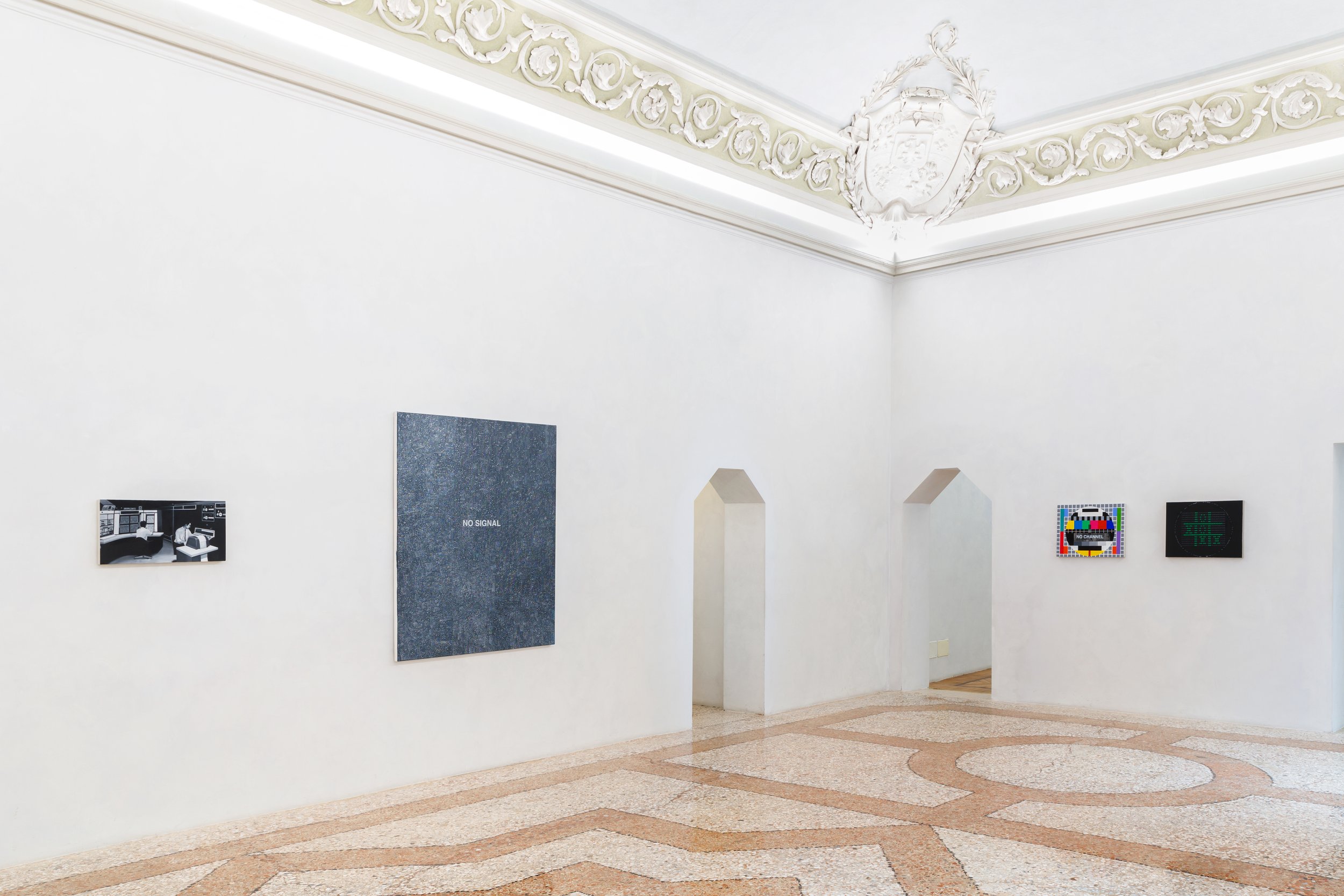
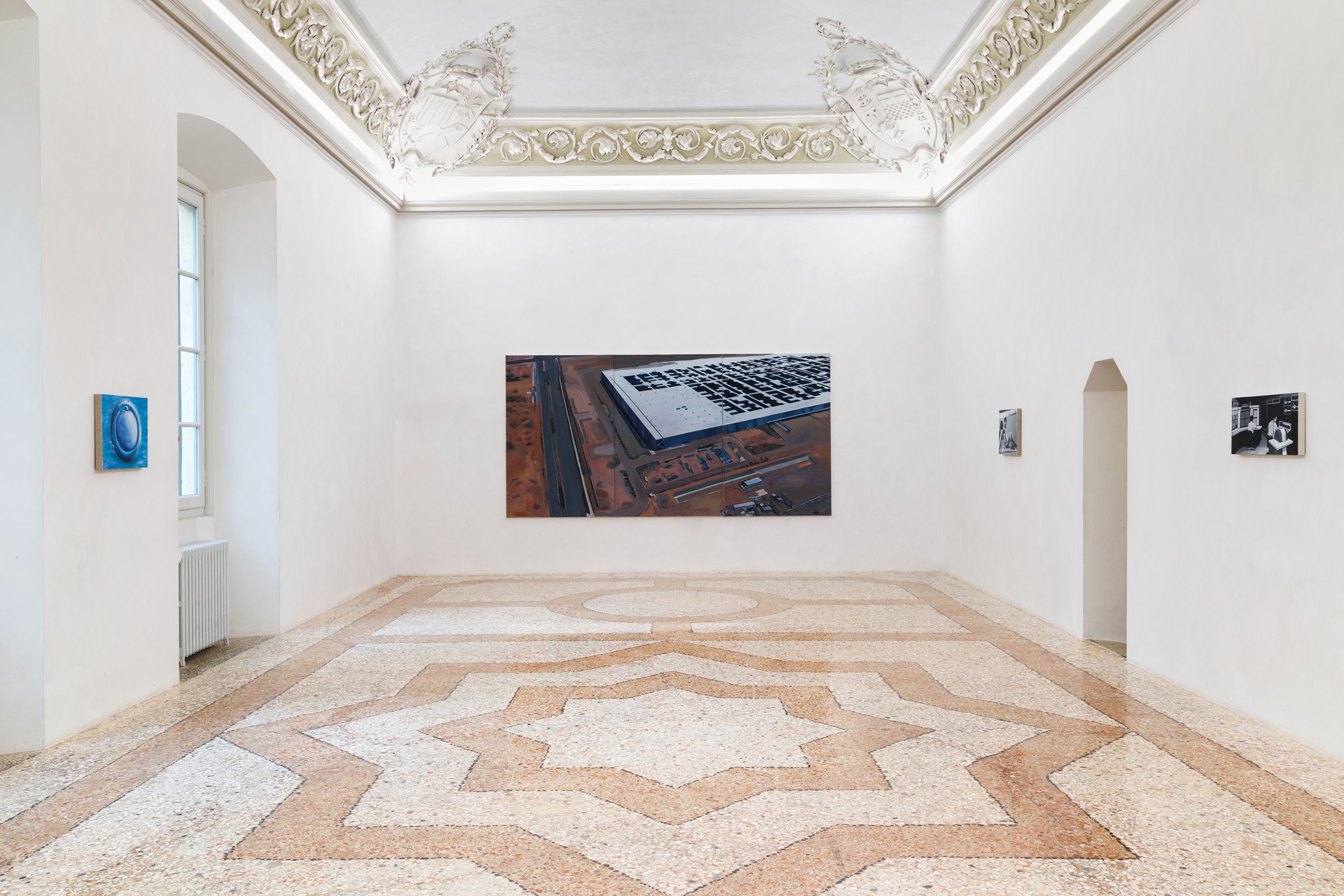
When this painting was exhibited at Peres Projects in Milan in 2022, Tan Mu placed it alongside NO SIGNAL (2019), creating what she described as "a dialogue between different moments in the history of technology." The two paintings, one depicting the birth of networked computing and the other depicting its failure mode, functioned as bookends. The PDP-10 represents the moment when computing became communal, when the machine's capacity for time-sharing allowed multiple minds to share a single computational resource. NO SIGNAL represents the moment when that communal infrastructure fails: when the signal drops, when the screen goes to static, when the network that connects us reveals itself as a fragile thing that can break. The pairing was not decorative. It was structural. Between the PDP-10 room, where people sit together and share a machine, and the static screen, where no one sits and no signal passes, lies the entire history of networked computing as a social form. Tan Mu's painting of the PDP-10 holds the beginning of that history still, the way a photograph holds a moment that has already passed but has not yet been released from its capacity to mean.
The room in the painting no longer exists. The PDP-10 was discontinued in 1983, and the buildings that housed them have been demolished or repurposed. The people who sat at those consoles have aged, retired, or died. But the painting does not mourn. It records. It takes the archival photograph of a computing lab and translates it, through the slow accumulation of oil paint on linen, into an object that occupies the same physical space as a viewer's body. The linen weave shows through the lighter passages. The brushwork is visible at arm's length. The painting insists on its own materiality in a way that the photograph it works from never could. This insistence is the painting's deepest argument. The PDP-10 was a machine made of metal and wire and magnetic core, operated by people who sat in rooms and typed with their hands. The painting, made of oil and linen and the labor of a single artist working alone in a studio, returns that physicality to view. The hands at the console have not disappeared. They have been painted.