The Map That Remembers Its Making: Tan Mu’s Mapping and the Archaeology of the Found Circuit
A circuit board does not want to be looked at. It wants to be inserted, connected, powered on, and forgotten. Its copper traces, solder points, and component sockets were designed for function, not contemplation. When a circuit board fails or becomes obsolete, it is discarded, its material value reduced to the few grams of gold and copper that can be recovered through chemical extraction. The board itself, with its intricate pathways and miniature cities of resistors and capacitors, becomes waste. Tan Mu collected thirty-five of these discarded boards, turned them over to expose their reverse sides, and mounted them on a wood panel to form Mapping (2021). The result is a work that refuses to let the functional object remain functional. It insists that the back of a circuit board, the side no one is supposed to see, contains a visual logic that rivals any map of the heavens. The gesture is simple: collect, flip, arrange. The consequences are not.
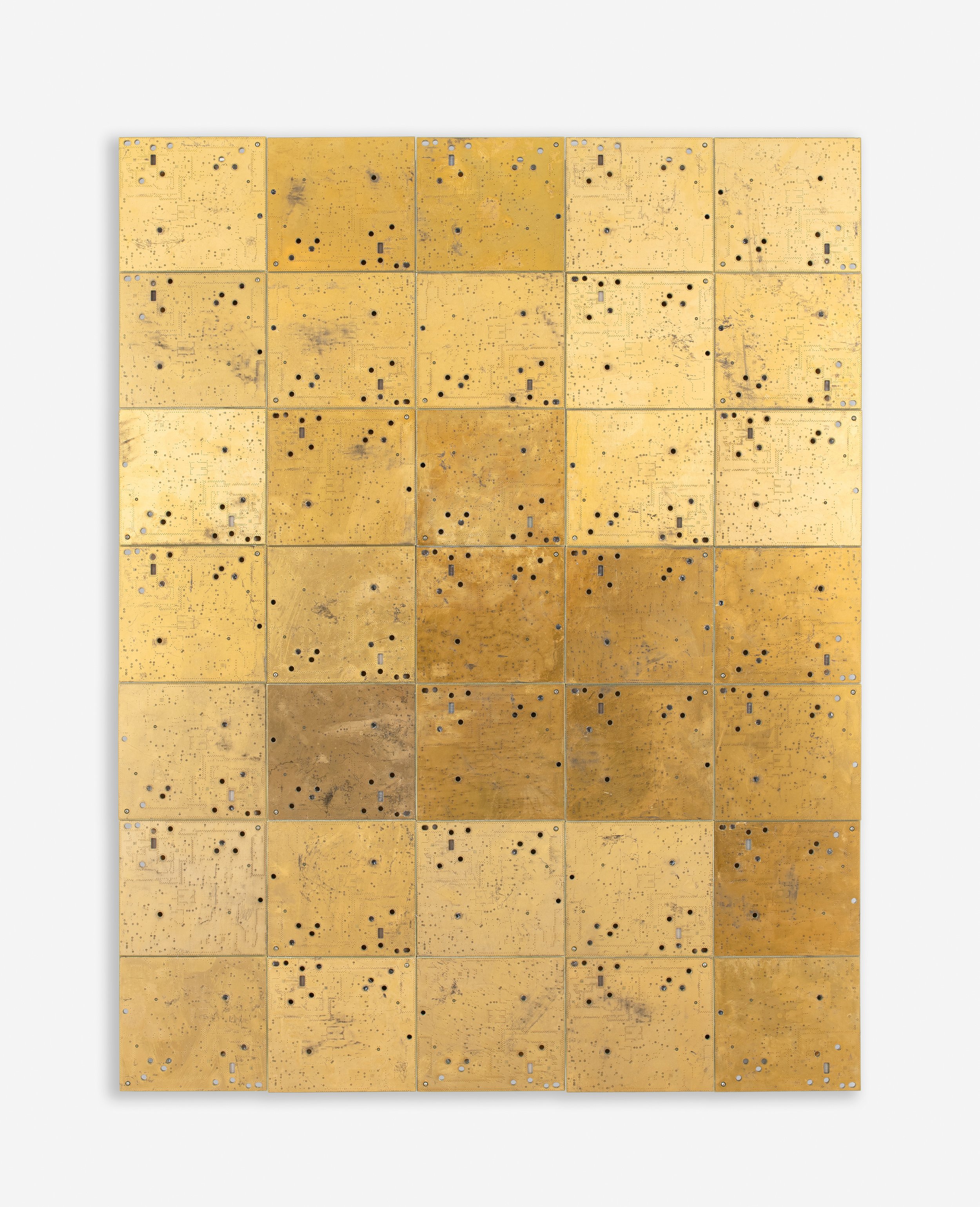
Circuit board mounted on wood panel, 63.5 x 49.5 cm (25 x 19.5 in). The dimensions are worth pausing on. This is not a painting scale. At roughly 64 by 50 centimeters, the work occupies a space closer to a photographic print or a small atlas page than to a canvas. The medium listing is precise and unusual: not oil on linen, but circuit board mounted on wood panel. The substrate is not a prepared ground waiting for paint. It is the object itself, or rather thirty-five objects, each with its own history, its own manufacturing date, its own intended function, now assembled into a single composition. The wood panel provides the support. The circuit boards provide everything else: color, texture, line, pattern, and the conceptual weight of discarded technology repurposed as visual material.
At arm's length, the surface of Mapping is a dense field of gold, green, and brown. The gold comes from the solder traces on the reverse sides of the boards, the conductive pathways that carry electrical signals from one component to the next. When the boards are flipped, these traces become the dominant visual element: thin golden lines that curve, branch, and intersect across each board's surface like tributaries of a river delta seen from above. The green is the fiberglass substrate, the standard FR-4 material that gives most circuit boards their characteristic color. The brown is the wood panel showing through the gaps where boards do not fully cover the surface. At two meters, the thirty-five boards resolve into a single composition that resembles a star chart or a satellite image of a city at night. The golden traces become constellations. The gaps between boards become dark corridors. The eye searches for familiar patterns and finds them everywhere, because the brain's pattern-recognition hardware is tuned to find order in random dot fields, and the circuit traces provide just enough regularity to trigger the recognition response without ever confirming it. Tan Mu has described this effect herself: the arrangement is meant to evoke "an astronomical pattern," with the sculptural landscape mirroring "a night sky filled with stars." At no distance does the work allow you to forget what it is made of. The component sockets, the solder pads, the silk-screened labels on the few boards whose front sides peek through: these are not abstract marks. They are the residue of function, and they persist in the composition like fossils embedded in sediment.
Kurt Schwitters began collecting waste paper, bus tickets, ration cards, and bits of wire in Hanover in the late 1910s, and he continued for thirty years, assembling these materials into collages, assemblages, and architectural constructions he called Merz. The word came from a fragment of the phrase "Kommerz und Privatbank," found on a piece of printed paper and isolated by Schwitters as the name for his entire practice. Merz was not just a technique. It was a position: the position that discarded material contains aesthetic potential that the culture which produced it has failed to recognize. Schwitters' Merzbild mit Bild (Merz Picture with Picture, 1919) incorporates a fragment of a reproduction painting, a piece of stamped metal, and a playing card into a composition where each element retains its original identity while participating in a new order. The playing card is still a playing card. The metal fragment is still metal. But the composition into which they have been gathered makes them speak to each other in ways their original contexts never required.
Schwitters' practice was founded on a principle of radical equivalence. A bus ticket, a piece of wood, a nail, and a fragment of a reproduction painting were treated as equal compositional elements. The value of each material was determined not by its origin or its market price but by its contribution to the total arrangement. This principle operates in Mapping with a different kind of found material. Tan Mu's circuit boards are not urban detritus in the Schwittersian sense. They are manufactured objects designed for precise technical functions, produced in factories to exact specifications, and discarded only when those functions become obsolete. But the structural logic of the assemblage is the same. Each board retains its identity as a circuit board. The traces are still traces. The solder points are still solder points. The composition does not transform them into abstract shapes. It places them in a new arrangement that makes their existing visual qualities visible in a way that their original context never required. The back of a circuit board is not seen when the board is functioning. It is pressed against the chassis, hidden, functional but invisible. Mapping makes it visible, and in doing so, reveals that the functional and the aesthetic have been cohabiting all along.
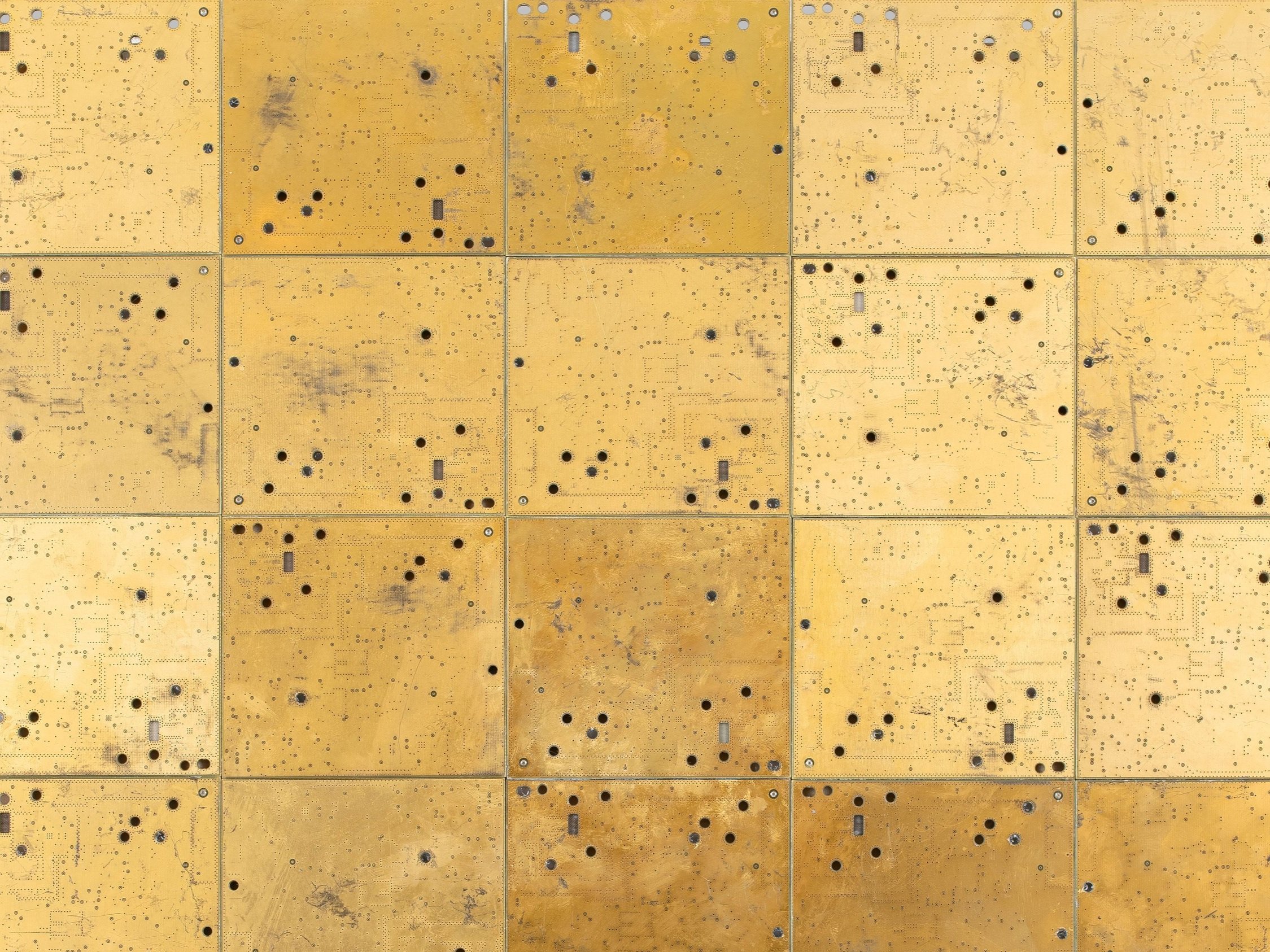
Tan Mu has written that Mapping "examines the functional essence of digitization while simultaneously creating a visual representation of the universe shaped by randomness and chance." This sentence carries more weight than it initially appears to. The "functional essence of digitization" is the binary logic of on and off, the manipulation of electrical signals through circuits that determine whether a gate is open or closed, whether a bit is one or zero. A circuit board is the physical substrate of this logic: every trace is a path for a signal, every solder point is a connection, every component socket is a place where a decision gets made. The board is a map of decisions, a cartography of logic. When Tan Mu arranges thirty-five of these decision-maps into a single composition, she is not abstracting away from function. She is accumulating functions until their combined visual weight becomes something other than function. The individual traces still carry their original meaning. Each golden line still once conducted a signal. But the total arrangement produces an effect that none of the individual boards could produce alone: the impression of a star field, a satellite view, a map of something larger than any single circuit could contain.
The printed circuit board, as a technology, has its own archaeology. The first PCBs were developed in the 1930s by Paul Eisler, an Austrian engineer who fled Vienna for London after the Anschluss. Eisler's invention was a method for etching conductive pathways onto a flat substrate, replacing the point-to-point wiring that made early radios and telephones labor-intensive to assemble. By the 1950s, the single-sided PCB had become standard in consumer electronics. By the 1970s, double-sided boards with plated through-holes allowed traces to run on both sides, doubling the density of connections that could be made on a single board. By the 1990s, multi-layer boards with four, six, or even twelve conductive layers stacked inside a single substrate had become commonplace in computers, and the traces on each layer were so fine that they could only be manufactured through photolithographic processes borrowed from the semiconductor industry. The boards in Mapping span this history. The thicker traces, wider component spacing, and through-hole mounting of the older boards represent an era when a single PCB might serve a single function in a single device: a television, a radio, a telephone exchange. The finer traces and denser component layouts of the newer boards represent the era of integration, when multiple functions were compressed onto progressively smaller surfaces. Tan Mu's decision to arrange these boards together, with their different generations of manufacturing visible side by side, creates a compressed timeline of computational evolution. The assemblage becomes a material archive of the shrinking distance between the trace and the decision it once carried.
The word "randomness" in Tan Mu's statement is carefully chosen. The arrangement of the thirty-five boards is not random in the mathematical sense. Tan Mu selected and placed each board. But the patterns that emerge from the assemblage, the connections between traces on adjacent boards, the visual correspondences that appear between components that were never designed to sit next to each other, these are the product of chance. Two boards manufactured for different devices, by different companies, in different decades, happen to share a similar density of traces or a complementary color of substrate. When placed next to each other, they form a visual rhyme that neither board's designer intended. This is not randomness as chaos. It is randomness as the condition under which pattern becomes visible. The circuit traces were designed to carry specific signals for specific machines. When those specific functions are no longer in play, the traces become lines, and lines can form constellations if you arrange enough of them and stand far enough back.
Tan Mu chose to present the back side of the motherboard as the main visual focus. Her reasoning is precise: "I chose to focus on the back side of the motherboard because it reveals a structure that is usually hidden yet fundamentally essential. This golden surface contains solder points, signal routes, power layers, and connection markings that quietly sustain the entire system." The front of a circuit board is all components: microchips, capacitors, resistors, sockets. It is the visible face of function, the part that engineers and technicians see and interact with. The back is the hidden architecture that makes the front possible. The solder traces on the back are the pathways through which every signal travels, every instruction passes, every computation is executed. They are the nervous system of the machine, and they are invisible during normal operation. Mapping makes this invisible architecture the primary visual experience. In doing so, it enacts the same reversal that Tan Mu describes in her broader practice: making visible what is normally hidden, treating the infrastructure as the subject rather than the support.
The Venezuelan-German artist Gego, working in Caracas from the 1950s through the 1990s, created sculptural environments she called Reticulareas. These were suspended webs of wire and metal, woven and knotted by hand into organic, net-like structures that hung in gallery spaces like three-dimensional drawings. Gego's Reticularea of 1969, installed at the Museo de Bellas Artes in Caracas, filled an entire room with interlocking wire meshes that visitors could walk through and around. The wire was industrial material, the same kind used in construction and manufacturing, but Gego transformed it through repetitive manual labor into something that read as both architectural and biological. The wire mesh suggested a nervous system, a spider web, a fishing net, a city plan viewed from above. It suggested all of these and committed to none of them.
Gego's wire was found in the sense that she did not manufacture it. She purchased it from hardware stores, the same places where builders and electricians bought it. Her transformation of industrial wire into art followed a logic parallel to Tan Mu's transformation of circuit boards. In both cases, the material retains its original identity. Gego's wire is still wire. Tan Mu's boards are still boards. But the arrangement into which each artist places her material generates meanings that the material's original context never required. Gego's Reticulareas have been read as critiques of modernist architecture, as celebrations of organic form, and as investigations of the relationship between line and space. All of these readings are valid because the work itself does not fix a single interpretation. It holds multiple possibilities in suspension, the way a net holds water. Mapping operates by a similar logic. The circuit boards suggest star charts, satellite views, neural networks, city plans, and river systems. Each reading is triggered by the same visual evidence: the golden traces, the green substrates, the gaps between boards. None of these readings is the "correct" one, because the work was not designed to illustrate any of them. It was designed to make the hidden architecture of computation visible, and in doing so, it makes visible the tendency of the human mind to find patterns in any field of marks.
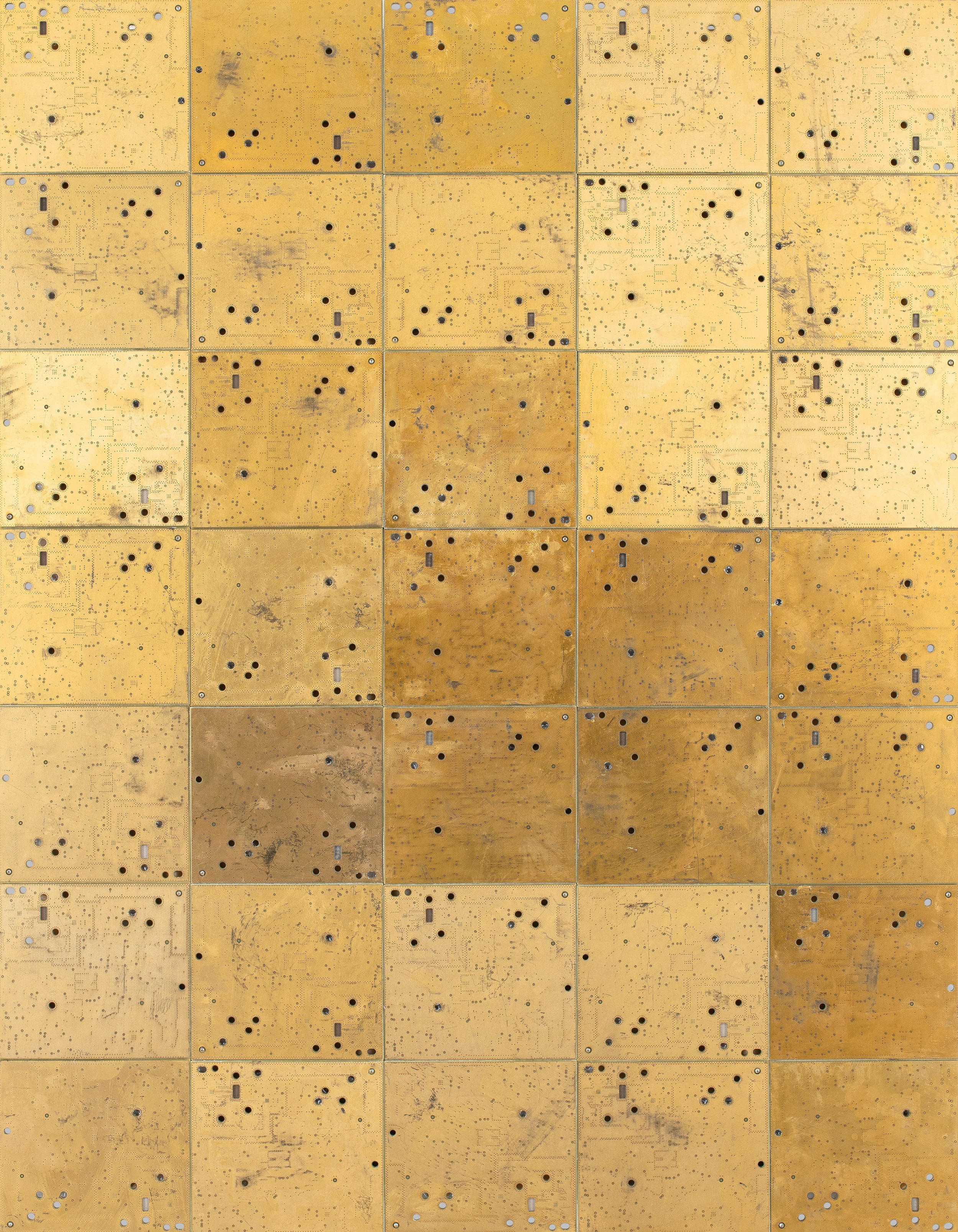
The curator Danni Shen, visiting Tan Mu's studio for Emergent Magazine in 2024, observed that the works "serve as a kind of witness to human socio-technological histories" and reflect "the trajectory and continuum of bodily and mediated presence through human technical developments." Shen's framing is particularly apt for Mapping, where the trajectory she identifies runs in both directions at once. The circuit boards carry the trajectory of human technical development: each one represents a specific generation of manufacturing, a specific set of capabilities, a specific moment in the history of computation. The oldest board in the assemblage may date from the 1980s or 1990s, when through-hole components and wide trace widths were standard. The newest may be from the 2010s, when surface-mount technology and multi-layer boards allowed for denser, finer traces. Together, they constitute a material record of several decades of computational evolution, compressed into a single visual field. But the trajectory also runs forward, from the specific functions these boards once served toward the new functions they now serve as compositional elements in an artwork. The solder trace that once carried a clock signal between a processor and a memory chip now carries a visual signal between one area of the composition and another. The signal has been rerouted. The trace still conducts, but what it conducts is attention, not electricity.
The Chinese philosophical principle of ge wu zhi zhi, which Tan Mu encountered during her studies at the Central Academy of Fine Arts in Beijing, translates roughly as "investigating things to extend knowledge." The principle holds that careful attention to the material world, to the specific properties and behaviors of objects, leads to deeper understanding of the principles that govern them and, by extension, of the moral and intellectual order that underlies all experience. Mapping is an exercise in ge wu zhi zhi by other means. The work investigates circuit boards. It turns them over, examines their reverse sides, arranges them, and looks at what the arrangement produces. The knowledge that results is not the knowledge of electronics. It is the knowledge that functional objects contain aesthetic dimensions that their designers neither intended nor suppressed, and that these dimensions become visible when the objects are removed from their functional context and placed in a new one. The circuit board does not become a star chart through some mystical transformation. It becomes a star chart because the human mind, confronted with a dense field of golden lines on a dark ground, recognizes the pattern it has been trained to find in the night sky. The board was always a map. It mapped signals. When the signals stop flowing, the map remains, and a different kind of reading becomes possible.
There is a specific pleasure in looking at the back of something that was never meant to be seen. It is the pleasure of finding a secret passage in a building you thought you knew, or discovering that the wallpaper in your grandmother's kitchen was printed on the reverse side of a military survey map. The hidden side always turns out to be more interesting than the side that was designed for display, because the hidden side was not designed for display at all. It was designed for work. And work, when it is stripped of its context and examined on its own terms, turns out to have its own aesthetic, its own logic, its own kind of beauty. Mapping takes this principle and makes it the basis of an entire composition. Thirty-five circuit boards, turned over and arranged on a wood panel, produce an effect that no single board could produce alone and that no functional context would ever have required. The map does not map a territory. It maps the act of mapping itself, and the territory it reveals is the one that was always there, on the back of every circuit board ever made, waiting to be seen.