The Delay That the Image Forgot: Tan Mu’s Share and the Time Painting Restores
On June 11, 1997, Philippe Kahn sat in the maternity ward of a hospital in Santa Cruz, California, waiting for his wife to give birth. He had a digital camera, a flip phone, and a laptop. While he waited, he wrote a few lines of code that connected the camera to the phone through the computer, creating a system that could take a photograph and transmit it instantly to a list of recipients. When his daughter Sophie was born, he took her picture and sent it. More than two thousand people received that image within moments of her first breath. It was the first photograph ever shared from a mobile phone. The technology that made this possible would, within a decade, transform the way every person on earth with a phone camera documented, transmitted, and consumed images. But in the moment it happened, it was a father in a hospital room, improvising a way to show his daughter to the world. Tan Mu paints this moment in Share (2021), and in doing so, she does something the technology never intended. She slows it down.
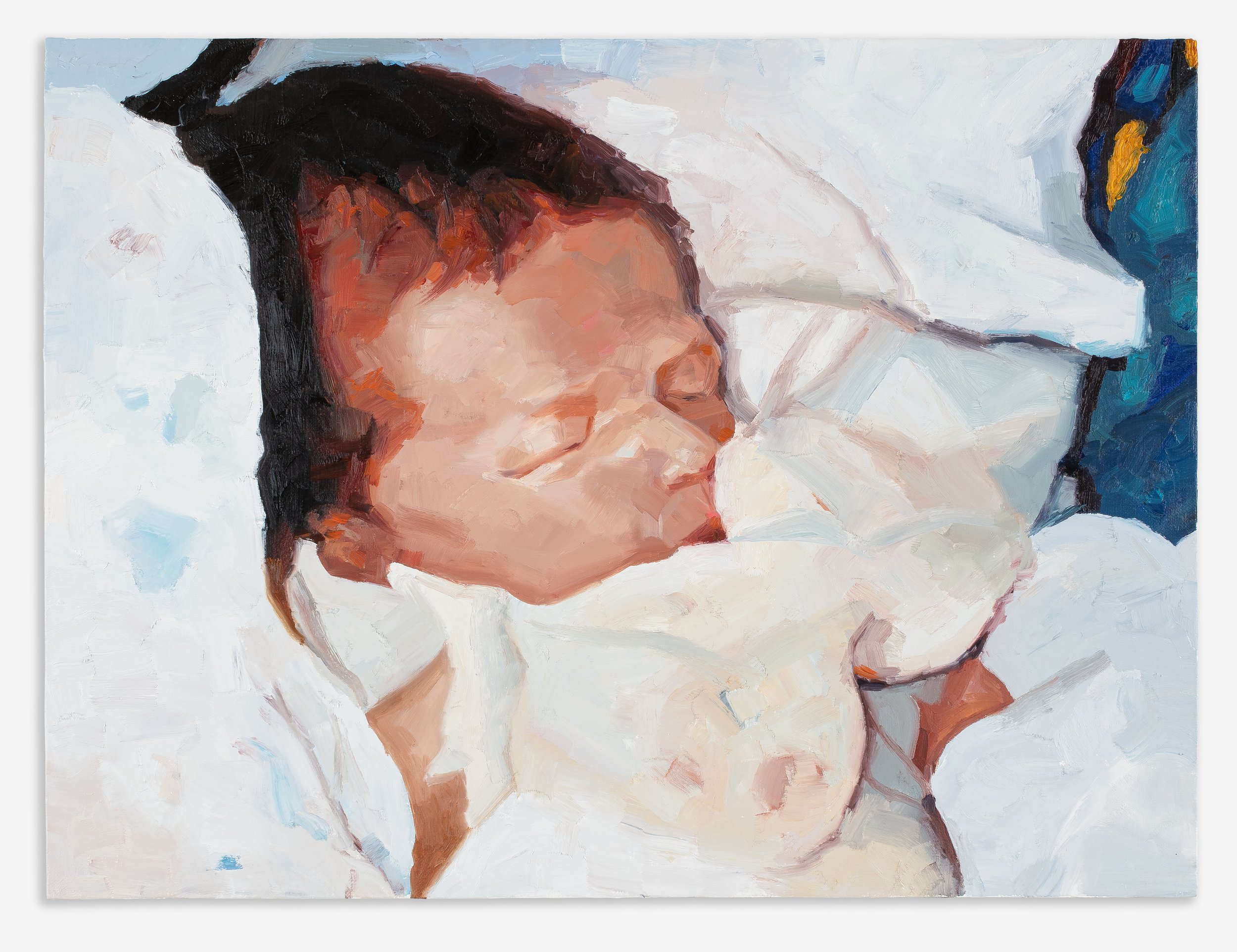
Oil on linen, 46 x 61 cm (18 x 24 in). The dimensions place the painting in an intimate register. This is not a monumental canvas that dominates a wall. It is a small rectangle, roughly the proportions of a tablet screen or a photograph held in two hands, designed to be looked at from arm's length, the way you would look at a picture of someone else's child on your phone. The paint is applied in thin, controlled layers over a warm-toned ground. The dominant palette is soft: cream, pale ochre, the muted flesh tones of a newborn's skin, and the darker shadows of the father's shirt and the hospital blanket. The composition is centered on the child, who occupies the middle of the canvas like a small bright form against the darker mass of the parent's body. At arm's length, the brushwork resolves into visible marks, each one a decision about where the light falls on skin, where the shadow pools in the folds of fabric, where the edge of a hand meets the curve of a blanket. At two meters, the painting coalesces into its source image: a low-resolution photograph taken by a digital camera in 1997, when a pixel was still visible and a compressed image still carried the grain of its transmission. Tan Mu has described her approach to this image in terms that make the relationship between source and painting explicit. She paints the photograph as it was: small, soft, slightly blurred, bearing the artifacts of the technology that produced it. The painting does not correct the image. It preserves its limitations.
The paint surface of Share enacts the same tension between clarity and diffusion that its source image embodies. In the areas around the child's face, Tan Mu applies the oil with a precision that borders on photographic: the curve of a cheek, the fold of a blanket, the shadow under a chin are all rendered with a tightness that holds the form in place. But as the eye moves toward the edges of the composition, the brushwork loosens. The father's shoulder dissolves into a field of dark strokes that suggest the shape of a body without delineating it. The hospital background is a haze of pale tones, applied in thin washes that let the linen weave show through. This gradation from sharp to soft is not a defect of the source image translated into paint. It is a compositional strategy that mirrors the experience of looking at a photograph on a small screen, where the center of attention is sharp and the periphery is indistinct, and where the eye fills in what the pixels cannot resolve. The painting makes the viewer's perceptual process visible: you look at the child, and everything else becomes background. The blur is not an absence of information. It is information about how attention works, and about how the technology of 1997 delivered its images in a state of partial resolution that required the viewer's participation to complete.
Tan Mu has said that "technology evolves rapidly, but the emotions behind it remain constant. Kahn's desire to share the joy of his daughter's birth is fundamentally the same reason people share moments on social media today." This observation is precise, and it carries a tension that the painting embodies rather than explains. The emotion is constant. The technology that mediates it is not. When Kahn sent that photograph in 1997, the act of sharing an image from a phone was a technical achievement. The image quality was poor. The connection was slow. The number of people who could receive it was limited by the hardware and the network. Today, sharing a photograph from a phone is so routine that it requires no thought at all. The emotional impulse has not changed. A parent still wants to show their child to the world. But the experience of sharing has changed beyond recognition, and with it, the experience of receiving. When two thousand people received Kahn's photograph, the novelty of the technology made them pay attention. Today, the same image would scroll past in a feed, glimpsed for half a second before the next image replaces it. The painting returns to that image the duration that the technology of sharing has taken away.
Christian Boltanski spent decades working with found photographs, taking images that were once personal and private and presenting them as collective memorials. His installation The Reserve of Dead Swiss (1990) fills a gallery with photographs of anonymous Swiss citizens taken from a newspaper obituary page, their faces lit by bare bulbs and wired to a system that clicks on and off at irregular intervals. The photographs are not enlarged or enhanced. They are presented at the scale of newsprint, grainy and impersonal, the way they appeared in the paper. Boltanski's intervention is not aesthetic. He does not improve the images. He recontextualizes them, taking them from one system of distribution, the newspaper, and placing them in another, the gallery, where the same faces that readers once skimmed past in a morning edition become objects of sustained, even devotional, attention. The clicking lights give each face a moment of visibility before it is plunged back into darkness, mimicking the way the newspaper had given each obituary a column of ink before moving on to the next story.
Boltanski's work operates on the boundary between the personal and the archival. The photographs he uses are personal in origin: they depict real people with real families, real lives, real deaths. But by the time Boltanski finds them in a newspaper, they have already been processed by a system that treats individual lives as data points, one obituary among hundreds. His installations restore something that the system of distribution had removed: the viewer's willingness to look, to pause, to grant a moment of attention to a face that the newspaper had already declared disposable. The analogy to Share is structural, not thematic. Tan Mu is not working with anonymous obituary photographs. She is working with a specific, historically documented image: the first photograph shared from a mobile phone. But the principle of recontextualization is the same. The original image, in its moment of transmission, was processed by a system that valued speed over duration. It was received, noted, and replaced by the next piece of data. The painting takes that image and places it in a context where speed is impossible, where the only way to look is slowly, because oil paint on linen demands duration from the viewer in the same way it demanded duration from the painter.
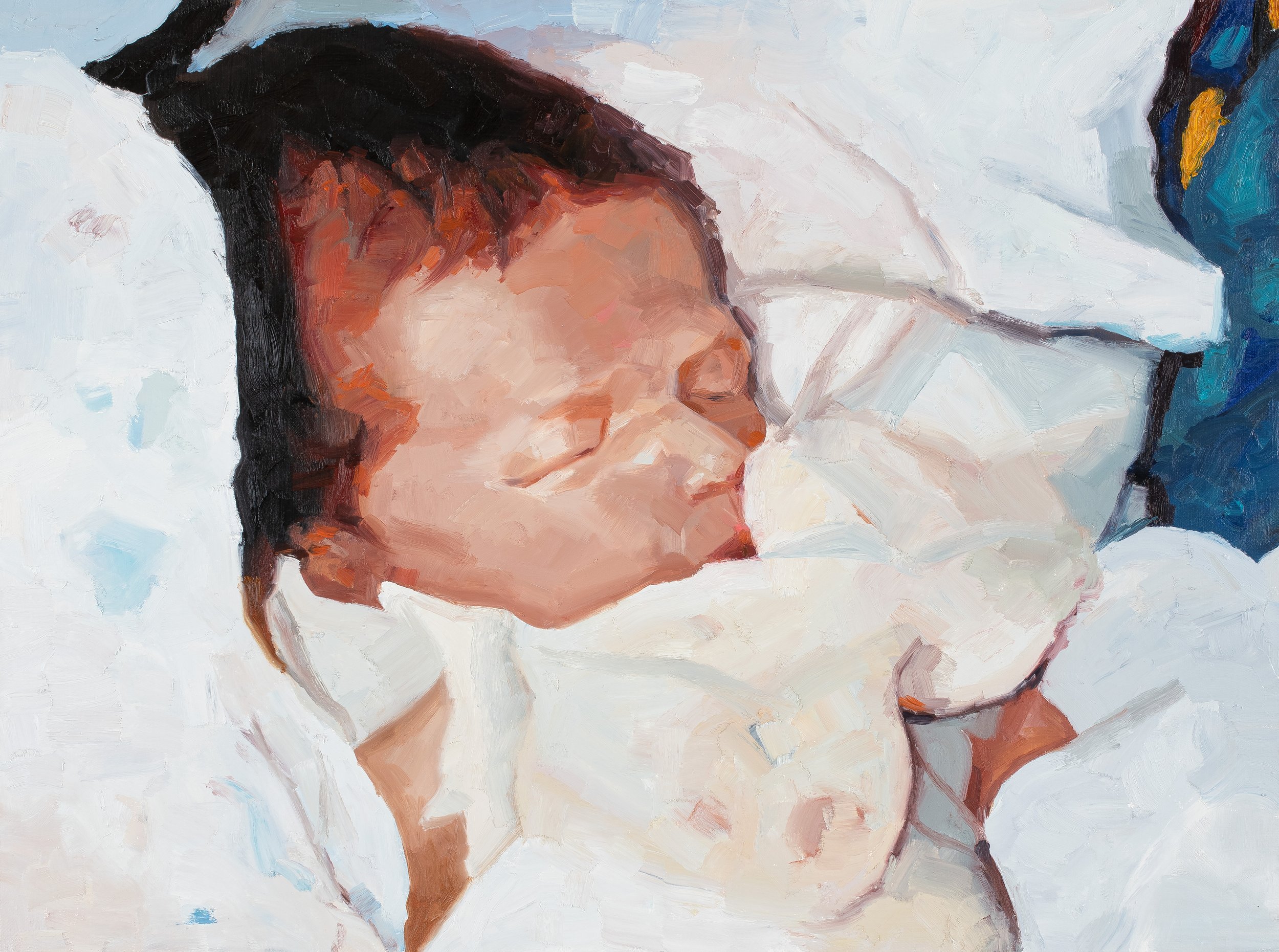
The painting Share depicts a scene that is almost uniquely positioned in the history of technology: a moment when a personal emotion, the birth of a child, and a technological first, the first mobile photo share, occurred simultaneously. Kahn did not set out to invent phone photography. He set out to share his daughter's birth with people who were not in the room. The technology was the vehicle, not the destination. Tan Mu's painting preserves this hierarchy. The child is at the center of the composition. The technology is present in the artifacts of the image: the pixelation, the soft focus, the slight blur that marks the image as having been taken by a camera with limited resolution and transmitted through a network with limited bandwidth. These are not flaws in the painting. They are its subject. They are the visual trace of the technology that made the sharing possible, and Tan Mu renders them with the same care she gives to the child's skin and the father's hands. The low resolution is not an accident to be corrected. It is a fact to be painted.
Tan Mu has drawn an explicit connection between the newborn in Share and the landscapes in her Horizon series. In her Q&A for the Atlas of Seeing, she notes that "I am drawn to images of newborns because they represent purity and the unknown. When a child enters the world, they exist before social labels, gender roles, or cultural frameworks take shape. This state of raw existence reminds me of images sent back by Mars rovers, showing landscapes untouched by human presence." The comparison is not casual. A newborn and a Martian landscape share a quality that Tan Mu identifies as the absence of prior naming. Neither has been categorized, labeled, or assigned a position in the social order. The child exists before identity. The landscape exists before habitation. Both are images of origin, and both are made visible by technology: the child by the camera phone, the landscape by the rover. In her studio, Tan Mu displays works depicting newborns alongside pieces from the Horizon series, and the pairing is deliberate. The final scene of Kubrick's 2001: A Space Odyssey, where a newborn floats above Earth, is the image she reaches for: a child and a planet, the beginning of life and the vastness of space, held in a single frame. Share belongs to this same logic. The newborn is not just a baby. The newborn is a threshold, a point before the world has named what it is looking at.
Doris Salcedo's sculptural works take everyday objects, shirts, shoes, chairs, beds, and subject them to processes that transform them from functional items into memorials. In Atrabilious (1992), Salcedo placed pairs of women's shoes in wall niches and covered them with sewn cow bladder, creating a membrane that is simultaneously translucent and opaque. The shoes are visible but inaccessible, present but sealed away. They are no longer shoes that someone could wear. They are shoes that someone once wore, and that now function as evidence of a body that is no longer there. Salcedo's materials are chosen for their domesticity. Shoes, shirts, beds: these are the objects that receive the imprint of a body most directly. They carry the shape of the person who used them. When Salcedo encloses them in bladder or stacks them in a gallery, she preserves the imprint while removing the function. The object becomes a vessel for absence.
Share operates by a parallel logic, but in reverse. Where Salcedo takes a functional object and renders it nonfunctional, Tan Mu takes a nonfunctional image and renders it functional again. The photograph Kahn sent in 1997 has long since ceased to circulate. It has been replaced by billions of subsequent phone-shared images, each one as instantaneous and disposable as the last. The original photograph, once a technological marvel, is now a historical artifact, its low resolution marking it as a relic of a slower era. By painting it, Tan Mu restores the image's capacity to hold attention. The painting does not duplicate the photograph. It translates it into a medium that requires time: time to make, time to look at, time to absorb. Nick Koenigsknecht, writing in the BEK Forum catalog about the Signal series, observes that "while observing technology, are we not looking at ourselves? Therefore perhaps these works function more as self-portraits, rather than depictions of external, scientific milestones." This is the key to Share. The painting is not a depiction of a telephone. It is a depiction of the desire to share, which is a human desire, not a technological one. Kahn built the technology in a hospital room because he wanted his family to see his daughter. The technology was the instrument. The emotion was the cause. The painting, by restoring the image to a medium that demands patience, returns the viewer to the emotion that the technology was built to serve but has since overwhelmed. Every phone-shared photograph is still motivated by what Kahn felt in that hospital room. But the speed of transmission has made the emotion harder to feel. The painting slows the image down to a pace where feeling becomes possible again.
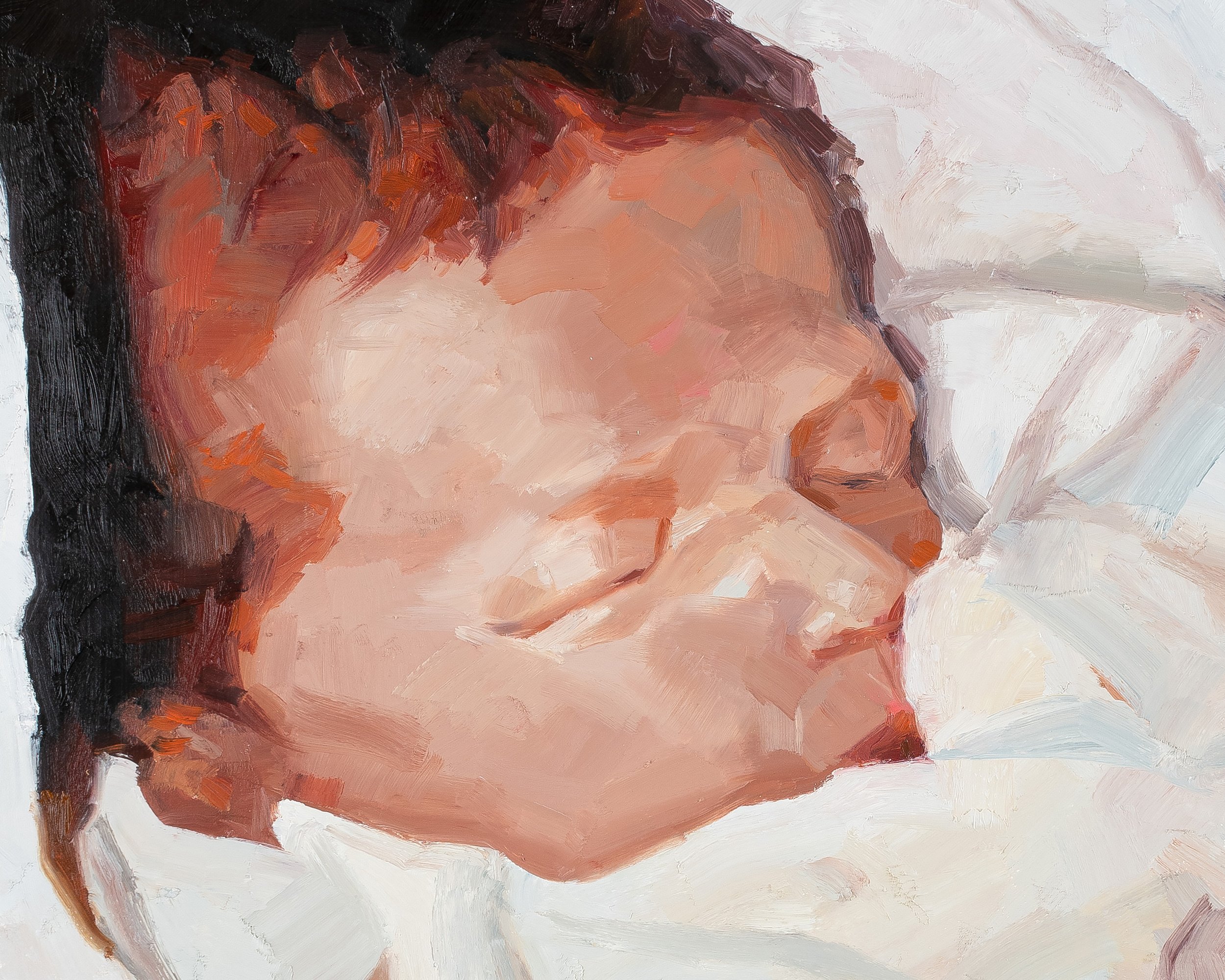
The scale of the painting reinforces its argument. At 46 x 61 cm, Share is small enough to be held, if paintings could be held. It occupies the space of a laptop screen or a photograph passed from hand to hand. This is not the scale of a history painting or an altarpiece. It is the scale of a personal document, the kind of image you keep in a drawer or prop on a desk. The intimacy of the dimensions matches the intimacy of the subject. A newborn cradled in a parent's arms is the most private of public images. It is private because the moment belongs to the family. It is public because the technology of sharing has already made it so. The painting holds both registers simultaneously: the private emotion of holding a child for the first time, and the public fact that this particular first-time was also the first time anyone shared a photograph from a phone. The composition does not privilege one over the other. The child is the subject. The pixelation is the medium. The emotion is constant. The medium has changed everything about how that emotion is received.
When the painting is exhibited alongside works from the Horizon series, as Tan Mu has arranged it, the newborn and the satellite view of a coastline occupy the same wall. One is a human scale of origin. The other is a planetary scale. What connects them is not just the technology that makes both visible. It is the condition of being seen for the first time. The newborn has never been seen before. The satellite landscape has never been seen from this angle before. Both images arrive through a technological medium that mediates between the viewer and a reality that would otherwise be inaccessible. And both images, in Tan Mu's rendering, are given back the weight of attention that their original media, whether phone camera or satellite sensor, were designed to transmit without retaining. The photograph of Sophie Kahn was seen by two thousand people and then replaced by the next image. The satellite photograph of a coastline is updated every few hours, each new version overwriting the last. The painting stops this process. It takes an image that was designed to move and makes it stay.
Koenigsknecht writes that the cables in Tan Mu's Signal paintings are "not only infrastructure but relic, glowing with the aura of what once physically tethered us together." The same can be said of the pixelation in Share. The low resolution of the 1997 camera phone is a relic. It is the trace of a technology that has been superseded so many times that its limitations now read as historical markers, the way the grain of a 1960s photograph reads as a period detail. But in the painting, the pixelation is not a relic. It is a living fact of the image. Tan Mu paints the blur and the soft focus with the same deliberate attention she gives to the child's cheek and the father's hand. The technological artifact and the human subject receive the same weight of paint, the same consideration, the same duration of looking. The painting does not distinguish between what is worth looking at and what is worth looking past. It treats the entire image as worthy of sustained attention, because the entire image, the child and the pixelation and the blur, is what the moment of first sharing actually looked like. The technology was never separate from the emotion. It was the vehicle through which the emotion moved. Painting that technology with care is painting the emotion with care. The delay that the image forgot, the time it takes to look at a painting and not just glance at a photograph, is the time that Share gives back.