The Edge That Has No Edge: Tan Mu’s Fractal 3 and the Architecture of Infinite Recursion
The Buddhabrot has no boundary. This is not a metaphor. The mathematical object that Tan Mu renders in Fractal 3 (2019) is a probability distribution of trajectories escaping the Mandelbrot set, and the distribution does not terminate at an edge. It attenuates. It thins. It becomes so sparse that the pixels representing it darken toward the background color, but the mathematical definition of the Buddhabrot assigns a non-zero probability to every point in the complex plane that produces an escaping trajectory, which means that, given sufficient computation time, the structure extends in every direction without reaching a limit. In practice, a computer rendering the Buddhabrot truncates it at some threshold of probability below which the pixel values become indistinguishable from black. The eye sees a border. The mathematics knows there is none. The painting occupies the space between what the eye perceives and what the structure dictates. It renders the attenuating edge as paint on linen, and in doing so, it transforms a computational artifact into a material fact.
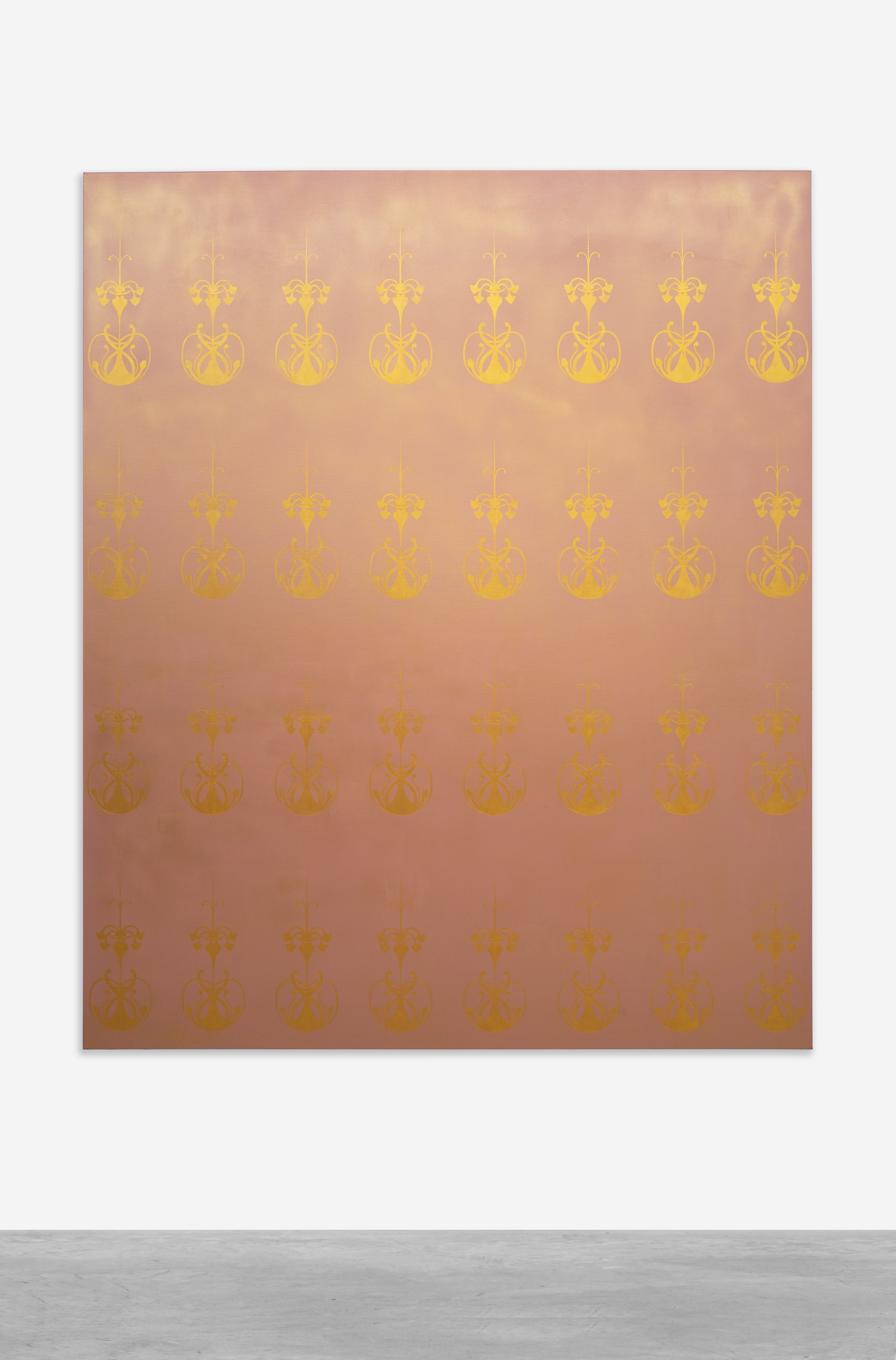
Oil and acrylic medium on linen, 182.9 x 152.4 cm (72 x 60 in). The dimensions place this among the largest works in Tan Mu's practice. A canvas nearly two meters wide and a meter and a half tall is not a surface you look at. It is a surface you enter. At arm's length, the paint reveals its hand. The acrylic medium creates a translucent ground through which the linen weave is visible, giving the surface a texture that hovers between the metallic sheen of a computer screen and the organic warmth of fabric. The oil paint is applied in thin, successive layers, each one a pass through the same region of the canvas, building density the way a computer builds pixel values through successive iterations. The darkest passages, the deep indigo and black at the center where the Buddhabrot's probability density is highest, are built from dozens of thin glazes that accumulate into a velvety darkness that the eye reads as depth rather than color. The lighter passages, where the probability thins and the trajectories become sparse, are rendered in pale washes of violet, grey-blue, and the occasional warm amber that reads as a trace of the light source embedded in the original computational rendering. At two meters, the painting resolves into its source image: the Buddhabrot, with its central dark form and its radiating branches, its filaments that reach outward and attenuate into the field of the canvas without ever arriving at a hard edge. The transition from dense to sparse is gradual, unbroken, and continuous. The painting does not frame the Buddhabrot. It extends it. The canvas is a finite surface, but the image it carries behaves as though the surface were infinite, petering out at the edges rather than terminating at a border.
Agnes Martin spent nearly four decades making paintings that appear to be grids. Horizontal and vertical lines, drawn in graphite on white or pale-colored grounds, spaced at regular intervals across canvases of modest to large scale. The grids are never rigid. The lines tremble slightly, the graphite catching light at different angles depending on where the viewer stands. Martin's The Islands (1979), a series of nine paintings each measuring 60 by 60 inches, presents nine variations on the same format: a square canvas with horizontal and vertical lines creating a grid of uniform cells. The nine paintings are identical in structure but different in color, ranging from a barely perceptible off-white to a deep rust. The variation is not in the grid. The grid is constant. The variation is in the ground, the surface on which the grid is drawn, and in the minute differences in the way the graphite catches the light. Martin insisted that her grids were not about geometry. They were about innocence, about the experience of seeing something for the first time, without memory or expectation. "My paintings have neither objects nor space nor time nor anything," she wrote. "They are about the awareness of being in the present moment."
The connection between Martin's grids and Tan Mu's Buddhabrot is not visual. Martin's paintings are minimalist. Tan Mu's painting is dense with filaments, branches, and attenuating trails. But the structural logic is the same. Both artists work with a recursive structure that generates infinite variation from a simple rule. Martin's rule is the grid: evenly spaced horizontal and vertical lines. The variation comes from the ground, the paint, the graphite, the light. Tan Mu's rule is the iteration: z equals z squared plus c, applied repeatedly to every point in the complex plane. The variation comes from the starting value, the number of iterations, the probability threshold. Both structures produce infinite depth from finite means. Martin achieves this through the subtle irregularities of the hand-drawn line, which make each grid cell slightly different from its neighbor in a way that the eye registers but cannot fully articulate. Tan Mu achieves it through the computational logic of the Buddhabrot itself, which generates new structures at every level of magnification, each one related to the whole but never identical to it. Both artists are painting infinity, but they are painting it from opposite directions. Martin starts with emptiness and adds the minimum structure needed to make that emptiness visible. Tan Mu starts with a maximum of structure and renders it with enough fidelity that the viewer can sense the infinite depth that the structure implies.
The Mandelbrot set, from which the Buddhabrot is derived, is generated by a rule of deceptive simplicity. Take a number c in the complex plane. Start with z equals zero. Apply the function z equals z squared plus c repeatedly. If the sequence remains bounded, c is in the Mandelbrot set. If it escapes, c is not. The boundary of the set, the line between the points that remain and the points that flee, is where the structure becomes infinitely complex. Zoom in on any point along this boundary and new shapes appear: spirals, seahorses, miniature copies of the whole set embedded at every scale. The Mandelbrot set was first visualized by Benoit Mandelbrot in 1980, though the mathematical groundwork was laid by the French mathematician Gaston Julia in the early twentieth century and extended by Pierre Fatou. Julia's work on iteration in the complex plane, conducted in 1917 and 1918, produced the Julia sets that would later be recognized as the structural building blocks of the Mandelbrot set, but Julia never saw his sets rendered visually. The computation required was beyond what was available in his lifetime. It was not until the arrival of computer graphics at IBM's research center in the late 1970s that Mandelbrot and his colleagues could generate the images that revealed the set's extraordinary complexity. The Buddhabrot, named by Melinda Green in 1993, takes the points that escape the Mandelbrot set and traces their trajectories back through the complex plane. The result is a probability map: regions where many trajectories pass are bright, regions where few pass are dark. The shape resembles a seated figure, which is why Green named it after the Buddha. The resemblance is not a mathematical property. It is an emergent feature of the probability distribution, a visual coincidence that the human eye recognizes because it is tuned to find anthropomorphic patterns in complex visual fields. Green's algorithm does not render the set itself. It renders the paths that escaping points take as they flee, accumulating probability density along their trajectories. The result is a visualization not of a boundary but of a behavior: the behavior of points that move from order to chaos and, in the process, trace paths that accumulate into something that looks like a figure sitting in meditation.
Tan Mu describes the Buddhabrot's structure as one where "a central black figure, with intricate branches and shapes radiating outward, yet the structure lacks a physical form." This is a precise observation. The black figure at the center is not an object. It is a region of maximum probability density, a zone where the trajectories of escaping points converge before diverging outward. The branches are not branches in the botanical sense. They are corridors of high probability, paths that escaping trajectories follow more often than others. The structure lacks a physical form because it is a mathematical object that exists only in the abstract space of the complex plane and is rendered visible through computation. It has no material existence until someone decides to compute it, sample it, and display it. Tan Mu's decision to render it in oil and acrylic on linen is a decision to give it material existence, to transform a mathematical probability distribution into a painted surface that occupies physical space and reflects physical light. The painting does not illustrate the Buddhabrot. It reifies it. It makes it a thing in the world, with dimensions, weight, and a surface texture that a viewer can approach, inspect, and walk away from, returning to find it unchanged.
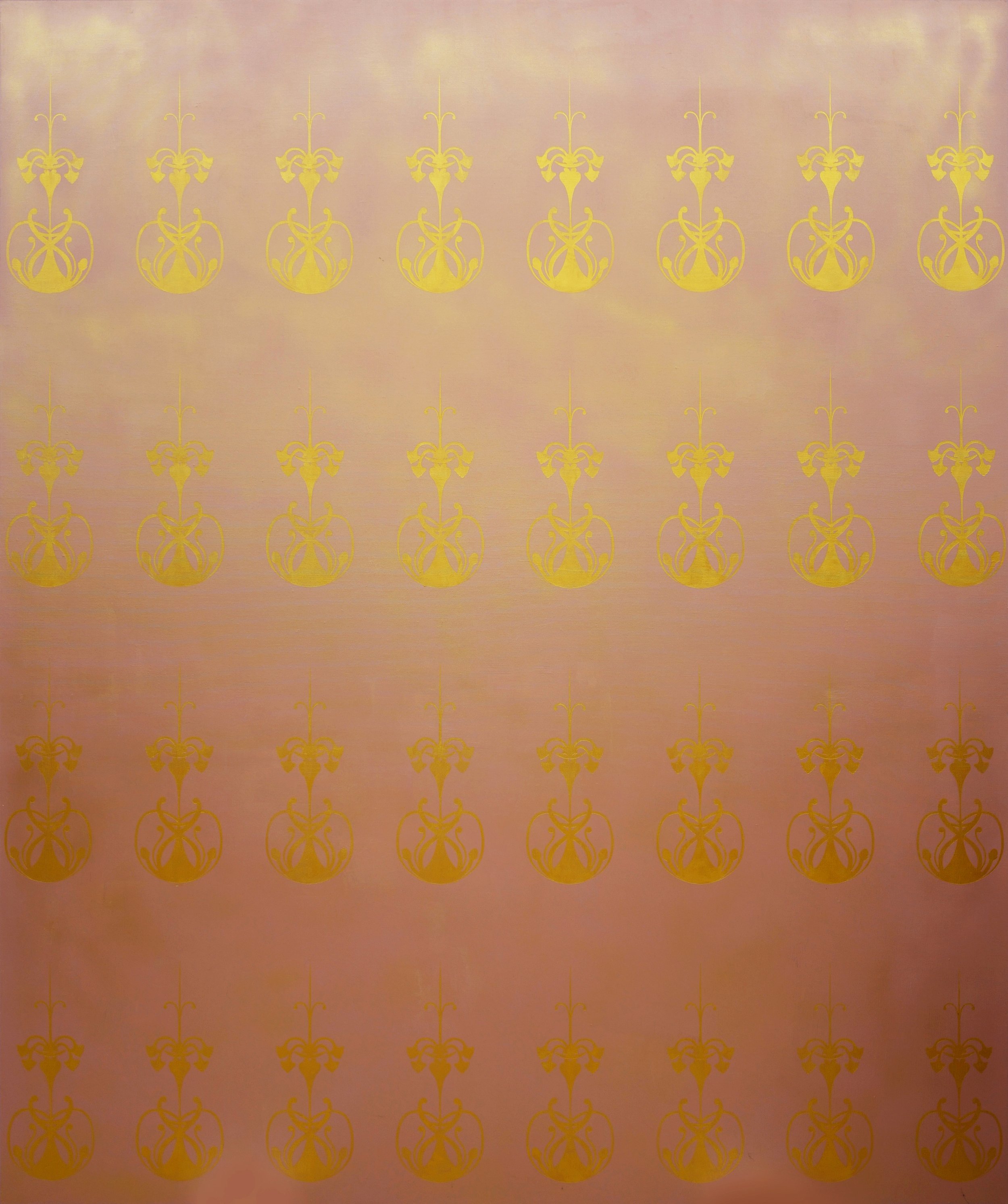
Anselm Kiefer's Sternenfall series, produced between 2007 and 2009, consists of large-scale works on canvas and lead that incorporate the names of stars, astronomical coordinates, and numerical sequences into thick, encrusted surfaces. The works refer to the poem "Every Man Is a Star" by the Romanian-Jewish poet Paul Celan, and to the Kabbalistic concept of tsimtsum, the divine contraction that created space for the world to exist by withdrawing infinite light into a single point. Kiefer's stars are not decorative. They are indices of absence, points of light in a field of lead and ash that represent the residue of contraction, the matter that remains after the infinite has compressed itself into finitude. The lead sheets that cover many of Kiefer's surfaces, heavy and oxidized, function as both material and metaphor: the heaviest common metal, a substance that resists transformation, pressed into service as a ground for the representation of the most distant objects in the universe.
The structural parallel between Kiefer's Sternenfall and Tan Mu's Fractal 3 lies in the way both works materialize the infinite. Kiefer's stars are painted on lead. Tan Mu's Buddhabrot is painted on linen. Both artists confront the same problem: how to represent a structure that exceeds the capacity of any finite surface to contain it. Kiefer's solution is to incorporate the material of his paintings into the argument. Lead is the densest common metal. It resists light. It absorbs it. When Kiefer paints a star on lead, the star is a point of brightness that the surface around it has been designed to suppress. The contrast between the luminous point and the heavy, absorbing ground enacts the logic of tsimtsum: the infinite contracts into a point, and the point shines against the field that has been emptied to make room for it. Tan Mu's solution is different but structurally analogous. The Buddhabrot does not contract into a point. It attenuates outward. But the logic of the painting is the same: the infinite is rendered on a finite surface by using the material properties of the medium to suggest what lies beyond the frame. The linen weave visible beneath the paint is the ground that absorbs light. The thin washes of oil and acrylic that fade toward the edges are the luminous filaments that the ground allows to appear. The viewer stands in front of the canvas and understands, without being told, that the structure continues beyond the edges, because the painting has trained the eye to recognize attenuation as a sign of continuation rather than termination.
There is a further correspondence between Kiefer's method and Tan Mu's that is worth drawing out. Kiefer's Sternenfall works are not representations of the night sky. They are surfaces that incorporate the names of actual stars, drawn from astronomical catalogs, inscribed in graphite or paint onto the lead ground. Each name is a reference to a specific point of light at a specific distance, a piece of data that anchors the painting to the real even as the material of the painting, the lead and ash, insists on the real's transformation into something heavier, more tangible, more present. Tan Mu's method is analogous in reverse. She does not inscribe the names of mathematical constants on her canvas. She inscribes the visual output of a mathematical function, rendered through a computational process that she then translates into paint. The Buddhabrot image she works from is not an approximation of the mathematics. It is the mathematics, computed to a specific resolution and rendered as pixel values. The painting takes those pixel values and translates them into layers of oil and acrylic, each one a decision about color, density, and transparency. The result is not a painting of a Buddhabrot. It is a painting that enacts the Buddhabrot's logic in a different medium, the way Kiefer's lead surfaces enact the logic of stellar contraction in a different medium. Both works take something that exists primarily as computation or concept and give it a material presence that the original form does not possess. The Buddhabrot, in its native habitat, is an array of floating-point numbers displayed on a screen. The painting makes it something you can stand in front of, something that occupies space and reflects light and returns your gaze with a density that no screen can replicate.
The art historian Li Yizhuo, writing about Tan Mu's practice in her 2022 essay "Imaginary of an Image," observes that the paintings "do not aim at diagnosing the modern spectacles from a distance. They conjure up a kind of vitality and depth of their own." This observation applies with particular force to Fractal 3. The painting does not diagnose the Buddhabrot. It does not explain it or comment on it. It conjures it. The vitality Li Yizhuo identifies is the vitality of a structure that is simultaneously mathematical and organic, a structure that produces new forms at every level of magnification the way a living organism produces new cells through division. The depth she identifies is the depth of infinite recursion, where each part contains the whole and the whole contains each part, and the boundary between part and whole is not a line but a region of continuous transformation.
Tan Mu has written that "in the Mandelbrot set, the dark central form appears to have a clear boundary, almost like a physical surface. Yet when you zoom in to search for its limits, new structures and spaces continue to emerge without end. Each magnification is not simply a closer look at something fixed but the generation of an entirely new image." This is the experience the painting offers. At two meters, the structure resolves into its overall form: the seated figure, the radiating branches, the field of attenuating probability. At arm's length, the structure dissolves into brushstrokes, glazes, and the visible weave of the linen. At ten centimeters, the brushstrokes dissolve into the texture of the paint film, the hairline cracks in the glaze, the grain of the linen fiber. Each level of magnification reveals a different order of information, and none of them is the final one. The painting is a finite object that carries within it the logic of infinite depth. It does not represent infinity. It enacts the condition of encountering a structure that generates new information at every scale, and it does so using the most finite of materials: oil paint, acrylic medium, and linen. The edge that appears to terminate the Buddhabrot at the boundary of the canvas is not the edge of the structure. It is the edge of the surface on which the structure has been rendered. The structure itself has no edge. The painting knows this, and it tells the viewer by the way the filaments thin and fade rather than stop. The thinning is the information. The fading is the proof.