The Frame That Slowed the Image: Tan Mu’s Philadelphia and the Paint That Holds the News Still
A car is upside down and on fire. This is not an unusual sentence to encounter in a news report from an American city in 2020. The image arrived through the same channels that had been delivering images of empty streets, closed storefronts, and masked faces for months: the phone screen, the laptop, the television running in the background of a locked-down apartment. Tan Mu saw it there, in a news report, and then she moved it. She took it out of the stream of images and put it on linen. She gave it a frame and a wall. She made it stay.
Oil on linen, 41 x 51 cm (16 x 20 in). The dimensions are those of a small painting, modest by the standards of Tan Mu's larger canvases but appropriate for a work that takes a single, compressed news image as its source. The scale is close to that of a laptop screen or a magazine page. You hold it at arm's length and the entire composition is visible without moving your eyes. The predominant palette is black and white. The background, the overturned car, the street surface, and the indistinct forms of the urban environment are all rendered in shades of gray that range from near-white to a dense, soot-black. Against this monochrome field, the flames emerge in sharp, hot color: orange, red, and the bright yellow that fire produces at its hottest point. The color is not blended into the gray. It cuts across it. The flames read as an intrusion, a vivid interruption in a world that has been drained of every other hue. This chromatic decision, the near-total suppression of color except for the fire itself, is not a representation of what the scene looked like. The original news photograph was in color. The decision to render the city in monochrome and reserve color for the flames is a painting decision, and it makes the flames the only living thing in the image. Everything else is documentation. The fire is event.
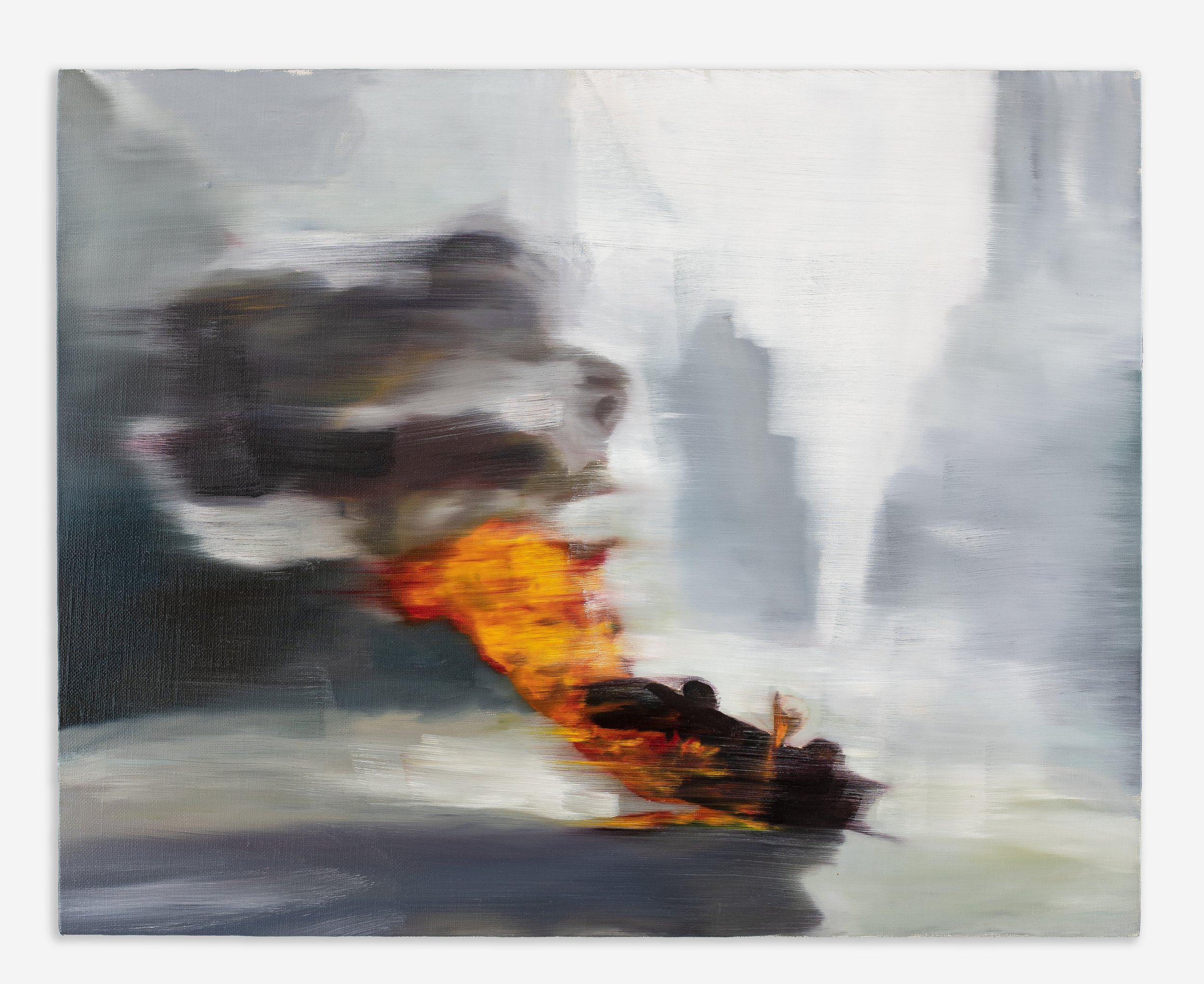
The brushwork reinforces the distinction between the monochrome field and the flames. In the gray passages, the paint is applied in horizontal strokes that drag across the surface, smearing the image into bands of tone that suggest motion blur, the kind of visual interference you get when a camera moves during exposure. These strokes are wide and rapid, laid down with a confidence that suggests speed rather than deliberation. They give the painting a kinetic quality, a sense that the scene is in motion even though the car is stationary, overturned, burning in place. The flames are painted differently. Here the strokes are smaller, more concentrated, layered on top of the gray ground in passages of thick impasto that catch the light and hold it. The orange and yellow pigments sit above the gray plane like a physical eruption on the surface of the canvas. At arm's length, you can see the individual strokes that build each flame. At two meters, the flames coalesce into a single, fierce presence that dominates the composition. The contrast between the smeared gray ground and the impasto flames enacts the same distinction that the color palette establishes: the city is background, documentation, gray. The fire is foreground, event, color.
Francisco Goya's The Third of May 1808 (1814) depicts the execution of Spanish civilians by French soldiers during the Peninsular War. The composition is organized around a single figure in a white shirt, arms raised in a gesture that simultaneously signals surrender and crucifixion, his body illuminated by the lantern that the soldiers have placed on the ground. The lantern is the only source of light in the painting. It falls on the central figure and on the faces of the men about to die, while the soldiers remain in shadow, their backs to the viewer, their faces unseen. The light creates a division in the painting that is moral as well as visual: the victims are seen, known, individual. The executioners are anonymous, mechanical, a wall of dark uniforms and leveled rifles. Goya did not witness the execution he painted. The events of May 1808 were reported through accounts and prints, and Goya reconstructed the scene from these mediated sources. The painting is not a document of direct observation. It is a document of what was known through the media of its time, reconstructed through the imagination and moral conviction of an artist who understood that the image, once painted, would become more durable than any newspaper report.
The structural parallel to Philadelphia is precise. Both paintings take a scene of collective violence that the artist learned about through mediated sources rather than direct experience. Both organize the composition around a central element that is illuminated while the surrounding environment remains dark: the lantern in Goya, the flames in Tan Mu. Both use that illumination to make a moral distinction visible. In Goya, the light falls on the victims. In Tan Mu, the color falls on the destruction. The burning car is not a victim in Goya's sense. It is an object, a piece of property, a machine that has been overturned and set alight. But the flames that consume it also illuminate it, making it the focal point of a composition that would otherwise be an undifferentiated field of gray. The fire is what the lantern is in Goya: the element that creates visibility, that divides the seen from the unseen, that makes it impossible to look away. And just as Goya's lantern casts the soldiers into shadow, making them anonymous agents of violence rather than individual men, Tan Mu's monochrome ground swallows the details of the city, making the urban environment into a backdrop of documentation against which the event, the fire, burns with an insistence that refuses to be ignored.
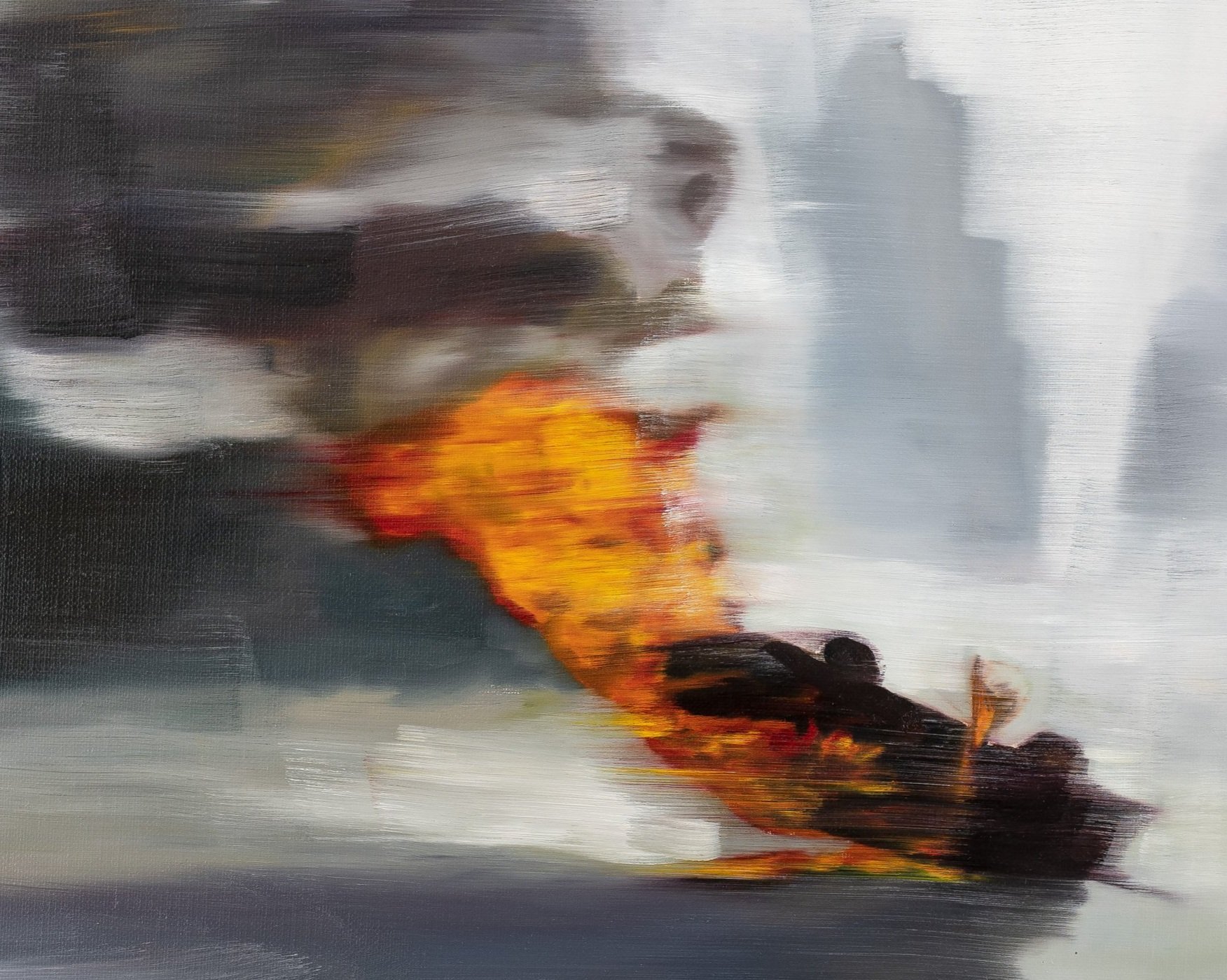
Tan Mu has described the painting's source explicitly. The image came from a news report she encountered during the early months of the COVID-19 pandemic, a period when she had moved her painting practice from her studio in New York back to her home, "experiencing isolation while witnessing collective upheaval through screens." The phrase "through screens" carries more weight than its brevity suggests. The pandemic made screens into the primary channel through which most people experienced the world. The streets of Philadelphia, the overturned car, the flames, the protesters, the police: all of this arrived through screens that compressed time and space into a single, continuous feed of images. The news image is designed for velocity. It arrives, registers, and is replaced by the next image in the sequence. Painting does the opposite. It takes an image and makes it stay. It removes the image from the stream and places it on a surface where it can be looked at for as long as the viewer chooses. This is not a neutral operation. It is a deliberate act of deceleration, and its effects are not just temporal but perceptual. When an image stays in front of you long enough, you begin to notice things that the velocity of the news feed makes invisible. You notice the color of the flames. You notice the gray of the street. You notice that the monochrome ground is not empty but full of horizontal strokes that suggest both the blur of motion and the texture of paint on linen.
Tan Mu's Q&A for the Atlas of Seeing connects Philadelphia directly to its companion painting, Minneapolis (2020), and the relationship between the two works clarifies what each one does on its own. In Minneapolis, the composition centers on a figure leaning out of a car window, holding a phone toward the burning scene. The phone becomes the compositional anchor, linking direct experience with digital recording. In Philadelphia, there is no figure holding a phone. There is only the overturned car and the flames. The act of witnessing has been displaced from the composition onto the viewer. The painting itself has become the medium of witness. The phone is no longer in the frame because the painting has taken over the phone's function. It is the device that captures and holds the image, except that where the phone accelerates the image into a feed, the painting decelerates it into a surface that demands sustained attention.
Andy Warhol's Death and Disaster series (1962-1964) takes its images directly from newspapers: car crashes, race riots, electric chairs, suicides. Warhol silkscreened these photographs onto canvas, often repeating the same image multiple times across a single work, each repetition slightly faded, slightly degraded, as though the image were wearing out from being seen too many times. In Orange Car Crash Fourteen Times (1963), the same photograph of a mangled car is repeated across the canvas in a grid that mimics the layout of a newspaper page or a contact sheet, the mechanical reproduction of the image mirroring the mechanical reproduction of the news. Warhol's interest was not in the events depicted. It was in the way those events were processed by the media system that turned individual tragedies into consumable content. The repetition enacts the numbness that comes from seeing too many images of too many disasters: each crash looks like the last one, and the viewer's capacity for outrage attenuates with each repetition until it disappears into the surface of the canvas.
Philadelphia occupies a position opposite to Warhol's in the spectrum of image deceleration. Where Warhol repeats the image until it becomes numb, Tan Mu holds the image still until it becomes visible. Where Warhol's silkscreen process mimics the mechanical reproduction of the newspaper, Tan Mu's oil painting mimics nothing. It is a hand-painted surface, built up stroke by stroke, each one a decision about tone, color, and density. The horizontal brushstrokes that smear the gray background suggest the motion blur of a photograph taken in haste, but they are not a photograph's blur. They are a painter's approximation of that blur, rendered in oil on linen, a medium that carries the memory of every stroke. The flames that cut through the monochrome are not a photograph's flames. They are painted flames, built from layers of impasto that hold the light in a way that no screen can replicate. The painting does not numb. It intensifies. It takes an image that was designed to be consumed quickly and makes it impossible to consume quickly. You cannot scroll past a painting. You have to stand in front of it and look, and while you are looking, the details that the news feed made invisible become visible: the specific orange of the flames, the specific gray of the street, the specific way the brushwork drags across the surface to create a sense of speed even though the surface itself is still.
The curator Saul Appelbaum, writing about Tan Mu's practice in his 2025 essay "Dreaming in Public," observes that her paintings "transform data cables into gestural constellations that oscillate between calculation and intuition." This observation, originally made about the Signal series, applies with equal force to Philadelphia, where the data in question is not submarine cable routes but the visual data of a news photograph. The transformation Appelbaum identifies, from calculation to intuition, is exactly what happens when a news image becomes a painting. The photograph was calculated by the camera's sensor, processed by the phone's software, compressed for transmission, and distributed through a network designed for speed. The painting is the product of intuition: the decision to drain the color from everything except the fire, the decision to smear the background with horizontal strokes, the decision to make the flames thick and present and physically above the surface of the canvas. Each of these decisions is a gesture that transforms the raw data of the photograph into something that the photograph, by itself, could never be: an object that demands time.
The size of the painting reinforces this demand. At 41 x 51 cm, Philadelphia is intimate. It is not a history painting that dominates a wall. It is a painting that you approach, that you lean toward, that you examine at close range. The flames, which from across the room read as a single chromatic event, resolve at arm's length into individual strokes, each one a deposit of pigment on linen, each one a separate decision made by a hand that was holding a brush while looking at a news photograph on a screen. The intimacy of the scale matches the intimacy of the act of looking. The news image was designed to be seen by thousands of people at once, scrolling past on a phone. The painting is designed to be seen by one person at a time, standing close enough to see the brushwork. This is not a trivial difference. It is the difference between consumption and attention, between seeing and looking, between an image that is over in half a second and an image that takes as long as you are willing to give it.
Tan Mu has said that "painting creates space for sustained attention and reflection" in a world where "images circulate rapidly and narratives are often shaped or distorted by media systems." Philadelphia is the enactment of this principle. It takes a single image from the endless stream of 2020 news coverage, removes it from its context, strips it of the color that would make it look like every other news photograph, and paints it in a palette that makes the fire the only source of chromatic energy in a world of documentation gray. The result is not a record of what happened in Philadelphia. It is a record of what happens to an image when you stop it from moving and look at it long enough to see what it contains. The fire is still burning. The car is still overturned. The gray city is still there. But the image is no longer interchangeable with every other image of every other burning car in every other city in every other year. It has become specific. It has become still. It has become something you cannot scroll past.