The Aperture That Looks Back: Tan Mu’s Gaze: Observable Infinity 02 and the Iris That Reverses the Gaze
The observable universe is a sphere with a radius of approximately 46.5 billion light years, centered on the observer. This is not the size of the universe. It is the size of the region from which light has had enough time to reach us since the Big Bang. Beyond this sphere, there is more universe, but we cannot see it because its light has not arrived yet, and in some cases it never will, because the expansion of space is carrying those regions away from us faster than the speed of light. The boundary of the observable universe is not a wall. It is a horizon, a limit imposed by the physics of light propagation and cosmic expansion, and it is different for every observer. The observable universe of a telescope in Chile is not the same as the observable universe of a telescope in Japan, though the overlap is nearly total. The observable universe of a being in a galaxy 30 billion light years away is entirely different, its sphere of visible space overlapping with ours only at the margins, and its center located around a point we will never see. To look at the map of the observable universe is to look at the boundary of what light can reach us, which is also the boundary of what we can know. Tan Mu's Gaze: Observable Infinity 02 (2025) takes this map and turns it into an eye.
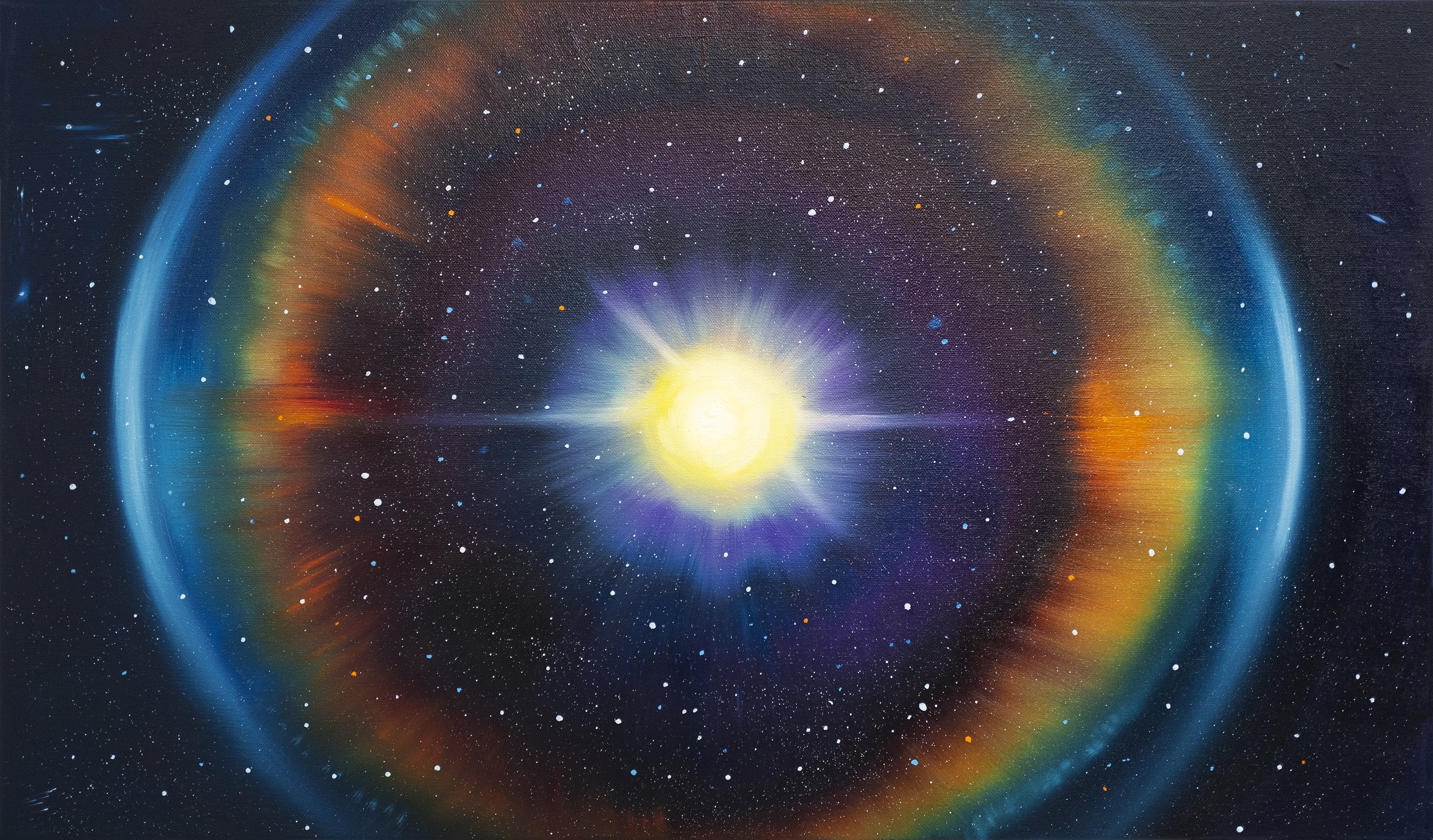
Oil on linen, 36 x 61 cm (14 x 24 in). The dimensions are intimate and horizontal, the proportions of a widescreen view or a human eye seen in profile. At this scale, the painting occupies the field of focused vision when held at arm's length, which is the distance at which you would hold a small object to examine it closely. The composition is dominated by a radiant circular form at the center of the canvas: a "cosmic iris," as Tan Mu describes it, composed of concentric rings of color that transition from warm tones at the center, amber, gold, fiery orange, to cooler tones at the edges, deep violet, indigo, and finally the near-black of the surrounding space. The transition is gradual. There is no hard boundary between the warm center and the cool periphery. The rings of color fade into each other the way the rings of a planetary atmosphere fade into the darkness of space, or the way the iris of an eye fades from its pigmented center into the darkness of the pupil. At arm's length, the brushwork reveals itself in thin, concentric strokes that follow the curvature of the rings, each one a deliberate pass around the central axis, building density through accumulation rather than through a single heavy application. The linen ground is visible in the darkest passages at the outer edge, where the paint thins to a transparent wash that lets the fabric show through, giving the periphery a textile quality that parallels the woven structure of a real iris. At two meters, the painting resolves into a single, luminous form: an eye, a sun, a map, a mandala, a cross-section of the cosmos organized around a center that radiates outward into darkness.
Tan Mu has described her process for this work with unusual directness. "The inspiration came from a map of the observable universe, which struck me as resembling an iris, almost as if the universe itself was gazing back." The resemblance is not incidental. The map of the observable universe, when rendered as a two-dimensional projection, shows a concentric structure: the most distant, and therefore oldest, structures form an outer ring of the cosmic microwave background, while the more recent, closer structures cluster toward the center, with our own galaxy at the center of the map. The visual result is a circular diagram with concentric shells of increasing density toward the middle, which does, in fact, resemble the cross-section of a human eye. The iris is a ring of pigmented tissue that controls the amount of light entering the pupil. The map of the observable universe is a ring of galactic structures that controls the amount of information reaching the observer. The resemblance between the two is not a metaphor. It is a structural isomorphism. Both the iris and the cosmic map are circular apertures that mediate between an observer and a field of information, and both are defined by what they allow to pass through and what they keep out.
Odilon Redon's The Cyclops (c. 1914) depicts a single enormous eye rising above a landscape. The eye belongs to Polyphemus, the Cyclops from Homer's Odyssey, but Redon's Polyphemus is not the terrifying monster of the epic. He is a gentle, almost tender presence, his single eye soft and watchful, gazing down at the sleeping figure of Galatea, the nymph he loves, who lies naked on the hillside below. The painting is not a scene of threat. It is a scene of observation. The Cyclops sees Galatea. Galatea does not see the Cyclops. The eye watches from a position of unreciprocated desire, and the landscape that surrounds both figures is lush, dreamlike, painted in pastel tones that suggest a world seen through the filter of longing rather than through the hard clarity of daylight. Redon's eye is not an instrument of surveillance. It is an organ of love, or at least of attention so sustained that it becomes indistinguishable from love. The eye watches because it cannot look away, and the painting holds the viewer in the same position, looking up at the eye that looks down at the figure it cannot possess.
The structural parallel between Redon's Cyclops and Tan Mu's cosmic iris is the reversal of the gaze. In both works, something enormous looks down at something small. In Redon, it is the Cyclops looking at Galatea. In Tan Mu, it is the universe looking at the viewer. The reversal is explicit in Tan Mu's own language: the cosmic iris, she writes, represents "only a fraction of the cosmos, limited by light's reach, and humbles us with the boundaries of our understanding." The map of the observable universe is the universe looking at us through the aperture of what we can see. When Tan Mu renders this map as an eye, she makes the reversal visible. We look at the cosmos, and the cosmos looks back. We map the universe, and the universe maps us. The concentric rings of the cosmic iris are the same as the concentric rings of the astronomical map, because the structure of observation is the same at every scale: a center, an aperture, a field of information, and a boundary beyond which nothing can be known. The painting does not illustrate this structure. It enacts it. The viewer stands in front of the canvas, looking at the eye, and the eye looks back, because the composition is organized around a center of radiance that pulls the gaze inward toward the bright core, the same way the pupil of a real eye pulls light inward toward the retina.
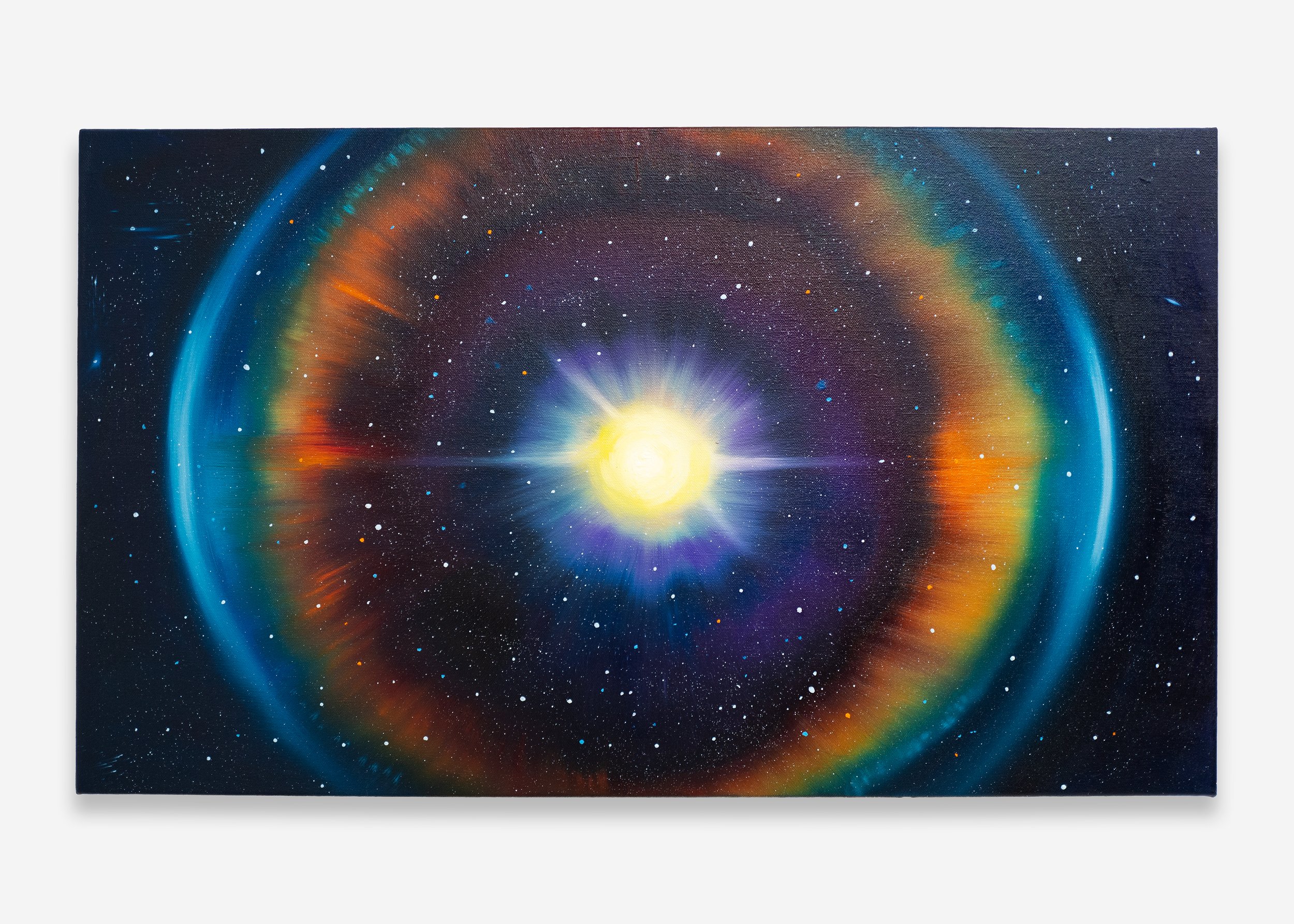
The observable universe is defined by the distance light has traveled since the Big Bang. Light from beyond this distance has not had enough time to reach us. This means that the boundary of the observable universe is not a physical edge. It is a temporal horizon. The universe continues beyond it, but we cannot see it because the light from those regions has not arrived. This is not a limitation of our telescopes. It is a limitation of the physics of information. Nothing travels faster than light, and light has only had 13.8 billion years to make the journey. The expansion of space has stretched the distance light has had to travel, which is why the observable universe has a radius of 46.5 billion light years rather than 13.8, but the principle remains: we can only see what light has had time to bring us. Tan Mu's description of the cosmic iris captures this principle with precision. The iris, she writes, represents "only a fraction of the cosmos, limited by light's reach." The word "fraction" is key. The observable universe is not the whole universe. It is a subset of it, defined by what light can reach and what it cannot. The boundary of the iris is the boundary of the fraction. Beyond the iris, there is more. But we cannot see it. The painting renders this boundary as a gradual transition from the warm, luminous center to the cool, dark periphery, where the paint thins to a wash and the linen shows through. The boundary is not a line. It is a gradient, a zone of diminishing information, the way the edge of the observable universe is a zone of diminishing light.
Tan Mu's Q&A for the Atlas of Seeing expands on this principle. "I wanted to move beyond a purely scientific view, infusing it with emotion and mystery. Technology and humanity converge. I am examining what we can observe while also honoring the vast unknown that science alone cannot fully capture. This piece reflects my fascination with the invisible structures that bind us, whether through technology, memory, or shared experience." The convergence she identifies is not a convergence of content but of method. Science observes the universe through instruments that extend the reach of the eye. Painting observes the universe through the eye itself, or rather through the hand that serves the eye, translating what the eye has seen into what the hand can make. The painting is not a map of the observable universe in the astronomical sense. It is a map of what observation feels like from the inside: the pull toward the center, the fading of information at the edges, the sense that the center is looking back.
Mark Rothko's mature paintings, from roughly 1949 onward, are composed of two or three rectangular fields of color stacked vertically on large canvases. The rectangles do not have hard edges. They float within the canvas, their boundaries defined by the gradual transition from one color zone to the next rather than by a line. In works such as No. 61 (Rust and Blue) (1953) and Orange, Red, Yellow (1961), the upper rectangles glow with warm, luminous color, while the lower zones recede into darker, cooler tones. The effect is of light emanating from within the canvas rather than being projected onto it. Rothko insisted that his paintings were not abstractions. They were dramas, he said, and the rectangles were actors. The specific drama varied from painting to painting, but the structure was consistent: a luminous form hovering above a darker ground, radiating light into the space around it, pulling the viewer's eye toward its center the way a candle flame pulls a moth.
The connection between Rothko's luminous rectangles and Tan Mu's cosmic iris is not merely visual, though both works share a palette that transitions from warm, bright centers to cool, dark peripheries. The connection is structural. Both artists use the same compositional logic: a center of radiance surrounded by zones of diminishing intensity, organized so that the viewer's eye is drawn inward toward the brightest point. In Rothko, this point is the upper rectangle, which hovers above the darker ground like a sun above a horizon. In Tan Mu, this point is the center of the iris, the brightest, warmest zone in a composition that fades outward into darkness. Both compositions create the illusion that light is emanating from within the canvas rather than being reflected off its surface. This illusion is achieved through the same technical means: thin, layered applications of paint that allow light to pass through the upper layers and reflect off the ground, creating a sense of depth and luminosity that opaque paint cannot produce. The comparison is not meant to collapse the distance between the two artists. Rothko's paintings are non-representational. Tan Mu's painting has a specific referent: the map of the observable universe. But the structural logic is the same. Both artists build a luminous center and a receding periphery, and both use that structure to create the sensation of looking into something that is also looking out.
The curator Yiren Shen, writing about Tan Mu's practice, observes that her works "serve as a kind of witness to human socio-technological histories" and that they "reflect the trajectory and continuum of bodily and mediated presence through human technical developments." In Gaze: Observable Infinity 02, the trajectory Shen identifies runs from the telescope to the eye. The map of the observable universe is a product of the most advanced telescopic technology humans have built: the Wilkinson Microwave Anisotropy Probe, the Planck satellite, the Sloan Digital Sky Survey, instruments that have mapped the distribution of galaxies and the fluctuations of the cosmic microwave background with a precision that would have been inconceivable a century ago. These instruments extend the reach of the human eye to the edge of the visible cosmos. But the map they produce, when rendered as a two-dimensional projection, takes the form of an eye. The technology of looking, pushed to its furthest limit, produces an image that resembles the organ of looking. The instrument of observation becomes a mirror of the observer. This is the reversal that the painting enacts. The telescope looks out at the universe, and the universe, through the telescope, looks like an eye that is looking back.
Tan Mu has noted that the painting came together "almost effortlessly, as if it had a life of its own." The colors "blended smoothly, and light seemed to naturally radiate from the canvas." She began with a smaller scale to test whether the cosmic iris would retain its intensity, and was "surprised by how powerful it felt." The surprise is revealing. The small-scale test confirmed that the compositional logic of a radiant center and a fading periphery generates its own intensity regardless of the size of the canvas. The cosmic iris does not need to be large to be powerful. It needs to be precisely calibrated, with the transition from warm to cool, from bright to dark, managed so that the eye is drawn inward and then held there, unable to look away, because the center is the brightest point in the visual field and the periphery is the darkest, and the eye, which is itself an organ designed to seek light, will always move toward the brightest point it can find. The painting uses the viewer's own visual apparatus against them. It makes the eye seek the center of the iris, which is also the center of the cosmos, which is also the center of the map, which is also the point from which the universe is observed. The center of the painting is the center of observation, and observation is the center of the painting. The gaze reverses itself, and the viewer becomes the viewed.
The title of the work contains the key. Gaze: Observable Infinity 02. The colon divides the title into two parts. "Gaze" is the act. "Observable Infinity 02" is the object. But the colon also suggests equivalence, the way a colon in a dictionary definition suggests that the term on the left can be substituted for the term on the right. The gaze is the observable infinity. The observable infinity is the gaze. We look at the cosmos, and the cosmos, in its structure, looks back. The painting holds this reversal still. It takes a process, the continuous, reciprocal act of observing and being observed, and freezes it into a single image that can be looked at for as long as the viewer chooses. The iris does not blink. The center does not dim. The light continues to radiate from within the canvas, not because the painting emits photons, but because the layers of translucent paint, applied with the precision of a jeweler working on a small surface, create the illusion of internal luminosity that persists for as long as the viewer stands in front of it. The painting is an aperture. The aperture is an eye. The eye is the universe. The universe is looking at you looking at it, and the boundary between observer and observed, like the boundary of the observable universe itself, is not a wall but a gradient, a zone where the known fades into the unknown, and the light that reaches you is the same light you have been sending outward since the moment you opened your eyes.