The Light That Replaces the Light: Tan Mu’s Sunset and the Signal Behind the Window
Rayleigh scattering dictates that the shorter wavelengths of sunlight, the violets and blues, scatter first as the sun descends toward the horizon. What remains to reach the eye are the longer wavelengths, the oranges and reds, which is why sunset produces its characteristic warmth. The physics is precise: the greater the distance light travels through the atmosphere, the more the shorter wavelengths are deflected away from the direct path, and the redder the transmitted light becomes. At the moment Tan Mu photographed the East River from her studio in downtown Manhattan, the scattering had already begun its quiet substitution. Natural illumination was thinning. Within minutes, the streetlights and window lamps across the water would take over, and the transition from one regime of light to another would be complete. Sunset is not a static view. It is a process of replacement, and the painting that bears its name registers that process at the exact instant when the replacement becomes visible.
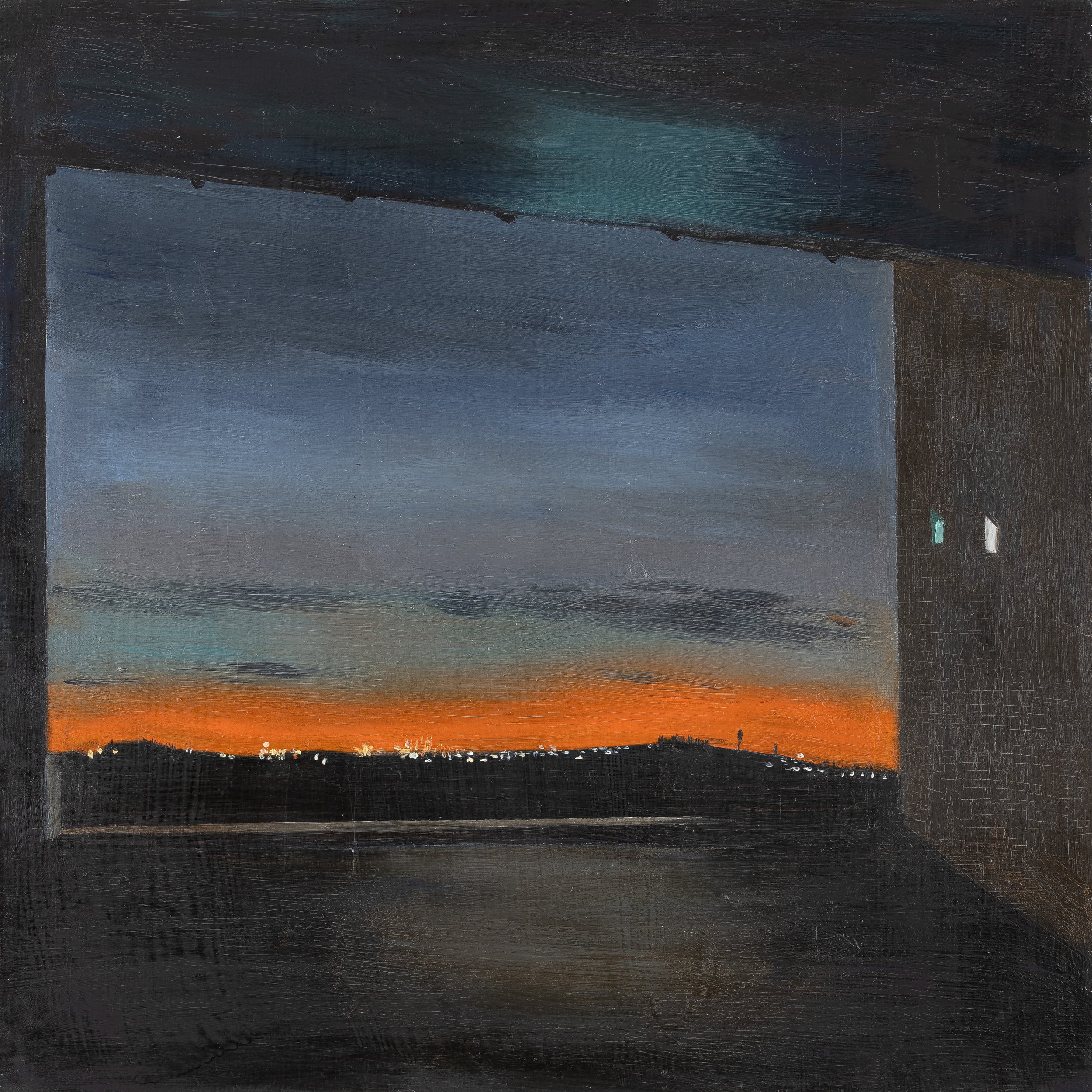
Sunset (2021) is small, just 31 x 31 cm, a square panel of oil on canvas. The dimensions matter. This is not a painting that engulfs the viewer. It is a painting that requires the viewer to come close, to lean in, the way one leans toward a window at dusk. The scene is composed from an interior: a room with a wall that catches the last warmth of daylight, a window or balcony rail, and beyond it the wide band of the East River reflecting a deep orange that bleeds upward into muted violet. On the far shore, small points of artificial light have already appeared. They are pinpricks, each one a marker that natural light has begun to cede its authority. The interior wall carries its own small light, a lamp or reflected glow, that mirrors the distant illumination across the water. The painting holds this moment of double registration, the last of the sun and the first of the electric grid, in a square that fits in the palm of two hands.
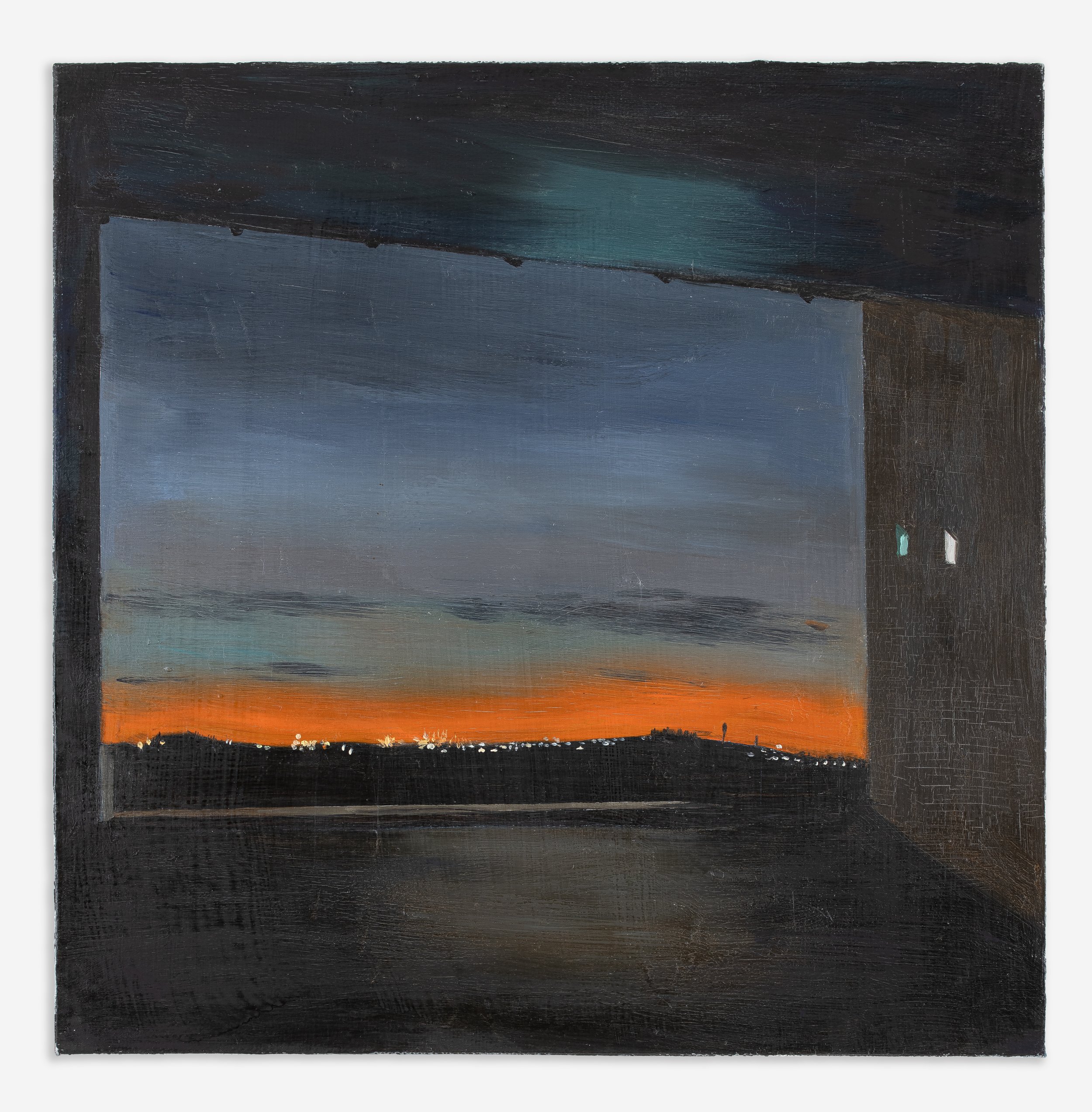
The surface of Sunset tells a story about attention and duration. The sky over the East River has been built in thin, successive layers of oil paint, each one a correction or a deepening of the one before it. The orange band at the horizon is not a single gesture but an accumulation, the way actual sunset color builds as particulates and moisture scatter light at increasing angles. At arm's length, the surface reveals its history: you can see where an earlier layer of cooler violet was allowed to show through the warmer orange, producing a chromatic vibration that the eye registers as luminosity rather than as separate colors. The water below is darker, almost black in places, with horizontal strokes that suggest reflection without describing it. These strokes do not mimic the river's surface. They record the act of looking at it, the hand moving laterally the way the eye scans across water. The city lights on the far bank are applied with a different pressure, small dense marks that sit slightly above the surrounding paint, each one a tiny raised point that catches actual light when the painting is viewed under gallery conditions. Tan Mu has described how she builds access points in her Signal paintings with "thick, wax-heavy oil paint, resembling the soldered connections of electronic circuits." Here, in a quieter register, the distant window lights across the East River receive the same treatment: they are nodes in a network, and their material presence on the canvas makes them physically legible as such.
Vilhelm Hammershoi painted windows and the light that passes through them for his entire career. In Interior with Young Woman Seen from Behind (1904), a woman stands at a window in a Copenhagen apartment, her back to the viewer, looking out at a courtyard. The room is painted in tones of grey and muted brown, and the light from the window falls across the floor in a pale rectangle that barely disturbs the stillness of the interior. Nothing in the painting asks to be dramatic. The drama is in the precision of the restraint. Hammershoi eliminates every element that does not serve the geometry of threshold: the woman marks the boundary between inside and outside, the light marks the boundary between natural and domestic, and the floor receives both. His interiors are not descriptions of rooms. They are descriptions of what light does to a room, how it enters, how it transforms the color of a wall, how it defines the boundary between warmth and cold, between public and private. The window is never merely a window. It is the frame through which one regime of visibility yields to another, and the interior is the register where that yielding becomes visible.
Tan Mu's Sunset works the same threshold from the opposite direction. Where Hammershoi paints a room receiving daylight, Tan Mu paints a room losing it. The warm glow on the interior wall in Sunset is the last light of the sun, not the first, and its function in the composition is twofold: it registers the sun's departure and it prepares the surface for the electric lights that will replace it. The window in Hammershoi admits the world into the private space. The window in Tan Mu's painting frames a view that is already transitioning from natural perception to a mediated one, where the lights across the river are not merely visual phenomena but signals, data points in an urban network that operates regardless of whether anyone is watching. Danni Shen has observed that Tan Mu's works "serve as a kind of witness to human socio-technological histories," and Sunset makes this explicit: the distant lights are not scenic details. They are the visible evidence of an infrastructure that will outlast the sunset, that was already operating before the sun went down, and that will continue after the sky has gone entirely dark.
The transition from natural to artificial light that Sunset documents is not merely an aesthetic event. It is a daily instance of what the historian Wolfgang Schivelbusch identified in Disenchanted Night (1983): the industrial revolution's replacement of organic time with mechanical time, and the replacement of firelight and daylight with gas and then electricity. Schivelbusch traced how the introduction of gas lighting in nineteenth-century cities did not simply extend the day. It restructured social life, reordered the relationship between public and private space, and produced an entirely new visual environment in which artificial illumination became the norm rather than the exception. Before gas lamps, the city was dark after sunset in a way that is difficult to imagine now. The street and the river were not merely unlit. They were invisible. Night was a genuine interruption in the continuity of urban perception. When Tan Mu frames the East River at the moment when the last natural light and the first electric light coexist, she is not painting a view. She is painting the exact instant when the city ceases to be a natural environment and becomes a technological one. The transition is not abrupt. It happens in degrees, in minutes, and it happens every single day. Sunset makes this continuous, quotidian substitution legible as a single image.
The East River itself has a specific relationship to this substitution. The body of water that separates Manhattan from Brooklyn and Queens is not a river in the geological sense. It is a tidal strait, a brackish channel connecting Long Island Sound to Upper New York Bay, and its currents reverse direction with each tide cycle. The lights that appear along its far bank during sunset are not abstract points. They belong to the neighborhoods of Long Island City, Greenpoint, and Williamsburg, whose waterfronts have undergone successive waves of industrial and residential development since the nineteenth century. The same shoreline that once held shipyards and sugar refineries now holds glass condominium towers whose windows reflect the last orange of the sunset before switching to interior illumination. The electrical grid that powers those lights was first constructed in the 1880s, when Edison's Pearl Street Station in lower Manhattan, just south of where Tan Mu's studio would later be located, became the first commercial central power plant in the world. The transition that Sunset documents, from the cosmic to the municipal, from the rotation of the earth to the switching of a grid, has a specific historical origin point within walking distance of the view the painting depicts. The East River at dusk is not a generic landscape. It is the place where electrified urban lighting was invented, and every evening the river witnesses the event that this invention made possible: the replacement of the sun by the grid, performed on the same shoreline where it first occurred.
Tan Mu has stated that the distant lights across the river "resemble points of data or signals, similar to the visual language I use in works about networks and information systems." This is not a metaphor she applies after the fact. The painting's composition already treats those lights as nodes. They are distributed across the far bank in a pattern that suggests neither randomness nor order, but the irregular regularity of an actual network: some clustered, some isolated, some barely visible, others bright enough to hold their own against the sunset's residual warmth. The same hand that paints submarine cable access points in the Signal series, building each one as a raised point of wax-heavy pigment, paints these Brooklyn and Queens lights with the same deliberation. They are not atmosphere. They are infrastructure, and their presence in the painting reframes the entire scene. What looks at first glance like a sunset over the East River becomes, on sustained attention, a portrait of two systems of illumination in the act of handing authority from one to the other.
Gustave Caillebotte's Young Man at His Window (1875) places a male figure at an open balcony, looking out across a Haussmann boulevard in Paris. The composition is divided vertically: the dark interior on the left, the sunlit exterior on the right, and the figure occupying the threshold between them. The buildings across the street are rendered in the precise, almost photographic detail that Caillebotte favored, and the effect is to create a visual field where the city is not a backdrop but the subject. The man looking out is our surrogate, but the painting is not really about his interior experience. It is about the city that unfolds beyond his frame, a city that has been radically redesigned by Baron Haussmann's boulevards and that now presents itself to the window as a spectacle of order, light, and stone. Caillebotte was painting the new Paris, the Paris of wide streets and uniform facades, the Paris where the view from a window was no longer a view of the neighbor across the alley but of a planned urban corridor that extended to the horizon. The window had become an instrument of urban planning, and the person standing at it had become a consumer of the view that planning had produced.
Tan Mu inverts Caillebotte's structure. Where Caillebotte's figure looks outward into daylight, Tan Mu's view is from inside a room looking at a scene that is losing its daylight. The city across the water is not a spectacle of architectural order. It is a field of scattered light points that will soon be the only illumination available. Caillebotte's boulevard is legible: you can read the buildings, the carriages, the pedestrians. Tan Mu's far bank is already becoming illegible: the buildings are silhouettes, the individual windows are reduced to pinpoints, and the only information the scene transmits is the fact of occupation, the fact that behind each point of light someone has turned on a lamp. This is what the city looks like when it has ceased to be architecture and has become a transmission network. The window that frames this view is not Haussmann's instrument of urban spectacle. It is a receiving station, and the painting is what that station registers at the moment when the signal changes from analog to digital, from sun to grid, from a single source to a distributed array.
The interior wall in Sunset carries a small light of its own. It is a modest detail, almost an afterthought in the composition, but it does crucial structural work. It establishes that the painting is not a landscape. It is a threshold portrait, a painting about the boundary between two spaces and two systems of illumination. The wall light is the third term in the painting's system: the sunset, the city lights, the interior lamp. Each one belongs to a different order of light. The sunset is cosmic, produced by the rotation of the earth and the physics of atmospheric scattering. The city lights are municipal, produced by a power grid and a network of transformers and underground cables. The interior light is domestic, produced by a single fixture controlled by a single switch. Tan Mu places all three in the same visual field and allows them to echo one another. The warm glow on the wall rhymes with the warm glow on the horizon. The tiny window lights across the water rhyme with the lamp on the wall. The painting proposes that these three systems are not separate but continuous, and that the transition from one to another is not a disruption but a handover, the way a relay runner passes a baton without breaking stride.
The square format of the painting, 31 x 31 cm, reinforces this sense of containment and simultaneity. A horizontal rectangle would privilege the landscape, the sweep of the river. A vertical rectangle would privilege the interior, the wall and its lamp. The square holds both in equilibrium. It is the format of a monitor, a screen, a viewport. When Tan Mu describes the distant lights as resembling "points of data or signals," she is not reaching for a technological metaphor. She is identifying a visual correspondence that the painting's composition has already enacted. The square frame treats the view from the window the way a screen treats its content: as a bounded field in which information is distributed according to a logic that is internal to the system. The sunset, the river, the city lights, the interior glow: all of these are data within that field, and the painting's task is to register the moment when the primary data source, the sun, begins to yield to the secondary one, the grid.
Sunset sits within Tan Mu's practice as a hinge work, the painting that makes explicit what the submarine cable paintings, the quantum cryostat paintings, and the MRI scans have always implied: that the visible world is never merely visible. It is always already a system of signals, and the task of the painter is not to represent the signals but to register the moment of their transformation. In the Signal paintings, the transformation is geographic and infrastructural. Cables carry data across ocean floors. In the MRI and Quantum Computer paintings, the transformation is technological and perceptual. Machines render the invisible visible. In Sunset, the transformation is temporal and luminous. It happens every day. It happens so routinely that most people stop noticing it, the way they stop noticing the cables under the ocean or the magnetic fields in a hospital scanner. The painting asks the viewer to notice it again. To see the moment when one kind of light, ancient and unearned, hands authority to another, manufactured and maintained, and to recognize that this handover is not a fall from grace but a continuation of the same perceptual contract. The signals were always there. The painting simply makes them simultaneous.