The Vial That Held the Future: Tan Mu’s Vaccine and the Object That Became a Prayer
Saul Appelbaum, writing about Tan Mu's Signal series in 2025, introduced the concept of "arbitration" to describe what happens when a system passes through the hands of an artist. The submarine cable becomes a painted line, the data point becomes a gesture, and between input and output sits a decision: what to keep, what to transform, what to discard. Appelbaum called this the human effort "to make sense of a signal as it passes through multiple notations, forms, materials, processes, and consciousnesses." Vaccine (2021) is a painting that performs this arbitration with ruthless precision. The input is a photograph of a glass vial containing less than half a milliliter of fluid. The output is a painting of such concentrated luminosity that the vial ceases to be a pharmaceutical container and becomes something closer to a reliquary. The signal that passes through is the entire weight of a global emergency, compressed into a single object small enough to hold in one hand.
Vaccine is oil on linen, 36 x 28 cm (14 x 11 in), a vertical format that suits its subject. The vial occupies most of the canvas, centered and slightly offset, its glass walls catching light from an unspecified source to the left. The background is a field of deep, warm darkness, not black but a dense composite of umber and indigo that reads as atmospheric rather than flat. Against this ground, the glass of the vial glows. Tan Mu renders the transparency with thin, successive glazes that allow the dark background to show through the vessel's walls, producing an effect of real transparency rather than painted imitation of it. The liquid inside catches a band of pale gold light across its meniscus, and below that surface, the contents shift from a translucent amber to a denser, more saturated yellow at the base where the fluid is deepest. The cap at the top of the vial, a flat disc of aluminum, is rendered with a single decisive stroke that distinguishes it from the glass without breaking the painting's tonal unity. It is the only element that does not glow. Everything else in the frame, the glass, the liquid, the light on the curved wall, participates in the same economy of luminosity. The vial is not depicted from a clinical distance. It is depicted from the distance of someone holding it up to the light, the way you would inspect a small quantity of something precious, turning it in your fingers to see what color it catches.
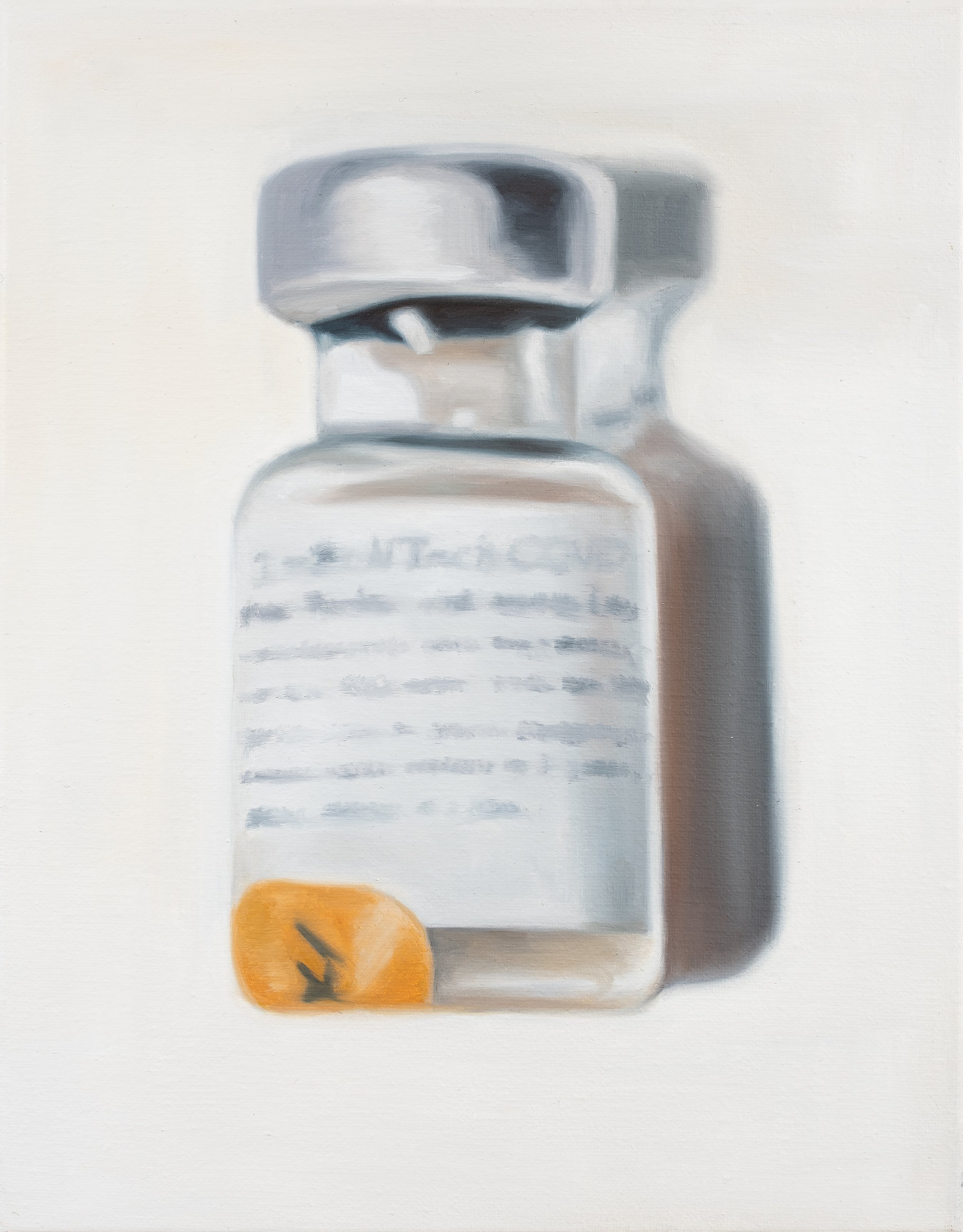
The surface of Vaccine rewards close inspection in ways that its modest dimensions might not promise. The linen weave is visible in the darker passages around the vial, where the paint has been applied thinly enough that the texture of the fabric becomes part of the painting's atmosphere. This is not an oversight. It is a decision that links the painting's physical substrate to its subject: the linen, a natural material woven from plant fibers, carries its own cellular structure beneath the painted image, and the vaccine, a product of biological engineering, carries its own molecular structure within the glass. At the vial's edges, where the glass curves away from the viewer, the paint thins to a nearly transparent film that lets the ground show through, producing the illusion of refracted light without the heavy-handedness of a highlighted contour line. The meniscus of the liquid is a single horizontal stroke of pale gold, perhaps two millimeters wide on the actual canvas, that catches light from the room where the painting hangs. This stroke does double duty: it describes the surface tension of the fluid inside the vial, and it acts as a compositional hinge, dividing the transparent upper portion of the vessel from the denser, more opaque lower half. Below this line, the amber paint thickens. You can see where a subsequent glaze has been laid over an earlier cooler tone, and the vibration between these two layers gives the fluid a sense of actual volume, as though the liquid were sitting in the glass rather than being painted onto it.
Giorgio Morandi spent decades painting bottles. Not wine bottles with labels, not perfume bottles with brand identity, but the plain, unmarked vessels that sat on the shelves and tabletops of his Bologna studio. In Natura Morta (1960), a group of four or five bottles and boxes of varying heights are arranged on a shallow shelf, their surfaces rendered in tones of cream, ochre, pale pink, and muted grey that seem to have been mixed from each other, as though each color contained a trace of every other color in the composition. The light is even and undramatic, falling from a window that Morandi never shows. The bottles cast almost no shadows. Their edges are soft, almost vaporous, as though the objects were still deciding whether to commit to their own outlines. Morandi's bottles are never allegorical. They do not stand for anything other than themselves. They are not metaphors for solitude or patience, although solitude and patience are what it took to paint them. They are objects that have been looked at for so long and with such sustained attention that the distinction between looking and being looked at begins to dissolve. The bottle becomes the act of seeing the bottle, and the painting becomes a record of that dissolution.
Tan Mu's vial shares this quality of sustained, almost devotional attention to a simple glass vessel, but the attention is directed toward a different end. Where Morandi paints bottles as objects of perceptual inquiry, containers whose meaning resides entirely in their visual presence, Tan Mu paints a vial as an object of collective memory, a container whose meaning extends far beyond its visual form. The vaccine vial in Vaccine is not the same kind of object as Morandi's bottles. Morandi's bottles were empty. They had been emptied of whatever they once contained and now existed purely as shapes, volumes, and colors arranged on a surface. The vial in Tan Mu's painting is full. It contains something specific: mRNA instructions suspended in lipid nanoparticles, a compound designed to enter human cells and instruct them to produce a protein that triggers an immune response. The painting's luminosity does not emanate from the glass alone. It emanates from the contents, and the contents are not a neutral fluid but a concentrated payload of engineered biological information. This is what gives the painting its charge. The glow is not aesthetic. It is pharmacological. The vial holds the future in solution, and the painting makes that future visible as light.
The Pfizer BioNTech COVID vaccine, which Tan Mu has identified as the specific reference for this painting, was developed in under eleven months, a timeline that compressed what had previously been a decade-long process into less than a year. The mRNA technology at its core represented a fundamental shift in how vaccines are designed. Rather than introducing a weakened or inactivated pathogen into the body, mRNA vaccines deliver a strip of genetic code that instructs cells to produce a harmless fragment of the virus, training the immune system to recognize the pathogen without ever exposing the body to the actual threat. This approach had been theorized for decades but had never been approved for human use before December 2020, when the Pfizer vaccine received emergency authorization from the FDA. Tan Mu has described the rapid development of the vaccine as "a powerful symbol of collective resolve" and noted that the mRNA technology "felt like a continuation of my long-standing interest in genetic codes, but now embedded within an urgent social reality." The painting registers this dual character: the vial is a medical object and a cultural artifact, a container of engineered biological instructions and a receptacle for the emotional weight of an entire year of isolation, uncertainty, and loss.
Tan Mu's statement that the vial "became a cultural artifact of the pandemic" is precise. During 2020 and 2021, images of vaccine vials circulated with an urgency and frequency that no pharmaceutical container had ever achieved. News broadcasts showed the first shipments arriving at hospitals. Social media filled with photographs of healthcare workers holding vials aloft like small trophies. The vial's distinctive shape, the narrow neck, the purple cap, the slight curvature of the glass, became recognizable even without labeling, a visual shorthand for an entire complex of feelings: vulnerability, anticipation, relief, gratitude, and the political tensions that surrounded distribution. Tan Mu's decision to paint the vial without branding or labeling is not an act of generalization. It is an act of recognition. She understood that the form itself had become legible, that the shape alone carried the weight of its historical moment, and that rendering it in paint would preserve not just the object but the concentrated emotional field that had gathered around it.
The mRNA technology inside that vial represented a paradigm shift in how medicine confronts infectious disease. Traditional vaccines train the immune system by presenting it with a weakened or dead version of the pathogen. The body learns to recognize the invader and builds a defense. mRNA vaccines work from the inside out. They deliver a strand of synthetic messenger RNA that instructs human cells to produce a specific viral protein, in the case of SARS-CoV-2, the spike protein that gives the coronavirus its characteristic crown. Once the cell manufactures this protein, it displays it on its surface, where the immune system identifies it as foreign and mounts a response. The mRNA itself never enters the cell nucleus and never alters DNA. It degrades within hours, leaving behind only the immune memory it triggered. This mechanism is what Tan Mu means when she describes the mRNA technology as "a continuation of my long-standing interest in genetic codes." The vial does not contain a miniature version of the virus. It contains a set of instructions written in the same nucleotide language that governs every biological process on Earth. The vaccine does not fight the virus. It teaches the body to fight the virus. The distinction matters for the painting because it reframes the contents of the vial. The amber fluid is not a weapon. It is a text. It is biological information, encoded and suspended in lipid nanoparticles, waiting to be read by the cells it enters. The glow that Tan Mu paints inside the glass is the glow of a language about to be spoken.
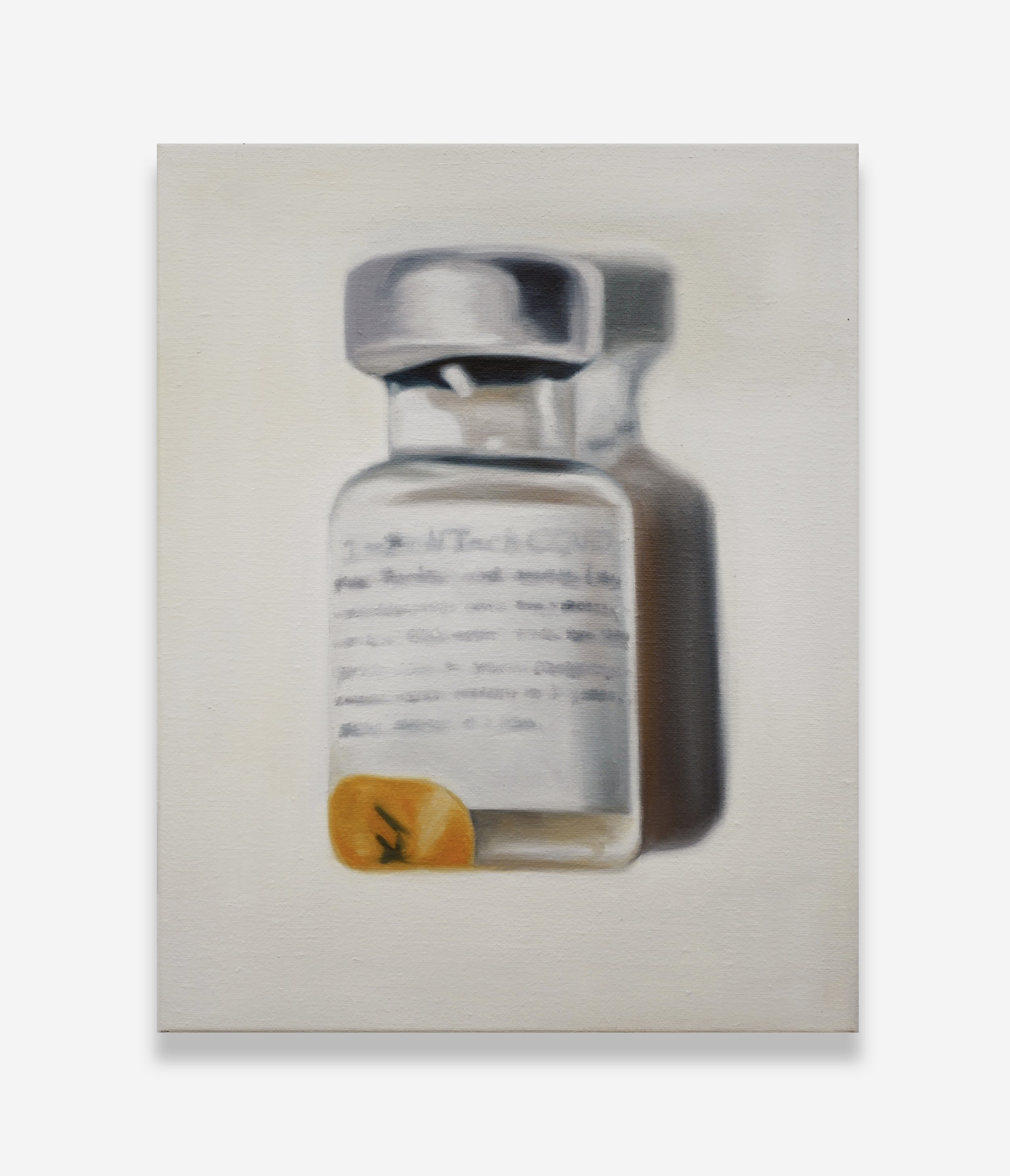
Appelbaum's concept of arbitration is useful here because it names the specific transformation that Vaccine performs. The signal that enters the painting is not a pure signal. It is already laden with meaning, already overdetermined by politics, by hope, by grief, by the news cycle. The artist's task is not to strip away these layers of meaning but to decide which ones to let through and which to hold in suspension. Tan Mu arbitrates between the vial as a scientific object and the vial as a cultural one. She keeps the glass and the liquid and the light, all of which belong to the physical reality of the object, and she keeps the glow, which belongs to the cultural reality. She discards the branding, the cap color, the specific dimensions of the Pfizer vial, all of which would tie the painting to a single product rather than to the idea that a small glass container could carry the weight of a global crisis. The result is an image that operates at the boundary between the literal and the symbolic, as Tan Mu herself has described: "The vial is not depicted as a pharmaceutical product, but as a container of layered significance. It holds scientific knowledge, political tension, public anxiety, and collective hope all at once." The arbitration is in the removal of everything that specifies the vial as a particular product and the retention of everything that generalizes it as an object of human consequence.
The painting's vertical format reinforces this sense of concentrated significance. At 36 x 28 cm, the canvas is roughly the size of a notebook page or a small portrait. The vial fills most of the vertical axis, its proportions echoing the actual proportions of a vaccine vial, which is taller than it is wide. This is not a compositional accident. The format was chosen to match the object's own geometry, allowing the painting to maintain the vial's proportions rather than recontextualizing it within a wider scene. There is no clinical setting, no arm receiving an injection, no gloved hand holding a syringe. The vial stands alone against the dark ground the way a figure stands in a portrait, which is what this painting ultimately is: a portrait of an object that carried more meaning than any single object should have to bear. Tan Mu has described her practice as operating "in the space between representation and abstraction," and Vaccine occupies that space with particular clarity. The vial is recognizable. Its form is legible. But the glow that rises from its contents, the way the liquid seems to generate its own light within the glass, pushes the painting toward something that representation alone cannot account for. The glow is not observed. It is inferred. It is what the vial meant to the people who waited for it, and it is what the painting preserves.
Vaccine occupies a specific position within Tan Mu's broader practice. It is the painting where the artist's long-standing interest in biological systems, from embryos to chromosomes to neural pathways, meets her engagement with current events at their most concentrated. The Chromosomes (2022) paintings depict the genetic code as an abstract pattern. The Embryo (2022) and First Week (2022) paintings show the earliest stages of human development at microscopic scale. The MRI (2021) painting renders the brain as a landscape of tissue and void. All of these works treat their subjects with the same forensic attention: close, detailed, unhurried. Vaccine applies the same forensic attention to an object that is neither microscopic nor cosmic but human-scale, something you can hold in your hand, and it is this shift in scale that gives the painting its peculiar force. The vial is not a representation of a biological process. It is a representation of the object that intervenes in a biological process. It is the delivery mechanism, the container, the vessel that transports the code from the laboratory to the body. In this sense, Vaccine is continuous with the Signal paintings, which depict the submarine cables that carry data across oceans. Both series are about infrastructure. Both are about the vessels that carry what cannot be seen from one place to another. The vaccine vial carries biological information. The submarine cable carries digital information. Both are painted with the same attention to the object as a node in a system, and both transform that attention into luminosity. What the cable paintings do for undersea data, Vaccine does for biochemical instruction: it makes the carrier visible, and in making it visible, it makes the thing it carries feel present, even though the contents remain behind glass.
The final resonance of Vaccine lies in what it does not show. There are no arms, no needles, no faces of relief or lines of people waiting. There is only the vial and the light it contains. This restraint is not avoidance. It is the same restraint that Appelbaum identifies when he writes that what matters in Tan Mu's work is "not a direct alignment between system and representation, but the act of arbitration." The painting arbitrates between the event and the object, between the year of global disruption and the small glass container that marked its end. By holding the vial in isolation, by rendering its glow without context, Tan Mu makes the object sufficient. The vial does not need the waiting room or the injection site to be understood. It has already absorbed all of that. The glow is the residual heat of a year of collective anticipation, concentrated into a single band of amber light inside a cylinder of glass. The painting does not add meaning to the vial. It reveals the meaning the vial already held.