The Blue Print of Uncertainty: Tan Mu's Chromosomes and the Genome That Is Never Complete
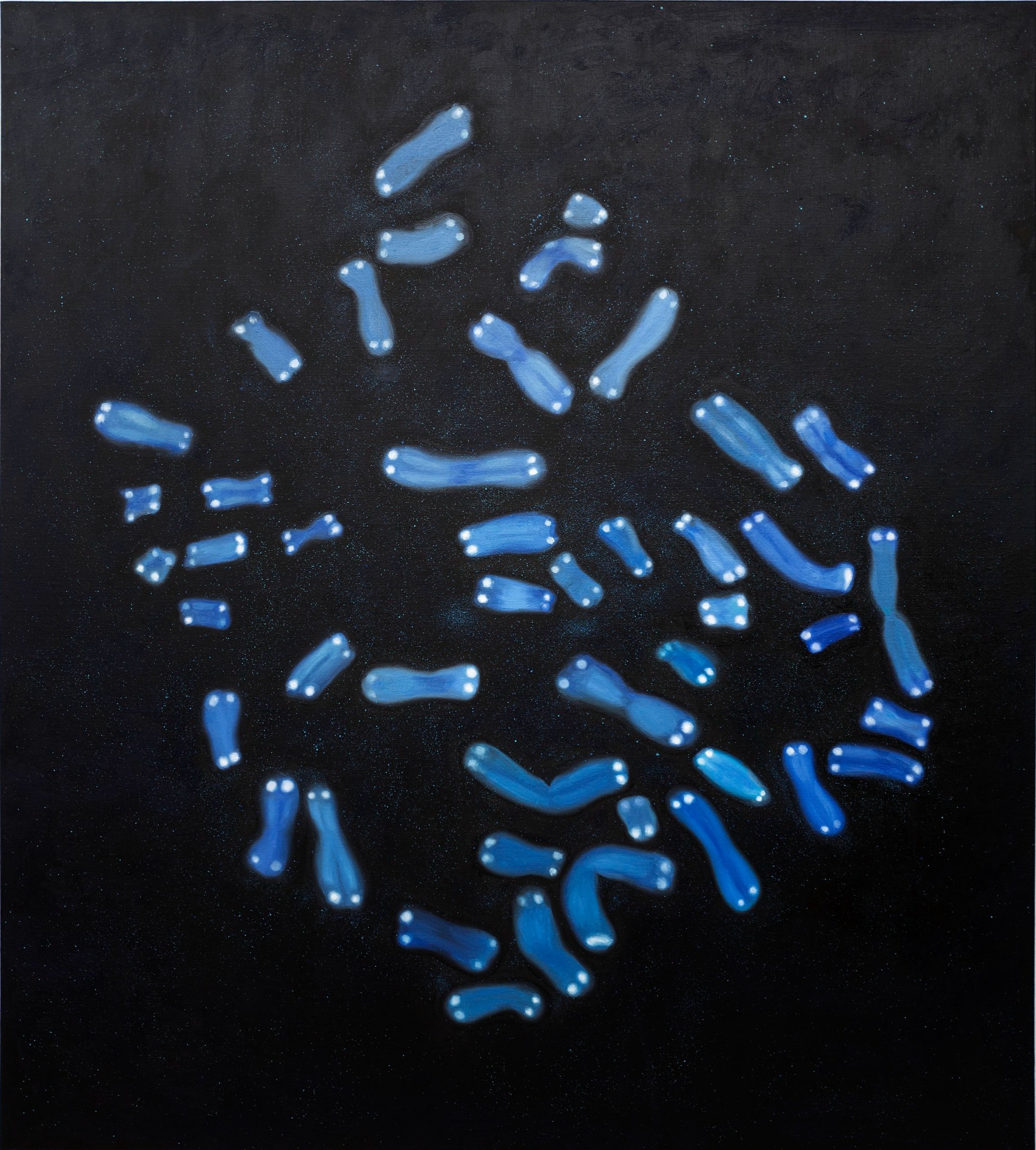
A painting made two days after the news arrived. On March 31, 2022, the Telomere-to-Telomere Consortium, a team of nearly one hundred scientists, announced that they had produced the first objectively complete sequence of the human genome. The Human Genome Project, which had begun in October 1990 and produced its "complete" draft in 2003, had in fact left approximately eight percent of the genome unmapped: the repetitive, hard-to-sequence regions near the telomeres and centromeres that resisted the technology of the time. The T2T Consortium closed that gap. Tan Mu read the news, went to her studio, and began to paint. The speed of the response is itself a statement. A scientific achievement that took thirty-two years from project inception to complete mapping was met by a painting that was underway within forty-eight hours. The painting does not illustrate the science. It does not diagram the karyotype or annotate the telomeres. It renders the forty-six human chromosomes in oil on linen, in blue and white on a dark ground, and in doing so, it measures a distance that the science alone cannot: the distance between what can be sequenced and what can be known, between the completeness of a data set and the completeness of a picture.
Chromosomes (2022) is oil on linen, 102 x 91 cm, 40 x 36 inches. The format is nearly square, a proportion that gives the arrangement of the forty-six chromosomes a centered, diagrammatic stability. Each chromosome is rendered as an individual form, a slightly curved or pinched shape with its own proportions, its own banding pattern, its own telomere caps at the ends. They are arranged across the canvas in the standardized format of a karyotype: organized into twenty-three pairs, ordered by size, with the two sex chromosomes placed at the lower right. The arrangement is immediately recognizable to anyone who has seen a genetics textbook or a medical report. It is the conventional way of displaying human chromosomal data, and Tan Mu follows the convention precisely, which makes what she does to it all the more striking. The chromosomes are not the crisp, labeled shapes of a scientific illustration. They are painted objects, each one built up from small touches of blue and white oil paint over a dark ground, their edges slightly soft, their interiors modulated with tonal shifts that give them volume and weight. The color palette is restricted to shades of blue, from an almost white pale blue to a deep midnight, with occasional warm touches where the dark ground shows through. The background is not a uniform black but a field of small blue dots, hundreds of them, painted with a fineness that makes them read as a texture rather than a pattern. At a distance, the dots dissolve into a dark, slightly granular blue-black. Up close, they are individual points of light, each one applied separately, each one a decision.
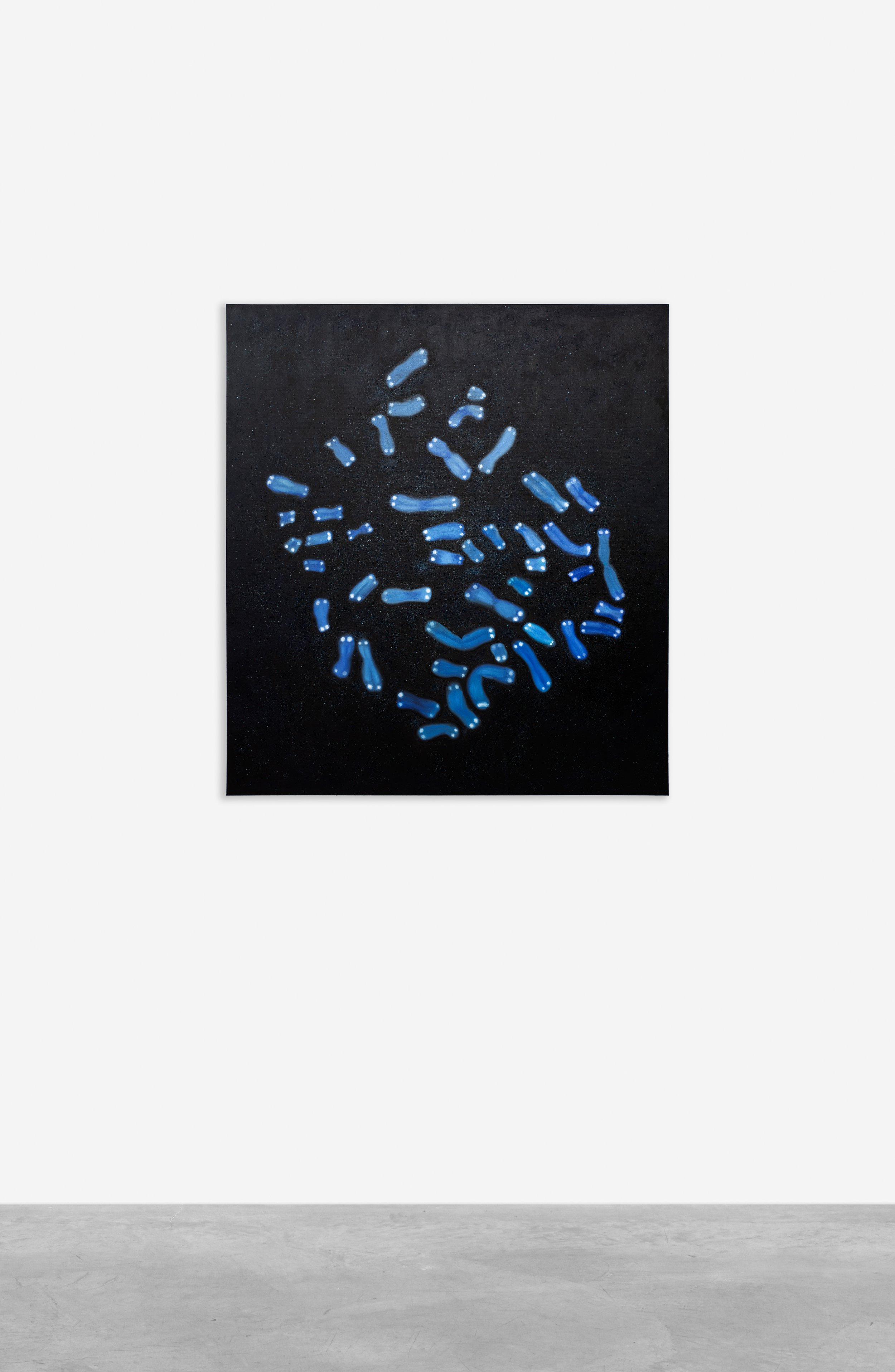
Tan Mu has described these background dots as a visual language that operates both symbolically and structurally. "In scientific imagery, these dots often represent data points or microscopic structures," she says. "In my painting, I intensified and expanded them, allowing them to resemble stars in the night sky or bioluminescent organisms in the deep ocean." The comparison is precise. The dots function at three scales simultaneously: as data points in a scientific chart, as cellular structures viewed under magnification, and as celestial bodies in a dark field. This is the slippage that the painting produces. The karyotype format locates the chromosomes in the territory of laboratory science, but the background relocates them in a field that could be deep ocean, deep space, or the interior of a microscope slide, depending on the scale at which the viewer chooses to read. The painting refuses to settle on a single scale, and this refusal is its most productive ambiguity. The chromosomes are always the chromosomes, but the space they occupy is never simply the space of a laboratory printout. It is a painted space, and painting, as Tan Mu insists, carries uncertainty in every mark.
Julie Mehretu's Stadia (2004) presents a visual field saturated with marks that behave like data but resist being read as data. The painting, one of three in a series, builds its surface from thousands of small gestures: arrows, vectors, dotted lines, architectural plans, crowd movements, stadium seating diagrams. The marks accumulate into a dense, swirling composition that suggests an event about to happen or an event that has just happened, a sports stadium or a political rally or a military review, the specifics always just beyond the viewer's ability to decode. Mehretu's marks are not arbitrary. They are drawn from real sources: stadium plans, protest maps, crowd flow diagrams. But the accumulation of so many specific sources into a single image produces a new condition, one in which the data points, however individually legible, collectively resist interpretation. The total is not the sum of its parts. It is a new kind of information, one that exists only in the act of viewing. Tan Mu's blue dots in Chromosomes operate in a similar register. Each dot is a precise, deliberate mark. But their accumulation produces a field that exceeds the function of any individual data point. The field is not a chart. It is not a star map. It is not a microscopic slide. It is all of these simultaneously, and the simultaneity is the point. Both Mehretu and Tan Mu use the visual language of data to produce a condition that data alone cannot account for: the experience of standing in front of a painted surface and recognizing that what you see is both a system and something that exceeds the system.
Mehretu has spoken about her work as an attempt to "make a map of a situation that doesn't exist yet," and this formulation applies with equal force to Chromosomes. The karyotype is a map of the human genome, but it is a map that has never existed in the form Tan Mu paints it. No one has ever seen their own chromosomes arranged in this way. The karyotype is a construction, an organizational tool that arranges the chromosomes by size and shape for diagnostic purposes, stripping them of their actual three-dimensional reality inside the cell. Tan Mu takes this construction, which is already an abstraction, and subjects it to a further abstraction by rendering it in paint, where the hand introduces deviation, interpretation, and imperfection at every turn. The result is a map of a map, a representation of a representation, and the distance between these two layers, the scientific karyotype and the painted karyotype, is precisely the distance that Tan Mu wants us to measure.
The Human Genome Project began in October 1990 and produced its first "complete" draft in 2003. The word "complete" required quotation marks because the draft left eight percent of the genome unsequenced, primarily the repetitive regions near the telomeres and centromeres that were technically intractable with the sequencing technology of the time. For nearly two decades, this eight percent gap persisted. The scientific community treated it as a known unknown, a region that would eventually yield to improved methods. In 2022, the T2T Consortium, using new long-read sequencing technology, filled in the remaining gaps and produced what they described as the first "objectively complete" human genome, all 3.055 billion base pairs, including the previously unmapped regions. Tan Mu was a child in the 1990s when the early genome maps appeared in textbooks and news reports, and she remembers those images as "simplified and incomplete representations of genetic sequences," rough and speculative, limited by the technology available. The memory is not incidental. It establishes a continuity between her early experience of scientific images and her current practice of painting them. The simplified textbook karyotype, the one she saw as a child, was itself a form of painting: a visual approximation made with the tools available at the time, a representation that acknowledged its own incompleteness. The complete genome of 2022 is the same kind of object, just with better tools. It is still a representation, still a map, still subject to revision, still carrying what Tan Mu calls "margins of uncertainty."
The eight percent that resisted sequencing for two decades is not random territory. It consists primarily of two structural features: telomeres, the protective caps at the ends of each chromosome that shorten with each cell division and are implicated in aging and cancer, and centromeres, the constricted regions near the middle of each chromosome where the spindle fibers attach during cell division. These regions are composed of highly repetitive DNA sequences, in some cases repeating the same few hundred base pairs thousands of times in tandem. The short-read sequencing technology used by the Human Genome Project could not resolve these repeats because it produced fragments only a few hundred base pairs long, and when every fragment of a repetitive region looks identical, there is no way to determine where one copy ends and the next begins. The T2T Consortium solved this problem using long-read sequencing from Pacific Biosciences and Oxford Nanopore, technologies capable of producing reads tens of thousands of base pairs in length, long enough to span entire repetitive arrays and pin each one to its unique position in the genome. The result was not merely an addition to the existing map. It was a structural revision of the map itself, revealing that the centromeric and telomeric regions contain regulatory elements, non-coding RNAs, and structural variations that influence gene expression across the entire chromosome. What had been dismissed as junk DNA, a term that itself reveals the assumptions of an earlier scientific moment, turned out to be architecturally essential. The genome that was declared complete in 2003 was not incomplete in the way a puzzle is missing a piece. It was incomplete in the way a building is missing its load-bearing walls. The parts that were missing were not peripheral. They were structural, and their absence distorted the understanding of the whole.
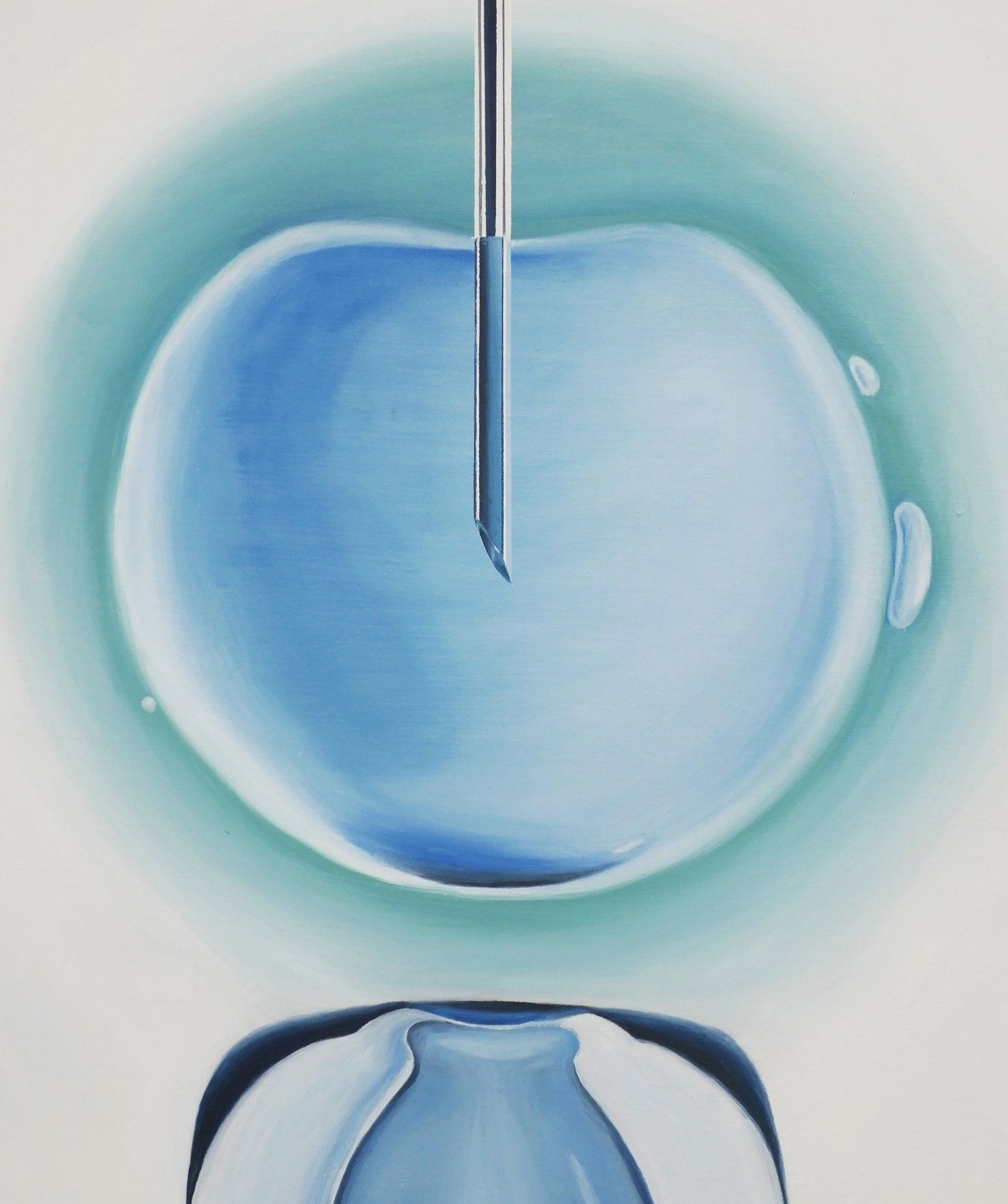
Tan Mu connects Chromosomes explicitly to her earlier work IVF (2020), which addresses "the decoding of genetic structures and the technologies that attempt to define life itself." The connection is structural. Both paintings take as their subject a technology that operates on human genetic material, in vitro fertilization in one case, genome sequencing in the other, and both present that technology through the filter of oil paint, a medium whose relationship to precision is fundamentally different from the relationship that scientific imaging technologies have to their subjects. A photograph of a karyotype produced by a laboratory can, in principle, be an exact copy of the original data. A painting of a karyotype cannot. The hand introduces variation with every stroke, and this variation is not an error but, as Tan Mu argues, "a defining quality" that "embodies individuality, time, and the physical presence of the artist." The contrast between the painting and its scientific source material is the subject of the painting. It is what the painting is about.
Terry Winters' Computation of Chains (1991) and the related paintings from his Graphic Primitives series of the early 1990s occupy a position that is instructively adjacent to Chromosomes. Winters, who had spent the 1980s developing a vocabulary of organic, biomorphic forms drawn from botanical and cellular imagery, shifted in the early 1990s toward a language of marks that referenced both biological structures and information systems. The paintings of this period feature repeated, modular shapes that evoke chromosomes, cellular division, and the visual logic of genetic code, but they never resolve into legible diagrams. The shapes accumulate across the canvas in patterns that suggest data without delivering it, organized in rows and clusters that recall karyotypes, genetic maps, and the display formats of early bioinformatics software. Winters' surfaces are built from layers of drawing and painting, each layer partially obscuring the one beneath, so that the final image contains traces of its own construction, a visual record of decisions made and revised. This is the same condition that Tan Mu describes when she speaks of painting as a "parallel system of knowledge" that "embraces ambiguity rather than eliminating it." In both practices, the painted surface is not a transparent window onto a scientific fact. It is a record of an encounter with that fact, an encounter that includes hesitation, correction, and the physical limitations of the hand.
The key difference between Winters' biomorphic abstractions and Tan Mu's Chromosomes lies in the relationship between the painted image and its scientific source. Winters' paintings reference biological structures but do not depict specific ones. They operate in the territory of analogy, where a painted shape can suggest a chromosome without being one. Tan Mu's painting operates in the territory of transcription, where a painted shape is recognizably, specifically, a chromosome, and the question is not whether the shape resembles a chromosome but how faithfully it transcribes one, and what the faithfulness, or the lack of it, reveals about the relationship between scientific knowledge and painted knowledge. This is a crucial distinction. Analogy produces a generative openness: the viewer can see many things in a Winters painting, and the artist does not insist on any single reading. Transcription produces a productive tension: the viewer can see that the painted chromosome is a chromosome, and can also see that it is not the same chromosome that appears in the laboratory printout. The gap between these two versions of the same object, the scientific and the painted, is where the meaning of Chromosomes resides.
Danni Shen, writing in Emergent Magazine in 2024, observed that Tan Mu's paintings "serve as a kind of witness to human socio-technological histories," and that the works "reflect the trajectory and continuum of bodily and mediated presence through human technical developments." The formulation is precise. A witness does not reproduce what it witnesses. It testifies to it, from a particular position, with the limitations and biases that position entails. A courtroom witness who saw an event from across the street does not reproduce the event in their testimony. They offer a partial, situated, human account of what they were able to perceive from where they stood. The account is valuable not despite its partiality but because of it: the partiality is information about the conditions under which the event was perceived. Chromosomes is a witness to the completion of the human genome, and its partiality is its testimony. The painting tells us that a human hand, working in oil paint on linen, took the scientific karyotype and made it into something that no laboratory instrument could produce: an image in which the data points tremble, the edges soften, the background glows with a light that belongs to no microscope, and the forty-six chromosomes float in a space that is simultaneously cellular, celestial, and painted. This trembling, this softening, this glow, this ambiguity of scale are not defects. They are the record of the encounter, and they are what makes the painting a witness rather than a reproduction.
Tan Mu has described her painting practice as "a form of temporal recording," in which "each painting becomes a knot tied along the timeline of technological and scientific progress." The metaphor is a rope, and the knots are the moments when the rope passes through the hands of someone who is paying attention. The T2T Consortium's announcement in March 2022 was one such moment, and Chromosomes is the knot that marks it. But a knot on a rope is not the same thing as the event it marks. It is a gesture that secures a position, that makes the rope hold at a particular point so that it can be found again. The painting secures the position of the genome's completion in the same way: not by reproducing the data but by occupying a position relative to it, at a specific moment, with a specific set of tools and a specific margin of uncertainty built into every mark. The genome is complete. The painting is not. The genome is a sequence of 3.055 billion base pairs, each one identified and catalogued. The painting is 102 x 91 cm of oil on linen, each chromosome rendered by hand, each background dot placed individually, each edge a decision rather than a datum. The painting does not contradict the genome. It sits beside it, on the same timeline, tied to the same knot, and it says: this is what it looks like when a human being, working with materials that resist precision, encounters the claim that the human blueprint is now complete. The claim is true. The encounter is also true. They are different kinds of truth, and they need each other, because the genome without the encounter is data without a witness, and the encounter without the genome is a painting without a subject. The knot holds them together.