The Heat That Was Not Felt: Tan Mu's Touch and the Handprint Across Millennia
A hand floats in deep blue, its fingers extended, its palm radiating warm yellow and orange that cool toward the fingertips into tones of green and violet. The hand is not drawn. It is mapped. Each area of color corresponds to a specific temperature range, the way a weather map assigns chromatic values to atmospheric pressure. The hottest zone, the center of the palm and the base of the fingers, glows with the amber of a body at rest, approximately 33 degrees Celsius. The coolest zones, the fingertips and the outer edges of the hand, register in cooler greens and blues, where blood flow is reduced and the skin approaches ambient temperature. This is not a portrait of a hand. It is a portrait of a hand's heat signature, captured by a thermal imaging camera and then translated into oil paint, a medium whose entire history has been devoted to rendering the visible world and which now, in this painting, renders the invisible: the temperature of a body seen from the outside, recorded by a machine that cannot feel what it measures.
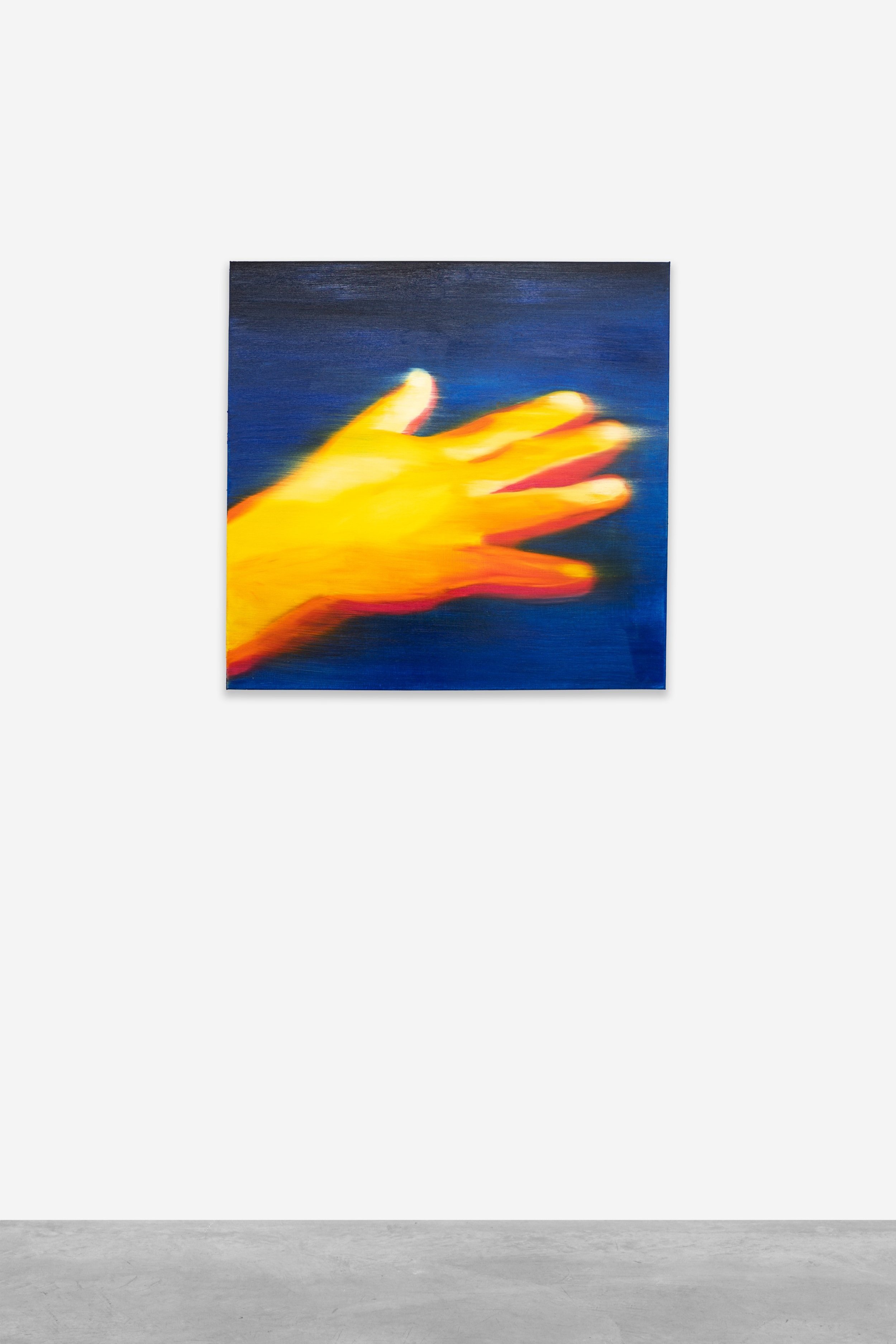
Tan Mu's Touch (2022) is an oil on linen painting, 76 x 76 cm (30 x 30 in), a square format that gives the hand equal weight in every direction, so that it does not reach toward an edge but occupies the center of a field, a specimen in its own thermal environment. The painting takes as its source a thermographic image of a hand, a technology that converts bodily warmth into color through a predetermined palette, transforming a tactile sensation into visual information. The deep blue ground that surrounds the hand is not a background in the traditional sense. It is the temperature of the environment, the space the hand occupies, the air that receives the body's heat and absorbs it. The hand is warm. The air is cold. The painting makes this opposition visible by making it chromatic. The yellows and oranges of the palm assert presence. The blues of the surrounding space assert absence. Between them, along the edges of the hand where warmth meets cold, the colors transition through greens that do not belong to either domain but exist only in the contact zone, the boundary where the body's heat leaks into the air and the air absorbs what the body releases.
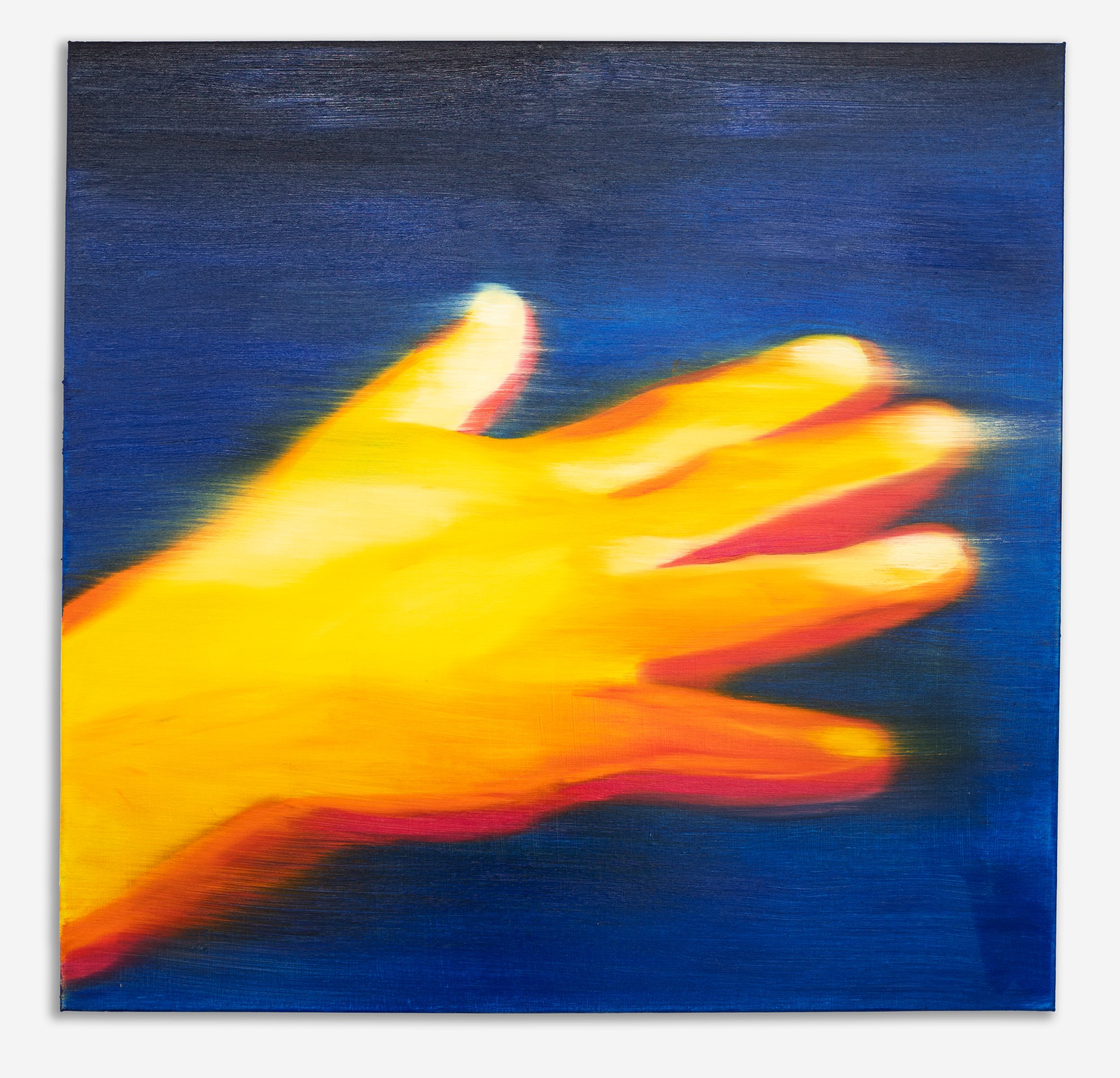
The paint surface of Touch is built in two distinct regimes that mirror the two temperature zones of the composition. The deep blue ground, which fills the majority of the canvas, is laid down in thin, even washes that allow the linen weave to show through, creating a surface that is flat and atmospheric rather than descriptive, a color field that breathes rather than describes. This is the cold zone, the ambient temperature, and it is rendered with the kind of evenness that suggests uniformity, as though the air surrounding the hand were a single, undifferentiated condition rather than a series of pockets and drafts. Against this ground, the hand itself is rendered in thicker, more opaque passages. The yellow-orange of the palm is built up in layers of cadmium yellow and burnt sienna over a warm underpainting, so that the heat of the hand is not a single flat color but a stratified accumulation, each layer slightly warmer than the one beneath it, each brushstroke adding another degree of thermal presence. The edges of the hand, where the warm body meets the cold ground, are painted with a softness that is not blurred but dissolved, as though the boundary between the hand and the air were a zone of negotiation rather than a sharp line. This softness is not an effect of imprecision. It is the painting's most precise observation: the body does not end where the skin meets the air. The body's heat extends beyond the skin, radiating outward in a gradient that the thermal camera records and the painting reproduces in the vocabulary of oil paint, where the transition from warm to cool is the transition from thick to thin, from opaque to translucent, from presence to absence.
The handprints in the Cueva de las Manos, located in the Pinturas River canyon in Santa Cruz, Argentina, are among the oldest known records of human presence on a surface. Created between approximately 7,300 and 9,500 BCE by the ancestors of the Tehuelche people, they were made by placing a hand against the rock wall and blowing pigment around it, producing a negative image: the hand blocks the pigment, and what remains on the wall is the outline of the hand surrounded by a halo of sprayed color. The hand itself is absent from the image. What remains is the shape of its absence, the silhouette it left behind, the trace of a body that was once pressed against the stone and then withdrew. There are hundreds of these prints in the cave, in red, ochre, white, and black, overlapping and layering across the rock face in a composition that was accumulated over millennia rather than designed in a single moment. They are not decorative. They are not narrative. They are records of presence, made by a process that requires the hand to be physically present at the moment of creation and then to leave, so that what the wall holds is the memory of contact, not the contact itself.
The structural parallel between the Cueva de las Manos handprints and Touch is not incidental. Tan Mu cites the cave explicitly as a source. "The handprints in the Cueva de las Manos are among the earliest traces of human presence," she has said. "Created through a stencil process, they record the physical act of placing a hand against a surface and leaving behind a negative image. These marks preserve a moment of touch across thousands of years. To me, they represent a timeless human impulse to connect, to assert presence, and to be remembered." The connection she draws is between two technologies of the hand: the stencil, which records the hand's presence by capturing the outline of its absence, and the thermal camera, which records the hand's presence by capturing the pattern of its heat. Both technologies produce an image of the hand that is not the hand. Both translate the physical body into a visual trace. Both depend on the hand being present at a specific moment and then removed, so that the image exists only as evidence of something that is no longer there. The cave handprint and the thermographic hand share this logic of the trace. They are images of contact that survive the end of contact.
Tan Mu has described the origin of Touch in terms that connect it directly to the experience of the pandemic. "In March 2020, during the lockdown, I began painting at home as physical movement and social interaction became limited," she has said. "Temperature became a central marker of health, and technologies such as thermal imaging and AI-based monitoring were widely deployed in public spaces. These tools reduced the body to data points, reinforcing a sense of distance and surveillance." The painting's soft colors, blurred edges, and lack of sharp boundaries are, in her description, "something receding or dissolving, mirroring the erosion of intimacy during a period when proximity itself became a risk." The thermographic hand is the hand as the surveillance state saw it during the pandemic: a source of data, a temperature reading, a body reduced to a metric that could be scanned from a distance without contact, without touch, without the need for proximity. The painting takes this reductive technology and makes it the subject of sustained visual attention, treating the thermal image not as a diagnostic tool but as a composition, with the warmth of the palm as its center and the cold of the air as its ground.
The pandemic context is not decorative. It is the specific historical condition that made the thermographic image of a hand into a cultural artifact rather than a purely scientific one. Before 2020, thermal imaging was a specialized technology used in industrial inspection, military targeting, and medical diagnostics. During the pandemic, it became a public technology, deployed at airport gates, office building entrances, hospital triage stations, and school checkpoints. Every person who entered a public space was scanned for fever, their body temperature read by a camera that did not need to touch them, that did not need to be near them, that could measure their heat from across a lobby. The body became a data point. The hand became a temperature. The handshake, the most ancient and universal gesture of trust and greeting, became a vector of transmission. The hand that reaches out to another hand became, for a period, a hand that was safer kept to itself. Touch records this condition by painting the thermal image of a hand that is not reaching toward anyone. It is open, extended, palm facing outward, in the gesture of a wave or a stop or a blessing, but it is not touching another hand. It is radiating heat into empty air.
Rachel Whiteread's Ghost (1990), now in the collection of the National Gallery of Art in Washington, DC, casts the negative space inside a room into a positive form. Using plaster and steel, Whiteread filled the interior of a Victorian living room, capturing every detail of the wallpaper, the mantelpiece, the window frames, and the door handle, and then removed the room itself, leaving only the cast of the space the room had occupied. The result is a solid block that looks like an architectural fossil, the interior of a room turned inside out, its voids made tangible, its absences made present. The fireplace, which in the original room was a source of warmth and light, appears in the cast as a dark rectangular void, a negative of a negative, an absence within an absence. The window, which in the original room was an opening onto the world, appears as a raised rectangle of solid plaster, a presence where there should be a gap. Everything is inverted. What was empty is now solid. What was solid is now empty. The room is not depicted. It is replaced.
Whiteread's method of casting negative space into positive form provides a structural parallel for understanding what both the Cueva de las Manos handprints and Tan Mu's Touch accomplish. In the cave, the hand is placed against the wall and pigment is blown around it. What remains on the rock is not the hand but the space around the hand. The hand itself, the warm body that made the gesture, is gone. What persists is the trace, the negative image, the outline of an absence. In Touch, the thermographic camera performs a related inversion. It does not record the hand as it appears to the eye. It records the heat the hand emits, which is not the hand itself but the hand's thermal signature, the energy that the hand radiates into the air. This signature is a kind of cast: it is the shape of the hand's warmth made visible, just as Whiteread's Ghost is the shape of a room's emptiness made solid. In both cases, the technology, whether it is the stencil process of blowing pigment or the digital sensor of a thermal camera, records what the body leaves behind rather than the body itself. The painting, by rendering this thermal signature in oil, adds another layer of mediation. The hand is not present. The heat is not present. What is present is paint on linen, arranged in colors that correspond to temperatures that were recorded by a camera that was pointed at a hand that was warm. The chain of mediations is long. The painting makes it visible.
Yiren Shen, in her 2025 conversation with Tan Mu published in 10 Magazine, observed that "the underwater world resembles outer space, a dreamlike realm where the boundaries of reality fade away." The remark concerns the ocean, but its logic extends to the thermal image, which also renders the familiar unfamiliar. The hand you see in Touch is not your hand. It is not even a hand. It is a temperature map of a hand, a pattern of chromatic zones that the thermographic palette assigns to specific degrees of Celsius. The warmest zones are yellow and orange. The coolest are blue and violet. The painting does not give you the hand as you would see it with your eyes. It gives you the hand as a thermal camera sees it, which is to say, it gives you the hand as a source of heat, as a radiating body, as a thermal event rather than a physical object. This is the same transformation that Whiteread performs with architecture: the room is not a room. It is a cast of the space the room occupied. The hand is not a hand. It is a map of the heat the hand produced. And yet, the painting insists, the hand is still recognizable. The five fingers, the extended palm, the gesture of openness: these are legible even when the visual information has been replaced by thermal data. The form survives the translation. The hand remains a hand even when it has been reduced to a temperature reading, and this persistence of form through mediation is the painting's deepest subject.
The square format of the canvas, 76 by 76 centimeters, gives the hand a visual weight that it would not have in a rectangular composition. A rectangle implies a landscape or a portrait, an orientation toward narrative. A square is a field. It does not prioritize the vertical over the horizontal. It does not suggest that the hand is reaching toward something or retreating from something. It holds the hand in suspension, in a state of equilibrium, neither approaching nor withdrawing, neither warming nor cooling, but simply existing in its thermal signature at a single moment, as though time had stopped and the only thing left to see was the pattern of heat that a body leaves in the air when it is still. The painting holds this moment open. It does not tell you whether the hand is about to touch another hand or whether it has just been withdrawn. It does not tell you whether the body that produced this heat is healthy or feverish, present or absent, reaching out or holding back. It shows you the heat. It shows you the shape. It shows you the trace. What you do with the warmth is your own.