The Flash That Stays: Tan Mu's TRINITY TESTING and the Instant That Made Time Stop
At 5:29:45 a.m. on July 16, 1945, in the Jornada del Muerto desert in southern New Mexico, a device called the Gadget, an implosion-type plutonium weapon designed by a team of physicists led by J. Robert Oppenheimer at Los Alamos, was detonated on a one-hundred-foot steel tower. The explosion produced a light that witnesses described as brighter than the sun, a flash that turned the pre-dawn desert into noon for a fraction of a second before the shockwave arrived, a wall of pressure that knocked some observers to the ground and was felt as far away as El Paso, Texas. The fireball rose through the atmosphere, pulling a column of dust and vapor with it, and as the column separated from the fireball, it formed the mushroom shape that would become the defining visual icon of the nuclear age. The entire sequence, from the flash to the formation of the mushroom cloud, took less than ten seconds. The blast left a crater of green, glassy, radioactive sand that the scientists named trinitite. Oppenheimer later recalled a line from the Bhagavad Gita: "Now I am become Death, the destroyer of worlds." Kenneth Bainbridge, the test director, said something shorter and more direct: "Now we are all sons of bitches." The test was code-named Trinity. Nobody is certain why. Oppenheimer may have named it after a line from John Donne's Holy Sonnet XIV: "Batter my heart, three-person'd God." The name stuck, and the event it designated became the threshold of a new era, the moment when human beings acquired the capacity to destroy themselves and their world at a speed that made all previous forms of violence look like gestures of hesitation.
Tan Mu's TRINITY TESTING (2020) is a work in seven parts, each panel an oil on linen painting measuring 28 x 36 cm (11 x 14 in), with an overall span of 28 x 252 cm (11 x 98 in). The seven panels read from left to right as a sequence, each one capturing a different stage of the nuclear explosion, from the initial flash of light to the formation and expansion of the mushroom cloud. The format is cinematic in its logic: seven frames from a film that no camera shot in real time, because no camera at the Trinity test could have captured the entire sequence at a speed that the human eye could follow. The cameras that recorded the test ran at thousands of frames per second, compressing an event that lasted seconds into footage that could be stretched across minutes, and Tan Mu's seven panels extend this compression further, stretching a fraction of a second across seven paintings that took roughly ten days to complete, one panel per day, each one painted with full concentration over a period of about ten hours. The ratio of event time to painting time is approximately one to three hundred thousand. A second of detonation, stretched across a week and a half of concentrated labor. The format of the work, seven small panels arranged in a horizontal row, is not a sequence that moves. It is a sequence that holds still. Each panel is a complete painting, self-contained and resolved, and the viewer can look at any one of them without needing the others to make sense of it. But together, they form a continuous narrative that reads left to right, like a film strip, like a countdown, like the stages of an explosion that cannot be seen by the naked eye because it happens too fast and must be decomposed into instants by high-speed photography in order to be understood. The painting takes what photography decomposed and reassembles it, not into a single image but into a series of held moments, each one a fraction of a second that has been expanded to fill a canvas the size of a hardcover book, a format that Tan Mu has described as holding "special importance" in her early practice because it "allows for close attention to detail and an intense focus on fleeting visual phenomena."
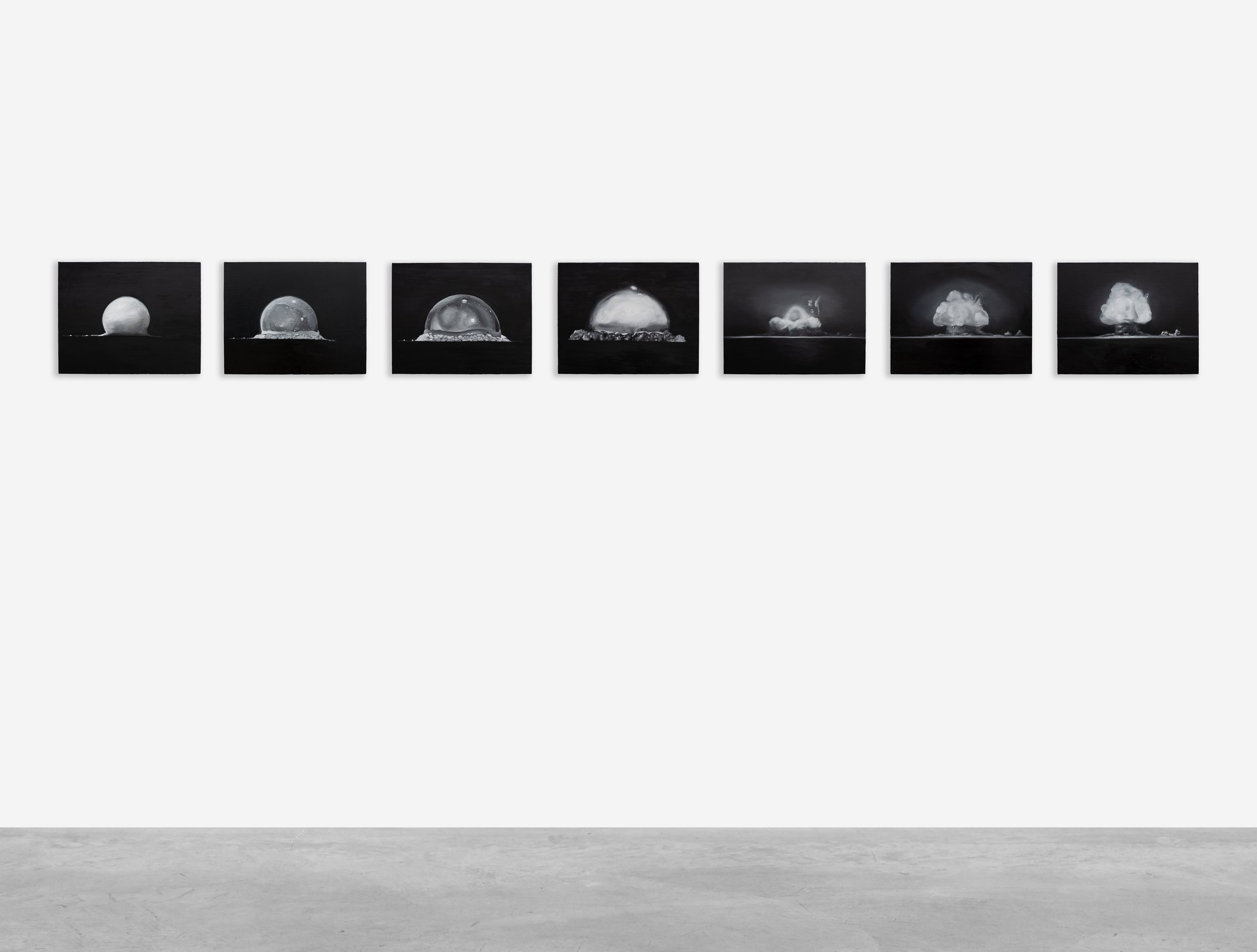
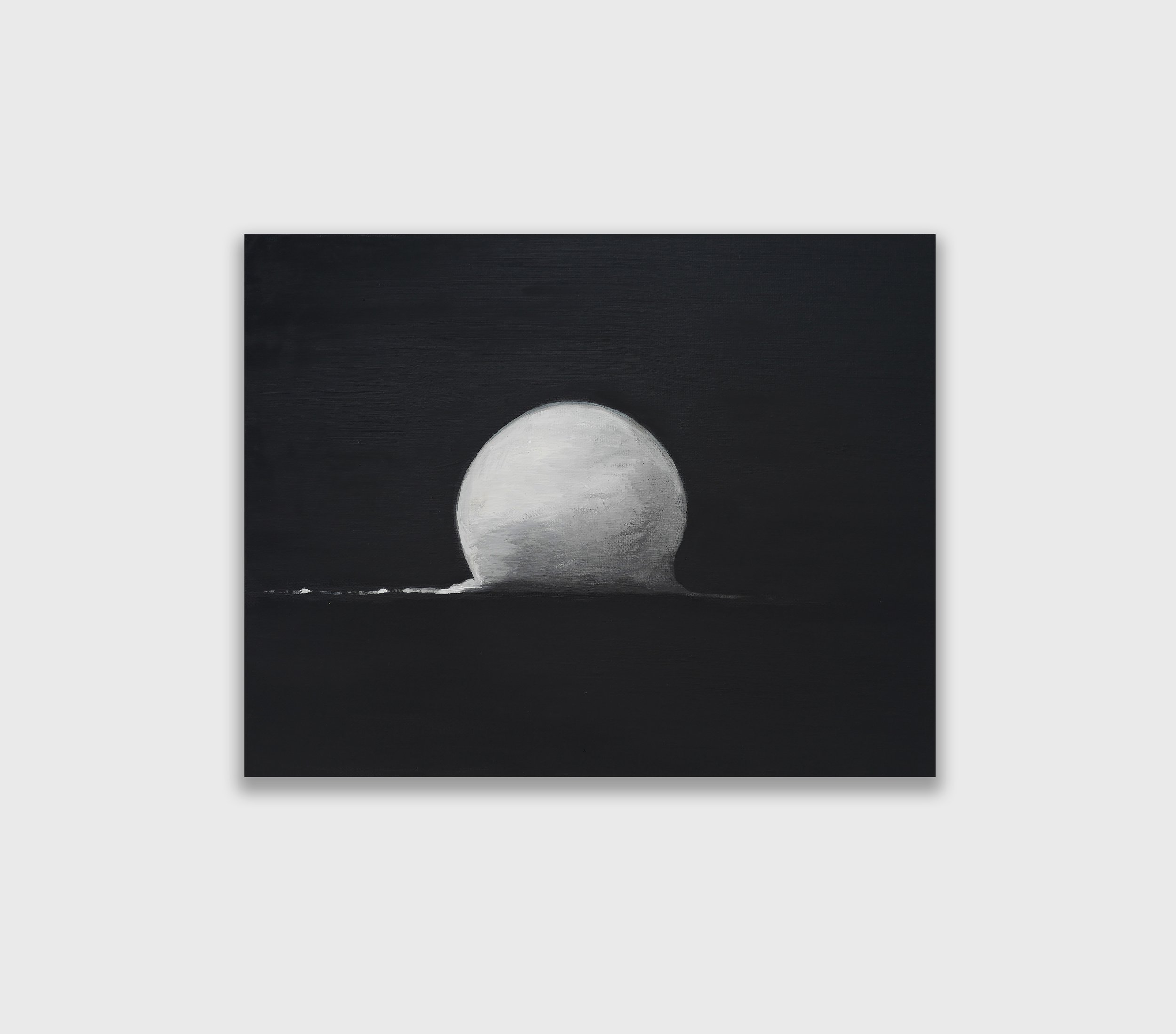
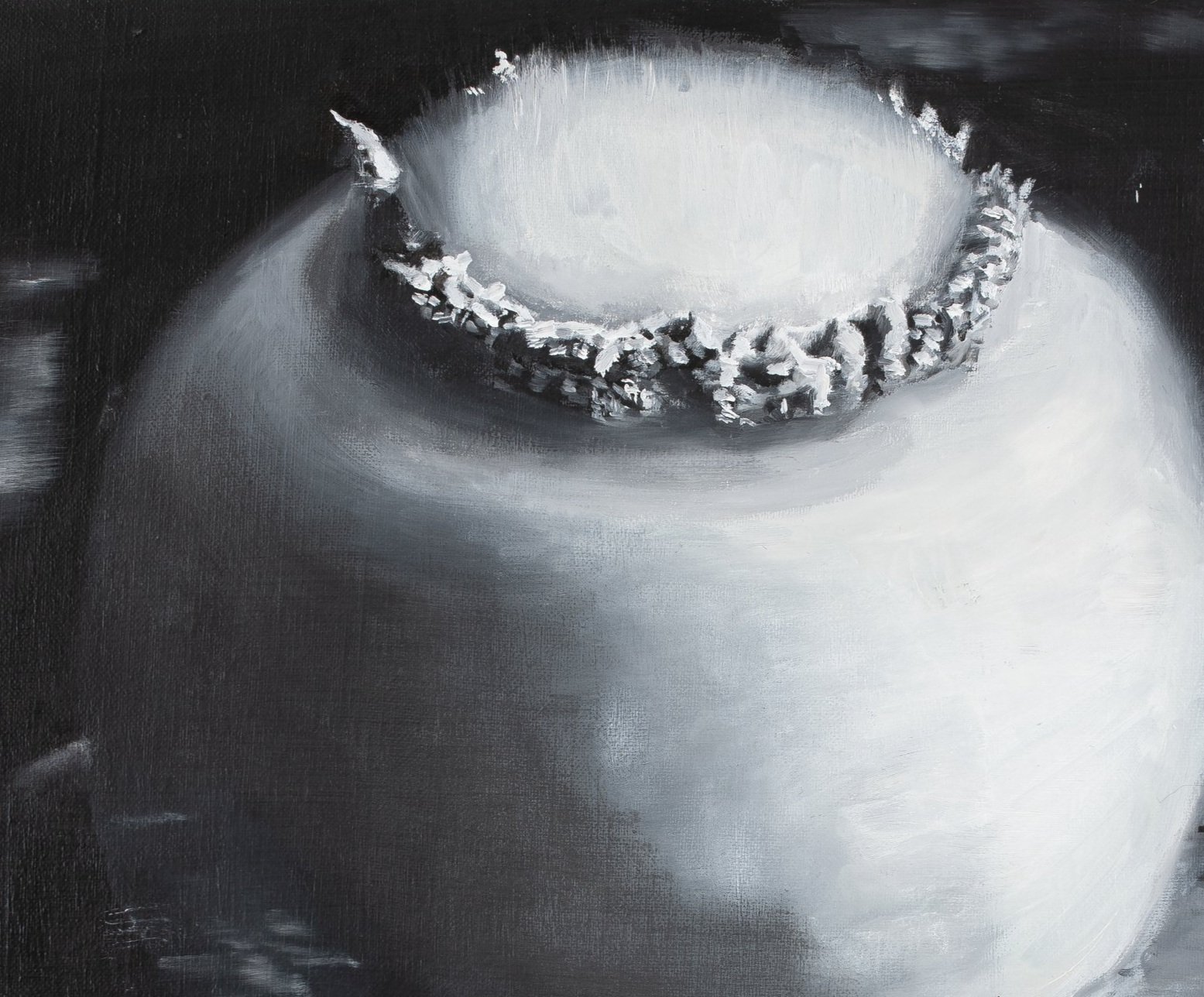
The paint surface of TRINITY TESTING is defined by its palette, or more precisely, by the decision to work almost entirely within the register of black, white, and gray. Tan Mu has described removing color as a strategy that "strips away the familiarity of the visible world," forcing viewers to reconsider their perception because "when images are rendered in black and white, familiar environments become strange, and what we think we understand begins to operate within a different system." The mushroom cloud, rendered in monochrome, no longer functions solely as an image of explosion. It becomes "a visual expression of vibrational frequency," a form stripped of its documentary function and presented as pure energy, pure release, pure transition from one state of matter to another. The backgrounds of the panels are deep black, applied in thin, even layers that create a surface of uniform darkness against which the explosion stands out in gradations of white and gray. The black is not the black of night. It is the black of the instant before the flash, the black of the sky before the fireball illuminates it, the black of the unexposed film before the light hits it. The explosion itself is rendered in thick, impasto applications of white and gray oil paint, built up in concentric forms that mimic the expansion of the fireball and the rising column of the mushroom cloud. In the earlier panels, the explosion is a tight, concentrated burst of white, a near-perfect circle of light with a slightly darker core that corresponds to the fireball's hottest center. In the later panels, the cloud expands upward and outward, the white paint thinning at the edges as the mushroom cap spreads and the stem pulls material up from the ground. The texture of the paint in the early panels is thick and ridged, as though the paint itself is under pressure, compressed into a small space and trying to expand. In the later panels, the paint thins and spreads, the ridges flatten, the surface becomes more even, and the explosion begins to dissipate into the surrounding black, not because it has lost energy but because the energy has distributed itself across a larger area and the temperature has dropped enough for the white to cool into gray. The transition from thick to thin, from compressed to dispersed, from white to gray, is not an illustration of the explosion's progress. It is a material enactment of it. The paint does what the explosion did. It concentrates, expands, and thins.
Bruce Conner's film CROSSROADS (1976) is a thirty-six-minute work composed entirely of archival footage of the Operation Crossroads Baker nuclear test, conducted at Bikini Atoll on July 25, 1946. Conner obtained the footage from government archives and re-edited it, slowing the film down, repeating key moments, and setting the entire sequence to a pair of electronic compositions by Terry Riley. The film shows the explosion from multiple angles, some shot from ships, some from aircraft, some from towers on neighboring islands, and it presents each angle repeatedly, cycling through the same event from different vantage points, so that the single detonation, which lasted less than a second in real time, becomes a sustained meditation that lasts over half an hour. The repetition does not diminish the event. It intensifies it. Each viewing reveals details that the previous viewing missed: the column of water rising from the lagoon, the condensation cloud forming around the fireball, the ships of the target fleet being lifted and thrown by the shockwave, the base surge of radioactive spray spreading across the surface of the water. The film does not explain the explosion. It presents it, over and over, from every available angle, and the repetition makes the event more incomprehensible rather than less, because each new angle reveals more of what happened without making it easier to understand how it could have happened.
Conner's method of decomposing a single instant into multiple views and repeating those views to create a sustained encounter provides a structural model for understanding what TRINITY TESTING does with its seven-panel format. Where Conner used time, slowing the footage and repeating it, Tan Mu uses space, arranging seven paintings in a horizontal row that the viewer reads sequentially, like a film strip, or individually, like seven separate encounters with the same event. The seven panels do not show the explosion from different angles. They show it at different moments, decomposing a fraction of a second into a series of held instants, each one complete and self-sufficient, each one demanding the same sustained attention that Conner's film demands from its viewer. But where Conner's film is hypnotic, looping, and ultimately overwhelming in its accumulation of footage, Tan Mu's panels are quiet, contained, and intimate. The small format, 28 x 36 cm each, is the size of a book that you hold in your hands, not a screen that you watch from a distance. The intimacy of the format is at odds with the magnitude of the event it depicts, and this dissonance between scale and subject is the painting's most productive tension. The explosion that destroyed a portion of the New Mexican desert and inaugurated the atomic age is contained within a surface that you could cover with your palm. The paint does not erupt from the canvas. It concentrates within it, thickening and compressing, and the result is not an image of explosion but a small, dense object that contains the memory of one, a time capsule sealed in oil and linen.
The subject of TRINITY TESTING, as Tan Mu has stated, is the moment of a nuclear explosion, specifically the instant when immense energy is released. She describes the nuclear explosion as "the ultimate metaphor for the release of energy," a moment that "marks humanity's breakthrough beyond physical limitations" while also containing "the duality of destruction and rebirth." She studied extensive archival footage of nuclear tests, focusing on the sequence from the accumulation of energy to its sudden release, and she is "especially drawn to the instant when an immense amount of energy erupts, whether it is man-made or natural." This fascination with the instant of eruption connects TRINITY TESTING to her Eruption series, which depicts underwater volcanic explosions and disruptions in submarine cables. In each case, the interest is in the moment when energy crosses a threshold, when the accumulation of pressure or heat or fission products becomes too great to contain and releases itself in a single, transformative event. The seven panels of TRINITY TESTING decompose this single event into a temporal sequence, but the sequence is not a record of what happened. It is a reconstruction based on archival footage and scientific documentation, filtered through the artist's hand and translated into the medium of oil on linen. The painting does not pretend to show the Trinity test as it actually looked. It shows the Trinity test as it has been imagined through decades of photographic documentation, film footage, and cultural repetition, a mushroom cloud that has become so familiar that it no longer needs to be seen to be recognized, a shape that carries its meaning before the viewer has finished looking at it.
The monochrome palette is not an aesthetic choice in the conventional sense. It is a strategy for defamiliarization. Tan Mu has explained that "when images are rendered in black and white, familiar environments become strange," and the mushroom cloud, which is one of the most recognizable images of the twentieth century, is precisely the kind of image that needs to be made strange before it can be seen again. Color photographs of nuclear explosions exist. They show the fireball in shades of orange, yellow, and red, the cloud in grays and browns, and the sky in the blue or overcast tones of the actual conditions at the time of the test. These colors make the explosion look like a sunset, like a natural phenomenon, like something that could happen without human intervention. The monochrome removes this illusion. A mushroom cloud in black and white does not look like a sunset. It looks like what it is: a photographed event, an image that has been mediated by the technology that recorded it and reproduced by the technology that disseminated it. The monochrome insists on the image's status as an image, on its distance from the event itself, and this distance is the painting's subject as much as the explosion is. Tan Mu is not painting the Trinity test. She is painting the image of the Trinity test, and the image of the Trinity test is a product of the same technology that made the test possible, the same photographic apparatus that documented the explosion from multiple angles and at thousands of frames per second, the same apparatus that Bruce Conner would later appropriate for CROSSROADS, the same apparatus that turned an act of destruction into a series of images that could be watched, studied, repeated, and eventually become so familiar that they stopped producing the horror they were meant to document.
Peder Balke's The Monster (c. 1860s) and his later storm paintings, many of which measure less than 20 centimeters across, depict the coast of northern Norway under conditions of extreme weather: crashing seas, lowering skies, vertical shafts of light breaking through clouds, tiny figures of lighthouse keepers or fishermen dwarfed by the forces that surround them. Balke was one of the first painters to travel to the North Cape, the northernmost point of Europe, and the paintings he produced from these expeditions, small, dark, and concentrated, present a landscape that is almost empty of human presence and almost full of natural force. The sea in a Balke painting is not a setting for human activity. It is the activity itself, a body of water in motion, generating its own light, its own weather, its own horizon. The tiny figures that appear in some of the paintings are not protagonists. They are witnesses, and their smallness is not a measure of their insignificance but of the scale of the forces they are witnessing, forces that do not know they are being watched and would not care if they did.
Balke's small format and his concentrated, dark palette provide a structural precedent for what TRINITY TESTING achieves with its seven 28 x 36 cm panels. The decision to paint a cataclysmic event on a surface that you could hold in two hands is not a decision to diminish the event. It is a decision to concentrate it, to compress it into a format that demands close, sustained attention rather than the wide-eyed, overwhelmed attention that a large-scale depiction would elicit. Balke understood this. His storm paintings are small because the intensity of the weather they depict requires a format that matches the intimacy of the viewer's encounter with it. A large canvas of a storm at sea invites the viewer to step back and take it in as a spectacle. A small canvas of a storm at sea forces the viewer to lean in, to bring the painting close, to enter a private relationship with the image that excludes the room and the world outside it. Tan Mu's seven panels operate in the same register of intimate intensity. The nuclear explosion they depict is the most destructive force human beings have ever created, and the format in which it is depicted is the most intimate format in Tan Mu's practice, one that she has described as holding "special importance" because it "allows for close attention to detail and an intense focus on fleeting visual phenomena, while maintaining a concentrated and intimate mode of expression." The intimacy of the format does not domesticate the explosion. It makes it unavoidable. A large painting of a mushroom cloud can be seen from across the room and registered as a representation of an event that happened elsewhere, to other people, in a different time. A small painting of a mushroom cloud must be approached and examined at close range, and at that range, the viewer's face is inches from the surface, close enough to see the brushstrokes that built the fireball, close enough to see the thick impasto of the initial flash and the thinning washes of the expanding cloud, close enough to register the texture of the linen underneath the paint, close enough to feel that the explosion is happening here, on this surface, in this room, at this moment, not in the New Mexican desert in 1945 but in the present, in the act of looking.
Tan Mu has described the process of painting TRINITY TESTING as a concentrated ten-day period, during which she worked for about ten hours a day, completing one panel per day. "Each painting took about a day," she has said, "and the entire group unfolded over slightly more than a week. During each session, I focused intensely on a single image and a single moment, the instant when massive energy is released. Each painting represents a fragment of time, transformed into a visual record. It felt as though I was stretching time, entering that brief instant and examining its impact from within." This description of the painting process mirrors the decompression of the explosion that the seven panels enact. The original event lasted less than ten seconds. The archival footage stretched those seconds into minutes and hours of slow-motion film. The painting process stretched the minutes of viewing into ten days of concentrated work. Each day of painting corresponded to one stage of the explosion, one panel in the sequence, one fragment of a fraction of a second that the artist entered and inhabited for the duration of a working day. The painting does not represent the explosion. It re-enacts it, in slow motion, over a period of time that bears no relationship to the event's actual duration but that reproduces, in the rhythm of daily work, the rhythm of sequential unfolding that the high-speed cameras captured when they filmed the test. The artist became a camera, in a sense, but a camera that works in oil paint instead of silver halide, and that takes ten hours to expose a single frame instead of one-thousandth of a second.
Yiren Shen, writing on Tan Mu's treatment of energy release in her recent catalog essay, has observed that "the instant of detonation in Tan Mu's work is not a representation of violence but a representation of transformation, the moment when one state of matter becomes another, when solid becomes gas, when containment becomes release, when the physics of the universe reveal themselves in a flash of light that no human eye can process at the speed at which it occurs." Shen's observation identifies the paradox at the center of TRINITY TESTING: the painting depicts an event that no human eye witnessed as it happened, because the flash was too bright and the shockwave arrived too fast, and the only records of the event are the photographs and films that the military cameras captured at speeds that exceed the capacity of human perception. The painting, which is a handmade object, produced by a single artist working with traditional materials over a period of ten days, reconstructs an event that was originally recorded by machines at speeds that no human hand could match. The painting does not compete with the camera. It does something the camera cannot do. It holds the moment still, not as a freeze-frame but as a duration, a length of time that the viewer can enter and inhabit, a length of time that corresponds not to the event's actual duration but to the time it took to paint it, and this time, this ten-day stretch that compressed ten seconds of nuclear detonation into seventy hours of concentrated labor, is the painting's true subject, the time it took to make an image of an event that destroyed the time in which it occurred.
The connection Tan Mu draws between TRINITY TESTING and her painting Off (2019), which depicts the flicker of a screen turning off, reveals the logic that links the two works. "Both works focus on brief yet monumental releases of energy," she has said. "One is a silent explosion of information, and the other is a deafening physical detonation." The comparison is not casual. It identifies the structural principle that governs her practice: the moment when energy crosses a threshold, whether that energy is nuclear fission releasing its force in a flash of light and a wall of pressure, or an electrical current ceasing its flow and leaving a screen dark. In both cases, the painting captures the instant of transition, the moment when one state ends and another begins, and in both cases, the painting arrests this instant in a medium that is defined by its permanence. Oil on linen does not flicker. It does not turn off. It does not explode. It holds. And what it holds, in the case of TRINITY TESTING, is a sequence of seven moments from an explosion that no one saw, reconstructed from images that machines made, translated into a material that human hands shaped, over ten days, in a studio, one panel at a time, each panel a time capsule that seals a fraction of a second inside a surface that will last for centuries if the linen is properly prepared and the paint is properly applied, which is precisely the kind of conditional permanence that the nuclear age itself represents: a permanence that depends on maintenance, that requires human attention, that will endure as long as someone is willing to look at it, and that will cease to exist when the attention stops.
The seven panels of TRINITY TESTING hang in a row, each one a complete painting, each one a moment in a sequence that the viewer reads from left to right, like a sentence, like a film strip, like the countdown that preceded the detonation, like the stages of an explosion that cannot be seen by the naked eye because it happens too fast and must be decomposed into instants by a camera running at thousands of frames per second. The format holds these instants apart from one another, giving each one its own space, its own frame, its own surface, and in doing so, it gives the viewer time to see what the explosion itself did not allow time for: the shape of the fireball as it expands, the way the column rises and the cap spreads, the way the white paint concentrates in the center and thins at the edges, the way the gray of the surrounding atmosphere darkens as the cloud absorbs more material from the ground. The painting gives the viewer time, which is exactly what the explosion did not give, which is exactly what the camera tried to give by running at thousands of frames per second, which is exactly what Tan Mu gave herself when she spent ten days painting an event that lasted less than ten seconds. The painting is an act of temporal generosity toward an event that offered none, and its small format, which could be held in two hands, which demands that the viewer lean in and bring it close, is the physical expression of this generosity: an act of attention so concentrated that it compresses ten days of work into an object the size of a book, and then decompresses that object into ten seconds of looking, or ten minutes, or however long the viewer chooses to stand before it, taking the time that the explosion denied.