The Strait That Carries Everything: Tan Mu's Signal: Submarine Network 08 and the Mediterranean Rewired
Tan Mu's mother was a professional windsurfer, part of China's first windsurfing team in the 1980s, and Tan Mu spent her childhood on the water, learning to read wind direction, wave patterns, and the shifting color of the sea before she learned to read a book. The ocean, for her, was not a place to visit but a place to inhabit, a medium whose moods and movements were as legible as a family member's expressions. This is not incidental biography. It is the experiential foundation for every painting in the Signal series, and it is especially relevant to Signal: Submarine Network 08 (Italy) (2025), because the Mediterranean is not just any sea. It is the sea that taught the Western world what a network looks like, and it did so thousands of years before the first fiber-optic cable was laid on its floor.
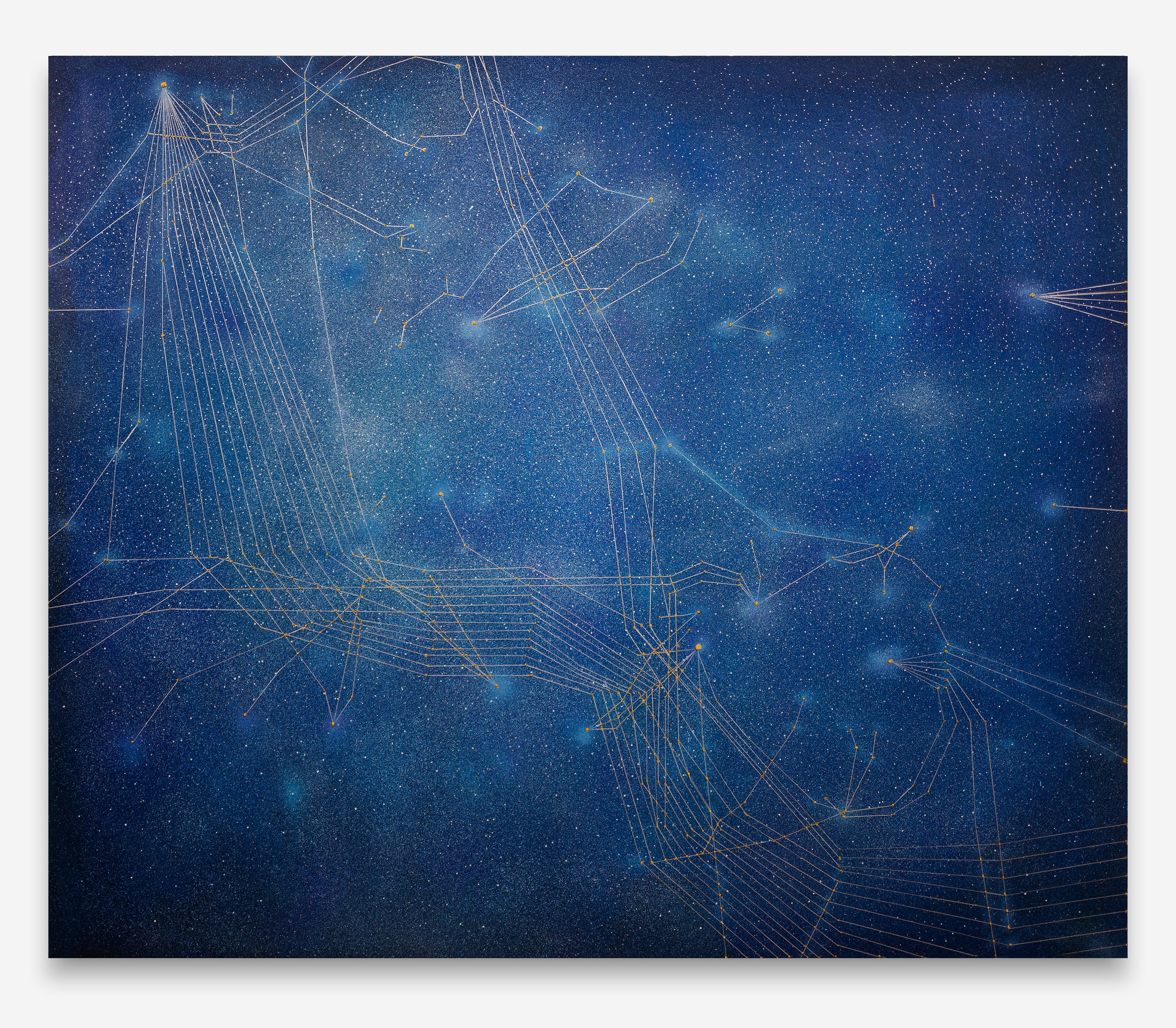
Signal: Submarine Network 08 (Italy) is oil and acrylic on linen, 152.5 by 183 centimeters, and it traces the convergence of submarine fiber-optic cables at Sicily, Malta, and southern Italy. The named cable systems, SeaMeWe-4, Unitirreno, and Blue, are among the most heavily trafficked data corridors in the world, and their convergence in the central Mediterranean reflects a geographic fact that predates the cables by millennia. The Strait of Messina, the channel between Sicily and mainland Italy that measures roughly three kilometers at its narrowest point, has been a bottleneck for maritime traffic since the earliest Phoenician voyages. Every ship that passed through the strait, from the Greek trading vessels of the eighth century BCE to the Norman warships of the eleventh century CE to the container ships and cable-laying vessels of the twenty-first, has followed the same corridor because the geography permits no alternative. The cables follow the same corridor for the same reason. The painting does not illustrate this historical continuity. It embodies it, by rendering the cable routes as a network of luminous lines on a dark marine ground that occupies the same visual field where a medieval navigator would have drawn trade routes on a portolan chart.
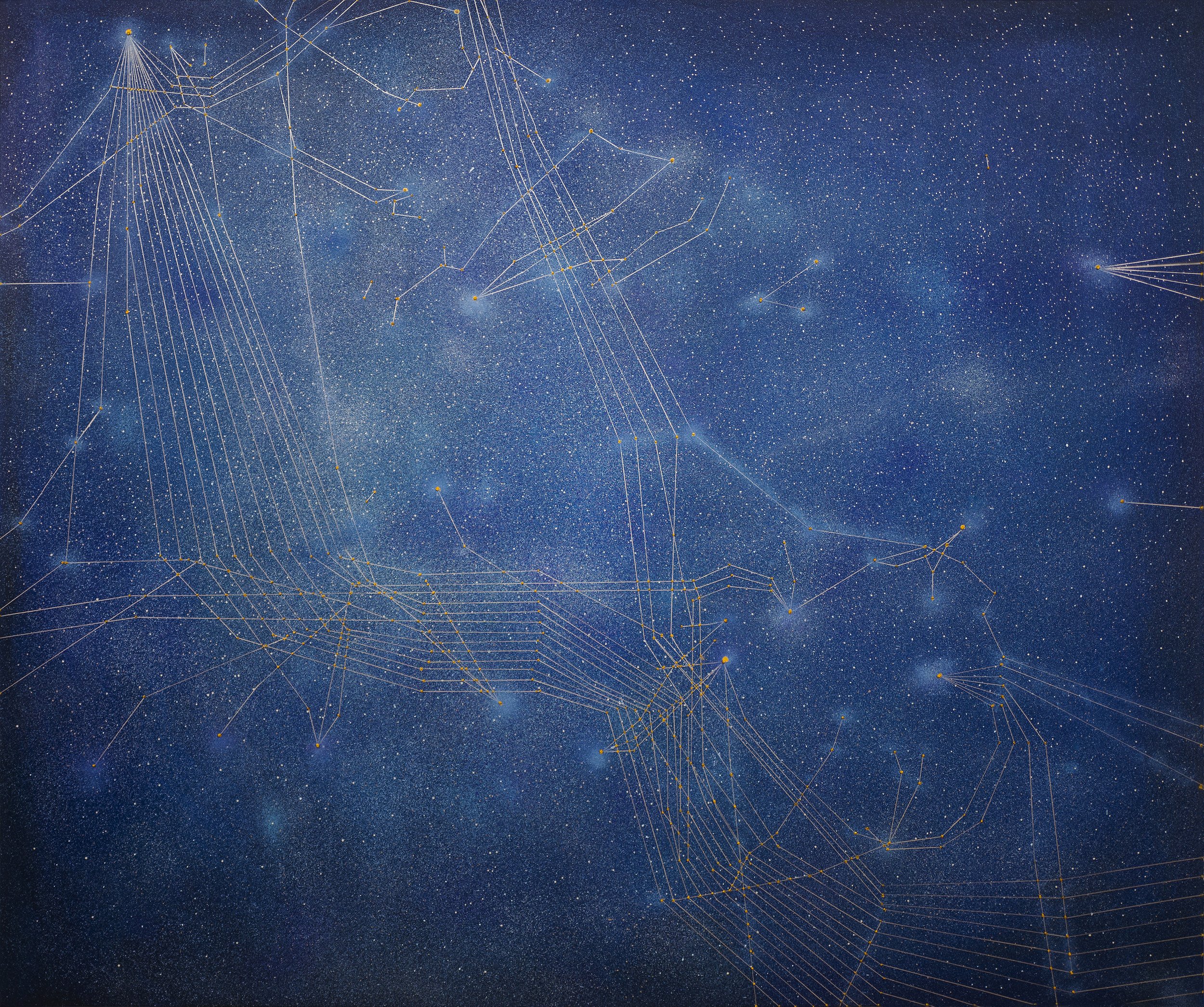
The surface of Signal: Submarine Network 08 is built in the manner that distinguishes the Signal series from Tan Mu's earlier work. The underpainting is created spontaneously, in a single session of loose, gestural mark-making that establishes the ocean's chromatic depth. In this canvas, the ground is a field of deep marine blue and teal, with passages of darker indigo in the regions that correspond to the deeper waters of the Tyrrhenian Sea and warmer tones of midnight green where the cables converge along the Sicilian coast. Over this ground, Tan Mu paints the underwater terrain in a second layer, building the seafloor topography that cable engineers must navigate: the narrow continental shelf along Calabria, the steep drop-off into the Tyrrhenian basin, the shallow approaches to Malta that force cables into long detours around the island's underwater plateau. Only then does she map the cable routes themselves, thin lines of luminous acrylic that trace paths of data between landing points marked by small, wax-heavy nodes of concentrated oil paint, each one raised slightly from the surface like a soldered connection on a circuit board.
The convergence at Sicily is the painting's structural center. The Italian landmass, rendered as a dark silhouette along the upper edge of the composition, concentrates landing points at Palermo, Catania, and Mazara del Vallo. From these points, cables extend south toward Malta, east toward Greece and Turkey, west toward Sardinia and the Balearic Islands, and south through the Strait of Sicily toward Tunisia, Libya, and Egypt. The landing points are the densest clusters of bright pigment on the canvas, and the lines that radiate from them create a pattern that resembles, depending on the viewer's distance and the quality of attention, either a telecommunications map or a constellation chart. At three meters, the network resolves into constellations. At arm's length, the landing points reveal their material specificity: each one is a small accumulation of wax-heavy paint, slightly raised from the surface, that catches light differently from the surrounding ground. The painting asks to be read at two distances, and the reading at each distance produces a different subject. From far away, the subject is the network. From close up, the subject is the landing point, the place where the cable reaches land and becomes accessible to the human infrastructure that distributes its data to the cities beyond.
Giotto di Bondone painted the ceiling of the Scrovegni Chapel in Padua between 1303 and 1305. The ceiling is a field of deep ultramarine blue studded with gold stars, each one a small disc of gold leaf applied over a raised bed of gesso that catches the candlelight and makes the entire surface shimmer. The stars are not astronomical. They do not represent the actual positions of constellations as they would have appeared above Padua on any particular night. They are devotional objects, a painted heaven that transforms the chapel's vault into a celestial canopy, a dome of stars that marks the space below as sacred. Giotto's stars are evenly distributed across the surface, without clustering or concentration, and they do not form the patterns that astronomers recognize as constellations. They are stars in the most general sense: points of light against a dark ground, the simplest possible representation of the night sky, and they serve a liturgical function. They place the viewer inside a sacred space that extends upward into the heavens, and they do so through the most economical visual means available to a painter working in tempera on plaster.
The comparison with Signal: Submarine Network 08 is not based on visual similarity. Giotto's stars are gold discs on a flat blue ceiling, and Tan Mu's landing points are wax-heavy paint nodes on a deep marine ground. The comparison is based on structural function. Both works transform a surface into a field of luminous points against a dark ground, and both works use that transformation to mark a space as significant. Giotto's ceiling marks the chapel as a space where heaven is present. Tan Mu's canvas marks the Mediterranean as a space where the infrastructure of global connection is present. In both cases, the luminous points are not decorative. They are structural. They define the space they occupy, and they define it as a space of connection, whether that connection is between the worshipper and the divine or between Sicily and Malta and Alexandria and Marseille. The Scrovegni ceiling and the Signal canvas are both representations of networks, and both understand that a network, when it is represented as a set of luminous points against a dark ground, becomes a kind of sky, a field of stars that the viewer reads for direction, for pattern, and for meaning.
The difference between Giotto's stars and Tan Mu's landing points is the difference between a devotional space and an informational space, and the painting knows this. The landing points in Signal: Submarine Network 08 are not evenly distributed. They cluster at Sicily and Malta, at the points where the geography concentrates the cables into narrow corridors, and they thin out in the open water of the southern Tyrrhenian Sea, where fewer cables run and the distances between landing points are greater. This distribution is not decorative. It is cartographic. It reflects the actual distribution of submarine cable infrastructure in the central Mediterranean, where the convergence of African, Middle Eastern, and European cable systems at a small number of landing points creates the densest nodes in the global network. The painting renders this density with precision. The landing points at Palermo and Catania are brighter and more closely spaced than the landing points at, say, Benghazi or Tripoli, and the lines between them are thicker and more numerous, reflecting the higher bandwidth and redundancy of the northern Mediterranean routes compared to the southern routes that cross from Europe to North Africa.
The Mediterranean has been a network for as long as humans have sailed on it. The Phoenicians established trading colonies across its length and breadth from roughly 1500 BCE, connecting Tyre to Carthage, Carthage to Sardinia, Sardinia to Sicily, and Sicily to the Greek mainland. The routes they followed were determined by the same geography that determines the cable routes today: the shortest distance between two points on a coast, the narrowest strait, the safest harbor. The Strait of Messina, the Strait of Sicily, the passage between Crete and the Peloponnese: these are the corridors through which trade has flowed for three thousand years, and they are the corridors through which data flows today. The painting makes this continuity legible by rendering the cable routes as lines on a marine ground that occupies the same visual field where a medieval navigator would have drawn trade routes on a portolan chart, and by clustering the landing points at the same geographic bottlenecks where the Phoenicians, the Greeks, the Romans, the Arabs, the Normans, and the Venetians clustered their trading posts, their naval bases, and their colonial settlements.
The specific cable systems that converge at Sicily illustrate the scope of this network. SeaMeWe-4, the Southeast Asia Middle East Western Europe 4 cable, stretches from Marseille in the west to Singapore in the east, connecting France, Italy, Egypt, Saudi Arabia, India, Thailand, Malaysia, and Singapore through a single fiber-optic trunk that carries data at terabits per second. The Unitirreno cable, as its name suggests, links the Italian peninsula through the Tyrrhenian Sea, connecting Sicily to the mainland and providing an internal route for Italian data traffic that avoids the longer path around the boot of Italy. The Blue cable, one of the newer systems, connects France, Italy, Greece, and the Middle East, providing an alternative to the older SeaMeWe routes and increasing the redundancy of the Mediterranean crossing. Each of these systems lands at Sicily because Sicily is where the Mediterranean narrows, where the African coast is closest to the European coast, and where a cable can cross from one continent to another with the shortest possible undersea route. The painting renders these systems as lines of different colors and thicknesses, each one tracing a path that follows the geography of the sea floor and the economics of cable routing.
Jasper Johns painted Map in 1961, using an outline map of the United States as the armature for a composition built from encaustic and collage on canvas. The states are filled with different colors, but the colors do not correspond to any data set, demographic variable, or political affiliation. They are simply colors, applied in the gestural manner that Johns had been developing since the flag paintings of the mid-1950s, with visible brushwork, drips, and areas of exposed fabric that make the map feel less like a representation of a country and more like a surface on which a country has been projected. The map is the structure. The paint is the experience. And the tension between the structure and the experience, between the rigid outlines of the state boundaries and the loose, gestural application of the encaustic, is the painting's argument: that a map is never just a representation of territory. It is a surface on which territory is projected, interpreted, and transformed by the medium through which it is rendered.
The connection between Johns's Map and Tan Mu's Signal: Submarine Network 08 is structural, not visual. Johns takes a map and paints over it, allowing the gestural marks to interact with the cartographic structure in ways that make the territory feel simultaneously known and unfamiliar, mapped and unmappable. Tan Mu takes a cable map and paints under it, building the marine ground first and then overlaying the cable routes, allowing the spontaneous chromatic depth of the underpainting to interact with the precise linear structure of the network in ways that make the infrastructure feel simultaneously engineered and organic, deliberate and inevitable. In both cases, the painting uses the tension between the structured and the gestural, the mapped and the painted, to make an argument about the relationship between territory and representation. Johns's argument is that the United States is a painted surface as much as it is a geographic fact. Tan Mu's argument is that the Mediterranean cable network is a painted surface as much as it is an engineering fact, and that the act of painting it reveals continuities between the cable routes and the trade routes that no engineering diagram would show.
The gestural underpainting in Signal: Submarine Network 08 is the Mediterranean as it is experienced by the body, by the sailor, by the windsurfer who reads the wind on the surface and the current beneath it. The precise cable lines that overlay this ground are the Mediterranean as it is managed by the engineer, the telecommunications company, and the global data infrastructure. The painting holds both Mediteranneans, the experienced and the managed, in the same frame, and the tension between them produces a visual effect that neither mode could produce alone. The marine ground, seen without the cable lines, would be an abstract seascape. The cable lines, seen without the marine ground, would be a telecommunications diagram. Together, they produce a representation of the Mediterranean that is neither a seascape nor a diagram but something that combines the sensory depth of the one with the structural precision of the other, and the combination makes visible a fact that neither mode could represent independently: that the Mediterranean has been a network for three thousand years, and the cables are the latest version of the routes that the Phoenicians, the Greeks, the Romans, and the windsurfers have always followed.
Nick Koenigsknecht, writing on the Signal series, describes the paintings as "a hagiography of an almost obsolete technology." The phrase is precise and it carries a weight that its author intends. A hagiography is a sacred biography, the story of a saint's life, and the word "obsolete" introduces the idea that the saint in question is already being replaced. The submarine cables are being supplemented and will eventually be superseded by satellite internet systems, and the paintings record them at the moment before their supersession, the way a hagiographer records a saint's life at the moment before martyrdom. The comparison is not ironic. It is structural. The cables are sacred to the global economy in the way that saints are sacred to the church: they are the invisible infrastructure that carries the most important traffic, they are venerated by the communities that depend on them, and they are being replaced by a new technology that claims to do the same work without the same physical investment. The paintings treat the cables with the gravity and the attention that a hagiographer would bring to a saint's relics, and the wax-heavy paint at each landing point, raised slightly from the surface, functions like the reliquary that holds the bone fragment, the container that makes the invisible sacred object visible and touchable.
Koenigsknecht's formulation also helps to clarify what makes the Mediterranean canvas different from the other Signal paintings. The South Pacific, covered in Signal: Submarine Network 07, is a vast ocean with relatively few landing points and long, solitary cable routes that stretch across thousands of kilometers of open water. The Caribbean, covered in Signal: Submarine Network 06, is a dense archipelago of short cable hops connecting islands that are visible from each other's shores. The Mediterranean is neither of these. It is a semi-enclosed sea, bounded by three continents, with a coastline that has been continuously inhabited for longer than any other coastline on the planet. The cables that cross it do not traverse empty ocean. They cross a sea that is already full, full of shipping lanes, fishing grounds, marine reserves, underwater archaeological sites, and the wrecks of three thousand years of maritime traffic. The density of the Mediterranean cable network is not just a function of the data traffic between Europe, Africa, and the Middle East. It is a function of the density of the Mediterranean itself, the fact that every kilometer of this sea has been crossed, mapped, claimed, and fought over since before written history. The painting renders this density by concentrating its landing points at the geographic bottlenecks where the cables must converge, and by allowing the underpainting to suggest the depth and complexity of the water that the cables cross, a water that is never empty, never neutral, and never free of the history that has accumulated on its floor.
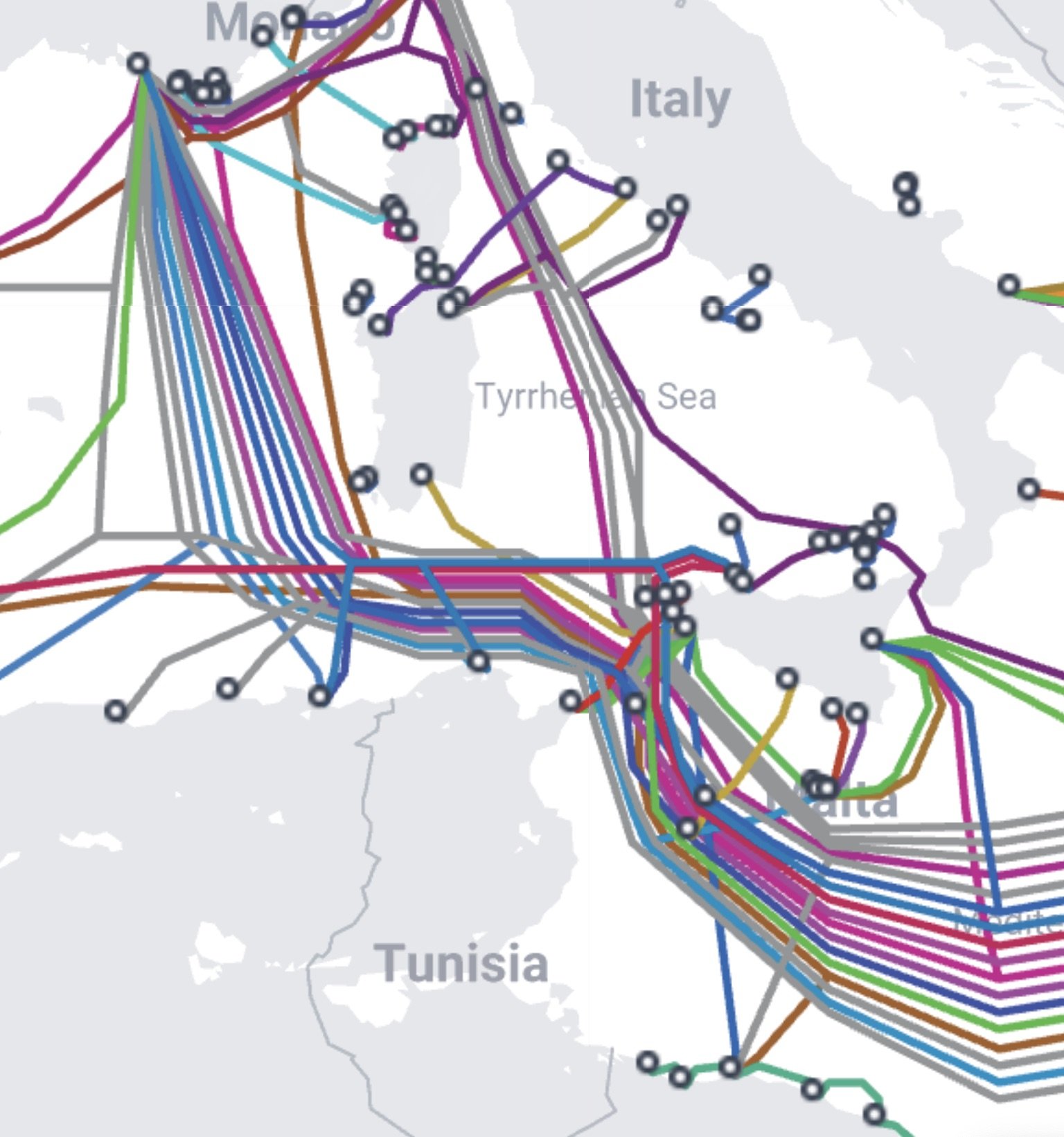
Tan Mu's own words about the series confirm the connection between the personal and the cartographic that the painting embodies. "My relationship with the ocean began very early," she has said. "I grew up by the sea, and it was always part of my daily life. My mother was a professional windsurfer, so I spent much of my childhood sailing and observing the movement of wind and water. My grandfather was a marine engineer who worked on large-scale coastal projects such as port design and land reclamation. Through him, I was exposed to marine maps, technical drawings, and engineering plans that revealed the ocean not only as a natural force but as a complex, constructed environment shaped by human systems." The passage connects two forms of knowledge that the painting holds in the same frame: the knowledge of the body, which learns to read wind and water through physical experience, and the knowledge of the map, which represents the ocean as a constructed environment shaped by engineering. The windsurfer's knowledge is gestural, immediate, and embodied. The marine engineer's knowledge is cartographic, mediated, and structural. The painting's underpainting belongs to the first form. The cable lines belong to the second. And the painting's argument, that these two forms of knowledge describe the same sea, is an argument that the artist has lived, first as a child on the water and then as an adult in the studio, reading cable maps with the same attention that her grandfather brought to his engineering plans.
The Mediterranean has been a sea of trade since the Phoenicians first sailed from Tyre to Carthage around 1100 BCE. The routes they established, along the North African coast, through the Strait of Sicily, past Malta and around the boot of Italy, are the same routes that the SeaMeWe-4, Unitirreno, and Blue cable systems follow today. The Phoenicians carried purple dye, cedar timber, and silver. The cables carry financial transactions, video calls, social media posts, and military communications. The cargo has changed. The routes have not, because the routes are determined by geography, and geography does not change. The painting renders this continuity by placing the cable routes on a marine ground that does not distinguish between the ancient and the modern, between the Phoenician trading vessel and the fiber-optic cable. The marine ground is the same water that the Phoenicians sailed, and the cable lines follow the same corridors that their ships followed, and the painting makes this continuity visible without stating it, without labeling the Phoenician routes or overlaying a historical map. The continuity is in the painting's structure, in the way the landing points cluster at the same bottlenecks where the ancient trading posts clustered, and in the way the lines between them follow the same paths that the ancient sailors followed, because the sea has not changed and the land has not moved and the shortest distance between two points on a coast is still the same distance it was three thousand years ago.
Tan Mu describes the landing points in her paintings as "digital constellations," and the phrase is not a metaphor. It is a description of what the painting does. A constellation is a pattern that humans impose on a field of stars, connecting points of light with imaginary lines in order to create a navigable image. The stars exist independently of the constellation. The lines between them are a human construction, an act of interpretation that turns a random distribution of luminous points into a structured representation that can be used for navigation. The landing points in Signal: Submarine Network 08 exist independently of the lines that connect them. They are physical locations where cables come ashore. The lines between them are a human construction, the routes that engineers have chosen based on geography, economics, and politics. When the viewer stands far enough from the canvas, the landing points and the lines between them resolve into a pattern that looks like a constellation, and the viewer navigates it the way a sailor navigates a night sky, by identifying the brightest points and following the lines between them. When the viewer moves closer, the constellation dissolves into its component parts: a landing point here, a cable route there, a patch of deep water between them. The painting holds both views in the same composition, and the transition between them is the experience of recognizing that the network is a constellation and the constellation is a network, and that both are human constructions imposed on a natural field that would otherwise be unordered.
Sicily is where the Mediterranean narrows. The passage between the eastern tip of the island and the coast of Calabria, through the Strait of Messina, is roughly three kilometers wide. The passage between the western coast of Sicily and the coast of Tunisia, through the Strait of Sicily, is about 145 kilometers wide. Every cable that carries data between Europe and Africa, and between Europe and the Middle East, and between Europe and Asia, must pass through one of these two passages, or through the passage between Malta and the North African coast. The geography dictates the route. The painting reflects this geography by concentrating its landing points at the points where the cables converge, and by thinning the lines between them in the open water where fewer cables run. The density of the network at Sicily and Malta is not an aesthetic choice. It is a cartographic fact, and the painting renders it with the same fidelity that a portolan chart would have rendered it six hundred years ago, when the landing points were called Palermo and Syracuse and Valletta instead of Palermo and Catania and Valletta, and the routes between them were called trading lanes instead of data corridors, and the cargo was wine and olive oil and silk instead of financial transactions and video calls and social media posts.
The painting ends, as all the Signal paintings do, at the edge of the canvas, with lines that extend beyond the frame and landing points that cluster at the borders, suggesting that the network continues in directions that the painting does not show. This is not a compositional limitation. It is a compositional argument. The network is larger than any single canvas can depict. The lines that exit the frame at Palermo extend northward to Genoa and Marseille and Barcelona. The lines that exit at Catania extend eastward to Crete and Cyprus and Beirut. The lines that exit at the Strait of Sicily extend southward to Tunis and Tripoli and Alexandria. The painting does not show these extensions, but it implies them, and the implication is that the Mediterranean is not a closed system. It is a node in a global network, and the cables that converge at Sicily are the same cables that connect to the cable systems that cross the Atlantic, the Indian Ocean, and the Pacific, and that terminate at the landing points that Tan Mu has painted in the other Signal canvases, from the Northwest Pacific to the Caribbean to the South Pacific to the North and Baltic Seas. The painting of the Italian convergence is a chapter in a global story, and the edges of the canvas are the places where the chapter ends and the next one begins.
The sea that carries the windsurfer and the cable is the same sea. The wind that the windsurfer reads on the surface is the same wind that drove the Phoenician trading vessels and the Greek triremes and the Norman warships and the cable-laying ships that laid the first Mediterranean telegraph cables in the 1850s. The painting does not separate the windsurfer's Mediterranean from the engineer's Mediterranean. It places them on the same surface, the gestural and the precise, the experienced and the mapped, and it asks the viewer to recognize that they have always been the same. The cables are not alien to the Mediterranean. They are the latest expression of its nature as a network, and the painting that makes them visible is the latest expression of a tradition of representing that network that stretches back to the portolan charts of the medieval navigators and forward to the digital constellations that Tan Mu arranges on a linen surface that holds, in its marine depth, the memory of every crossing that this sea has ever borne.